
A New COVID Variant Is Here, Are Vaccines Still Working?
- March 31, 2026
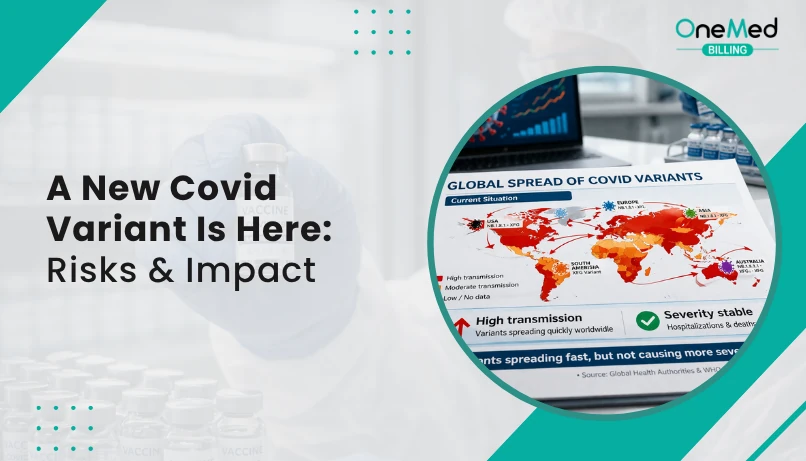
As of 2026, the COVID-19 virus is still evolving, and a new COVID variant has become one of the leading concerns throughout the United States and most of the world. Nowadays, Nimbus (NB.1.8.1) and Stratus (XFG) are the two strains that dominate the world transmission. Although these variants do not seem to contribute to a bigger and more serious disease, they are easily transmitted and partly resist immunity, which has made health officials vigilant.
Understanding the New Covid Variant
One of the recombinant strains, called Nimbus (NB.1.8.1), was developed by the combination of the genetic material of several Omicron subvariants. It has become an international spread and was defined as a Variant Under Monitoring. This is a new Covid variant, which became relevant because of its high infectivity and laboratory reports that it can enter human cells more effectively because of its tendency to bind the ACE2 receptor more strongly.
A sharp and severe sore throat is also one of the symptoms associated with this new Covid variant and many people state that they have a razor blade feeling.
Another variant of Covid that is new and which has genetic characteristics of various Omicron lineages is referred to as the Stratus variant (XFG). It is characterized by enhanced immune escape (i.e., it can partially overcome past infection or vaccination antibodies). Nonetheless, its symptoms are also similar to the previous variants, and a significant rise in hospitalizations has not been identified.
How the New Covid Variant Is Spreading?
The high rate of transmission of each new Covid variant is caused by the fact that it can be transmitted even to those who have already been immunized. Those variants are transmitted by respiratory droplets and aerosols that particularly occur in overcrowded or poorly ventilated areas.
International travel, reduced vaccine coverage, and highly-crowded spaces have also further contributed to accelerated transmission. The virus may be transmitted even in its mild or asymptomatic forms, and thus it becomes difficult to contain an outbreak.
Vaccine Effectiveness Against the New Covid Variant
The most reassuring news is that the existing vaccine is still effective in relation to severe illness due to any new variant of Covid. The 2025 to 2026 vaccine formulations are against strains that are closely related to Nimbus and Stratus.
Moderna, Pfizer-BioNTech and Novavax vaccines have helped minimize the risk of hospitalization and severe complications. Although the vaccine does not necessarily prevent the mild infection, it is significant in the prevention of severe disease.
It has also been demonstrated through research that T-cell immunity induced by such vaccines is effective against subsequent variants and assists the body in responding after the partial avoidance of the antibodies.
Who Should Take the Vaccine?
Even basic precautions help to ensure that you are not susceptible to any new Covid variant. Vaccinate when you are able to and follow up with boosters. Determine whether you develop any symptoms, including mild ones such as a sore throat or fatigue.
Exposure can also be minimized by improving the indoor air quality, preventing congested indoor places, and wearing a mask in places of high risk. Being proactive and in the know is the best solution.
What You Should Do Now
Health authorities are still working on reinforcing surveillance, updating vaccines, and assessing global access. Monitoring and vaccination have been the most effective defense against the virus as it evolves.
The continued monitoring of every emerging Covid variant will reveal whether additional measures will be necessary, yet as of now, existing vaccines are effective in terms of protection where it is most needed.