
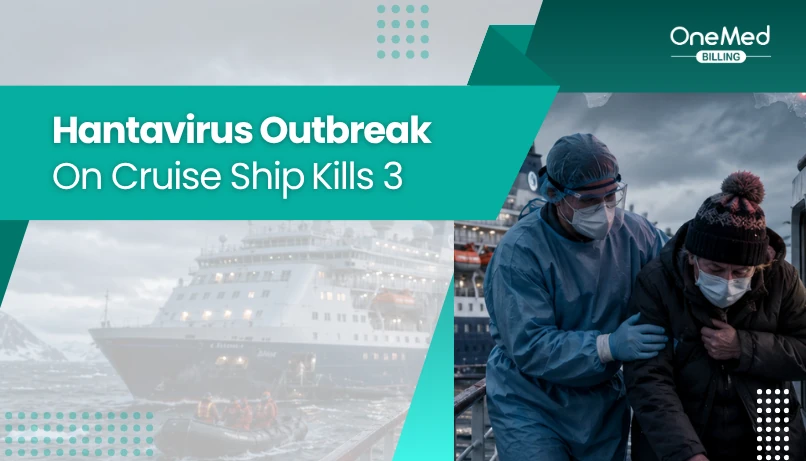
Hantavirus Outbreak on Cruise Ship Leaves Three Dead
- May 8, 2026
Health officials across at least four continents are racing to trace more than two dozen passengers who left a hantavirus-stricken cruise ship without contact tracing, nearly two weeks after the first passenger died on board. The outbreak has killed three people, left several others seriously ill, and triggered one of the most geographically complex public health responses in recent memory.
Passengers from at least 12 countries disembarked the MV Hondius on April 24, and authorities are now tracking them down while trying to trace others who may have come into contact with them since. The World Health Organization has stepped in, virus sequencing is underway, and the investigation is now pointing toward South America as the likely origin of the outbreak.
First Hantavirus Case on Board Was Confirmed on May 2
The first passenger died on board on April 11. It was not until May 2 that health authorities confirmed hantavirus in a passenger on the ship. That gap of more than three weeks meant dozens of passengers had already scattered across the globe before a single case was officially identified.
The body of the Dutchman who was the first to die was taken off the ship at the remote South Atlantic island of Saint Helena on April 24, when his wife also disembarked. She flew to South Africa the following day and died there. A third fatality, a German woman who died on May 2, remains on board the ship.
The case confirmed on May 2 involved a British man who was evacuated from the ship to South Africa from Ascension Island, three days after the Saint Helena stop. He was tested in South Africa and remains in intensive care.
Three people including the ship's doctor were evacuated while the vessel was near Cape Verde and taken to specialized hospitals in Europe for treatment. The ship is now sailing toward Spain's Canary Islands, carrying more than 140 passengers and crew. None of the remaining people on board are currently showing symptoms, the ship's operator said.
Passengers Who Disembarked April 24 Are Being Monitored
The April 24 disembarkation at Saint Helena has become the focal point of the global tracing effort. Oceanwide Expeditions, the Netherlands-based cruise operator, said 30 passengers left the vessel at Saint Helena, while the Dutch Foreign Ministry put the number at around 40. The company had not previously disclosed publicly that dozens of people had left the ship that day.
The consequences of that silence are now playing out across multiple countries. A man tested positive for hantavirus in Switzerland after disembarking at Saint Helena. Singaporean authorities said they were monitoring two men who got off the ship at Saint Helena, flew to South Africa, and then home. One had a runny nose. The other had no symptoms. Both were being isolated and tested. British health officials said two passengers who flew home midway through the journey were self-isolating but showed no symptoms, with a small number of their contacts also isolating as a precaution. Saint Helena authorities were monitoring a small number of higher-risk contacts and instructing them to isolate for 45 days.
South Africa Is Tracing Contacts From an April 25 Flight
South African authorities are focused on tracing contacts from an April 25 flight from Saint Helena to Johannesburg, the day after passengers disembarked. The Dutch woman who later died in South Africa briefly boarded that flight before she was too ill to continue and was removed from the plane in Johannesburg.
The ripple effects of that single flight are still being mapped. A flight attendant on that plane was showing symptoms of hantavirus and was being tested in an isolation ward at a hospital in Amsterdam. If confirmed positive, she would be the first known person outside the MV Hondius to contract the virus in this outbreak. Flights from Saint Helena to South Africa are rare, running roughly once a week, which gives investigators a narrow pool to work with but also underlines how quickly the exposure spread beyond the ship.
Andes Virus Is the Only Hantavirus That Spreads Human to Human
Tests confirmed that at least five people on the ship were infected with the Andes virus, a hantavirus strain found in South America and the only known variant that can spread directly between humans. It can cause hantavirus pulmonary syndrome, a severe and often fatal lung disease.
WHO Director-General Tedros Adhanom Ghebreyesus said the Dutch couple who presented the first two cases had traveled through Argentina, Chile, and Uruguay on a bird-watching trip before boarding the ship, visiting sites where the species of rat known to carry the Andes virus was present. Argentina's health ministry reported 28 hantavirus deaths last year, nearly double the five-year average, with close to a third of all cases proving fatal.
WHO said it had arranged for 2,500 diagnostic kits to be shipped from Argentina to laboratories in five countries as part of the wider response effort.
Dr. Abdirahman Mahamud, WHO's alert and response director, said the outbreak could be contained if public health measures were implemented and international cooperation held firm. For now, officials in more than a dozen countries are working against a virus that had a three-week head start on them.