



What Is Type of Service (TOS) In Medical Billing?
- Updated Date Aug 14, 2026
- Medical Billing
- Follow
Your claim looked clean. The payment did not arrive. The remittance said TOS and the team had to rework the visit. Cash slowed and the schedule kept moving. This guide shows what went wrong and how to stop it next time.
What TOS means
TOS stands for Type of Service. Medicare uses TOS indicators to group each billed CPT or HCPCS service so the claim system can price and pay it correctly. These indicators are defined in the Medicare Claims Processing Manual and are checked during processing in national Medicare systems such as the Common Working File.
In many clinics, staff also say “time of service” to mean collecting patient payments at the visit. That is a front desk workflow term and is different from Medicare’s Type of Service indicator.
TOS vs POS vs CPT
TOS, POS, and CPT work together on every claim. CPT names the exact service you provided. POS tells the payer where it happened, like office or hospital outpatient. TOS groups the service into a category the payer uses for payment rules. Think of CPT as the action, POS as the place, and TOS as the bucket that guides payment.
What TOS controls
TOS means Type of Service. It groups each billed service into a category that claim systems use for payment rules. Examples include medical care, surgery, radiology, and lab. CMS also gives rules like using TOS P when a drug is given through DME and TOS 1 when given in the office.
What POS controls
POS means Place of Service. It is a two digit code on professional claims that tells the payor where the service happened, such as office, hospital outpatient, or telehealth. CMS maintains the official POS code set.
What CPT describes
CPT means Current Procedural Terminology. It is the code that names the exact service or procedure you did. The American Medical Association owns and maintains CPT and updates it to match current care. Payers use CPT for claims processing.
Types of TOS (Type of Service) Indicator Codes
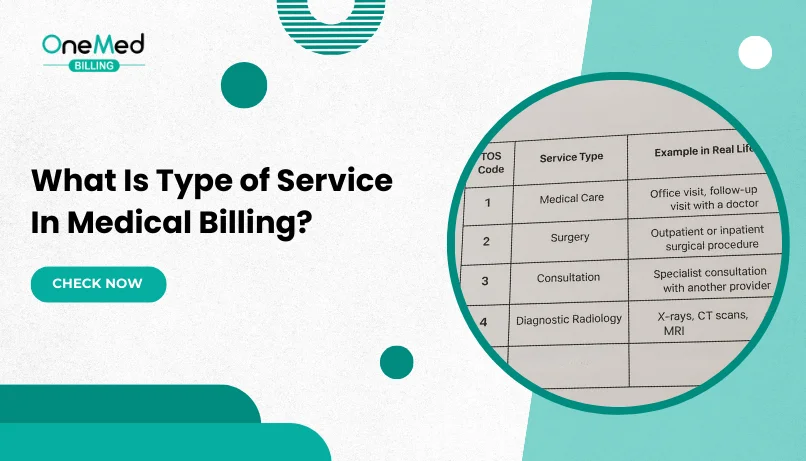
TOS codes are short indicators that tell Medicare and other payors what kind of service was provided. Each code represents a general category of care. They help the system apply the right payment rules, limits, and edits.
Below are some of the most common TOS indicator codes used in U.S. medical billing:
|
TOS Code |
Service Type |
Example in Real Life |
|
1 |
Medical Care |
Office visit, follow-up visit with a doctor |
|
2 |
Surgery |
Outpatient or inpatient surgical procedure |
|
3 |
Consultation |
Specialist consultation with another provider |
|
4 |
Diagnostic Radiology |
X-rays, CT scans, MRI |
|
5 |
Diagnostic Laboratory |
Blood tests, urinalysis, pathology work |
|
6 |
Therapeutic Radiology |
Radiation treatment for cancer |
|
7 |
Anesthesia |
Anesthesia during surgery |
|
8 |
Assistant at Surgery |
Physician assistant helping in surgery |
|
9 |
Other Medical Service |
Services not listed elsewhere |
|
T |
Mental Health Treatment |
Therapy or counseling sessions |
|
V |
Vaccines and Immunizations |
Flu shot, COVID-19 vaccine |
|
P |
DME-Related Drugs |
Drugs given through durable medical equipment (like infusion pumps) |
|
F |
ASC Facility Services |
Procedures done in an Ambulatory Surgery Center |
|
L |
ESRD Supplies |
Dialysis-related supplies for End-Stage Renal Disease |
|
D |
Diagnostic DME Services |
Diagnostic equipment testing at home |
How do Medicare and Commercial Insurers Use TOS Differently?
While Type of Service (TOS) codes are used across the industry to categorize care, Medicare and commercial insurers apply them in different ways when processing claims and calculating reimbursement.
For Medicare claims, TOS plays a direct role in how services are priced and grouped within CMS billing systems. Medicare uses TOS on the CMS-1500 claim form to help determine payment logic, coverage rules, and whether a service is treated as medical care, surgery, diagnostic testing, therapy, or another category. Incorrect TOS values can lead to pricing errors, delayed processing, or automatic claim rejections because Medicare edits closely tie TOS to CPT codes and coverage policies.
Medicare also relies on TOS for reporting and utilization tracking. Certain services are reviewed based on TOS patterns, especially for high-volume procedures, diagnostic imaging, and therapy services. When TOS does not align with the procedure billed, it can trigger medical review or post-payment audits.
Commercial insurers, on the other hand, use TOS more as a classification and validation tool rather than a strict pricing driver. Many private payers focus heavily on CPT codes, modifiers, and place of service, while TOS helps confirm that the service category matches payer policy rules. For example, a commercial insurer may use TOS to verify whether a claim should follow surgical benefit rules, diagnostic coverage guidelines, or preventive service policies.
That said, incorrect TOS values can still cause major issues with commercial payers, including:
- Claims being routed to the wrong benefit category
- Incorrect patient responsibility calculations
- Denials due to coverage mismatches
- Manual review delays
In multi-payer billing environments, the same service may process smoothly under Medicare but flag errors with commercial insurers if TOS coding is inconsistent.
This is why billing teams must ensure TOS codes align not only with the procedure performed but also with payer-specific rules. Treating TOS as a simple formality often leads to underpayments, denials, and unnecessary rework across both Medicare and private insurance claims.
Where do you see TOS in real work?
Type of Service shows up in everyday billing when your software checks a claim, when payors publish rule updates, and in the messages on your remittance advice. You do not enter TOS on the current CMS-1500 form, but payors still use it behind the scenes to decide if the claim is valid and how it should be paid.
- Software edits can flag a mismatch between the procedure code and the TOS category.
- Payor updates may add or change TOS for certain codes, often for imaging, drugs, injections, and outpatient surgery centers.
- If a denial mentions TOS, read the remittance message, compare your code to the payor’s TOS list, confirm the place of service fits the same rule, check for recent updates, then correct and resubmit.
- Keep a simple cheat sheet that pairs your common procedure codes with the right TOS to prevent repeats.
Common TOS Problems and Simple Fixes
TOS codes can create real problems in medical billing if not used or understood correctly. They affect how claims are paid and can lead to rejections if the code does not match the procedure or the place of service. Billers often deal with payor changes, outdated software tables, or confusion between Medicare and commercial rules.
Common challenges
- Wrong TOS mapping: A CPT or HCPCS code linked to the wrong Type of Service can cause claim edits or denials.
- Frequent payor updates: CMS and commercial payors often update TOS indicators each year, and systems must stay current.
- Different rules between payors: Medicare and private insurers may use similar codes but apply them in slightly different ways.
- Missing TOS on claim forms: The current CMS-1500 form does not include a TOS box, so billers cannot see what is applied unless they check software tables.
- Staff confusion: Some teams use “TOS” to mean “time of service payment,” which can cause training issues.
How to manage these challenges
- Keep your billing software updated so it reflects the latest CMS transmittals and payor edits.
- Check payor bulletins or newsletters each quarter for TOS changes.
- Create a quick internal reference sheet that matches your top 50 procedure codes with the correct TOS.
- Review claim denials that mention TOS carefully and compare them with CMS guidance before resubmitting.
- Train staff to use the right meaning of TOS depending on whether they work on claims or patient payments.
Conclusion
TOS tells payors what kind of care you billed. When it matches your CPT and your place of service, claims move faster and pay the right way. The biggest gains come from a simple TOS checklist, quick reviews of new payor updates, and clear team training so no one confuses Type of Service with time of service payments. Do these basics well and you will cut denials and speed up cash.
Frequently Asked Questions
Find quick answers to common questions about this topic, explained simply and clearly.
What does TOS mean in medical billing?
TOS means Type of Service. It groups each CPT or HCPCS into a service category, like medical care, surgery, radiology, or lab, so payers can price and pay the claim correctly.
What is TOS 9 in medical billing?
TOS 9 means Other medical service. It is used when the service does not fit a standard category such as surgery or lab.
What is the Type of Service code?
A TOS code is a one character indicator, number or letter, that tells the payer which service category applies. It helps drive edits, coverage checks, and payment.
What is the TOS on CMS 1500?
The current CMS-1500 (02/12) does not have a TOS field. Payers assign TOS from the CPT or HCPCS you submit, so providers do not enter it on the form.