


Is Medical Billing the Same as Medical Coding?
- Updated Date Dec 18, 2025
- Medical Billing
- Follow
Thinking about working in healthcare administration? Medical billing and medical coding are often mentioned together, but the day-to-day work is very different. Here’s what separates the two and which path might fit you better.
What Is Medical Coding?
Medical coding is the process of turning a patient’s visit into standard codes that computers, insurance companies, and government programs can understand.
After a doctor sees a patient, there are notes about symptoms, diagnoses, tests, and treatments. A medical coder reads those notes and assigns the right:
• ICD codes for diagnoses (what’s wrong)
• CPT codes for procedures and services (what was done)
• HCPCS codes for some supplies, drugs, and services
What Is Medical Billing?
Medical billing is the process of turning medical services into claims and getting those claims paid.
After a patient sees a doctor, their visit is coded using standard medical codes. A medical biller takes those codes, combines them with the patient’s insurance details, and creates a claim that is sent to the insurance company or other payer. The goal is simple: make sure the provider gets paid correctly and on time for the care they gave.
The medical billing page on Wikipedia explains that billers use information about diagnoses and procedures to determine which services are billable and who should be billed, then submit those claims and handle responses from payers.
Key Differences Between Medical Billing and Coding
Medical billing and medical coding sound like one thing, but they are two different jobs that work closely together. Coding comes first and focuses on what happened during the visit.
| Aspect | Medical Coding | Medical Billing |
| Main purpose | Turn doctor’s notes, tests, and treatments into standard medical codes (ICD, CPT, HCPCS) | Use those codes to create claims and make sure the provider gets paid. |
| Focus | Medical details and accuracy of codes | Money flow, claims, and payments |
| What it explains | What happened during the patient’s visit (diagnosis, tests, procedures) | Who pays what for the visit (insurance and patient) |
| Key tasks | Read charts and reports, pick diagnosis and procedure codes, follow coding rules, match codes to documentation | Build and submit claims, check eligibility and benefits, fix denials, post payments, send patient bills |
| Tools used | ICD, CPT, HCPCS code books or software; coding guidelines; clinical documentation | Practice management/RCM software, claim forms (CMS-1500/UB-04), payer portals, EOB/ERA reports |
| Core skills | Medical terminology, anatomy, coding guidelines, attention to detail, reading clinical notes | Insurance rules, payer policies, follow-up, problem-solving, communication with patients and payers |
| Position in revenue cycle | Upstream – happens first, right after the provider documents the visit | Downstream – happens after coding, when claims are created, sent, and paid |
| Main outcome | Clean, accurate codes that match the record | Clean, paid claims and correct patient balances |
How Billing and Coding Work Together in the Revenue Cycle
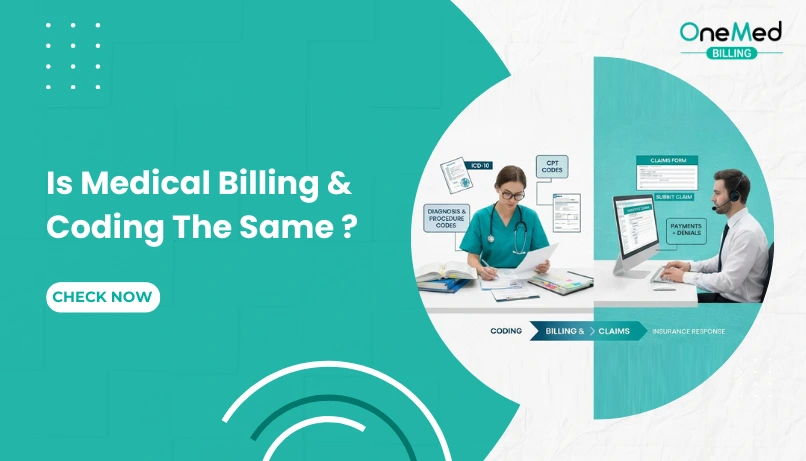
Medical coding and medical billing are two steps in the same money flow. It starts when a patient sees a doctor and ends when the doctor gets paid. The doctor writes down what happened during the visit, symptoms, diagnoses, tests, and treatments. A medical coder reads these notes and turns them into standard codes (ICD, CPT, HCPCS). These codes are a short, universal way of telling payers what care was given.
After that, a medical biller uses those codes plus the patient’s insurance details to create a claim. The claim is sent to the insurance company, which reviews it and decides how much to pay. The biller then posts the payment, fixes any problems, resubmits denied claims if needed, and bills the patient for any remaining amount.
If coding is wrong, the claim may not match the care given, which can cause denials or underpayment. If billing is weak, even correct coding can still lead to slow or missed payments. When both coding and billing are done well, you get clean claims, fewer denials, and a smoother, more reliable revenue cycle.
Do You Need Both Medical Billing and Coding?
Yes, you need both, but they don’t always have to be two separate people in your office. Coding turns the visit into accurate medical codes, and billing uses those codes to create and manage claims and payments. In small practices, one person or an outside company may handle both, but the functions of coding and billing must both be done for you to get paid correctly and on time.
Which Career Is Right for You?
Both careers are important and can be good options. The “better” one really depends on what you enjoy doing and how you like to work.
Medical Coding Might Be Right for You If:
- You like detail work and don’t mind sitting and focusing for long periods
- You enjoy reading and analysing doctor’s notes and medical records
- You’re okay with less phone calls and more “behind-the-scenes” work
- You like learning codes, rules, and guidelines and keeping them updated
Medical Billing Might Be Right for You If:
- You like working with people and numbers
- You don’t mind phone calls with patients and insurance companies
- You enjoy problem-solving (fixing denials, correcting claims, following up)
- You’re comfortable dealing with money, balances, and payment questions
What Pays More: Medical Coding or Medical Billing?
When comparing medical coding and medical billing salaries in the United States, the difference is real but usually not huge — and it depends on experience, certification, and where you work. Indeed+1
Medical Coders
- Medical coders often earn slightly more on average than billers because the role involves deep knowledge of coding systems and clinical documentation.
- Data from the U.S. Bureau of Labor Statistics shows that medical records specialists (which include coders) earn around $48,780 per year on average. campus.edu
Medical Billers
- Medical billers (often categorized under “billing and posting clerks”) tend to earn a bit less on average, with figures around $47,120 per year according to federal wage data. campus.edu
Typical Salary Ranges
- Entry-level billing or coding jobs: Often start between $30,000–$40,000 per year, especially without experience or certification. CALRegional
- Mid-level roles: Most experienced billing and coding professionals earn between $45,000–$60,000 per year. CALRegional
- Advanced roles: With certifications, specialization, and significant experience, some professionals can earn $60,000–$80,000+ annually. nurse.org
Key Points to Remember:
- On average, coding roles tend to have a slight edge in pay, but it’s not a large gap.
- Certifications (like CPC or CBCS) usually increase earning potential in both fields. Indiana University South Bend
- Experience, location, and employer type mean your actual salary can be higher or lower than national averages.
Conclusion
Medical billing and medical coding are often said together like one phrase, but they are two different roles. Coding focuses on what happened during the patient’s visit and turns that into accurate medical codes. Billing focuses on getting that visit paid, using those codes to create claims, follow up with insurance, and manage patient balances.
Both are essential for a healthy revenue cycle:
- Good coding → clear, correct records and fewer coding-related denials
- Good billing → clean claims, faster payments, and better cash flow
In the end, you don’t have “billing vs coding”, you have billing and coding working together. When each is done well, providers spend less time chasing money and more time caring for patients.
Frequently Asked Questions
Find quick answers to common questions about this topic, explained simply and clearly.
What pays more, medical coding or medical billing?
In most cases, medical coding pays more because it’s more specialized and often requires certifications. Exact pay depends on experience, specialty, location, and credentials.
Can you be a medical coder and not a medical biller?
Yes. Coding and billing are often separate jobs. Coders focus on assigning accurate codes, while billers handle claims submission, follow-ups, and payments.
What is the difference between a biller and a coder?
A medical coder reviews documentation and assigns diagnosis/procedure codes. A medical biller uses those codes to submit claims, track payer responses, post payments, and manage denials and patient billing.
Which is easier, medical coding or billing?
For most beginners, billing is easier to start. Coding is more technical and requires strong attention to detail, guidelines knowledge, and accuracy.