
10 Best Practices for Verifying Insurance Eligibility in 2026
- Updated Date Sep 16, 2026
- Eligibility Verification
- Follow
Eligibility verification is one of the first steps that affects claim accuracy, patient collections, and reimbursement speed. When coverage, benefits, referral rules, or prior authorization needs are missed before the visit, the practice may face avoidable denials and extra follow-up work later.
For providers, the goal is simple. Confirm the right insurance details before care is provided so the claim starts with cleaner information. This helps the front desk collect accurately, supports the billing team during claim submission, and gives patients a clearer idea of their financial responsibility.
Following eligibility verification best practices helps practices make this process more consistent, accurate, and easier to manage across daily appointments.
Why Should Practices Follow Eligibility Verification Best Practices?
Eligibility verification best practices help practices avoid the same billing problems from happening again and again. When staff follow a clear process, they are less likely to miss inactive coverage, wrong insurance details, referral rules, prior authorization needs, or patient responsibility.
For providers, this matters because one missed eligibility detail can delay payment or turn into a denial. It can also create extra work for the billing team, more payer follow-up, and confusion for patients when they receive a bill they were not expecting.
Following best practices helps your practice:
- Check coverage before the visit
- Confirm copay, deductible, and coinsurance
- Identify referral or authorization needs early
- Reduce eligibility-related denials
- Collect patient responsibility more accurately
- Avoid repeated claim corrections
- Keep the billing process more organized
These best practices work better when they are part of a clear eligibility verification process, so staff know what to check, when to check it, and how to document the result
Best Practices to Verify Insurance Eligibility Accurately
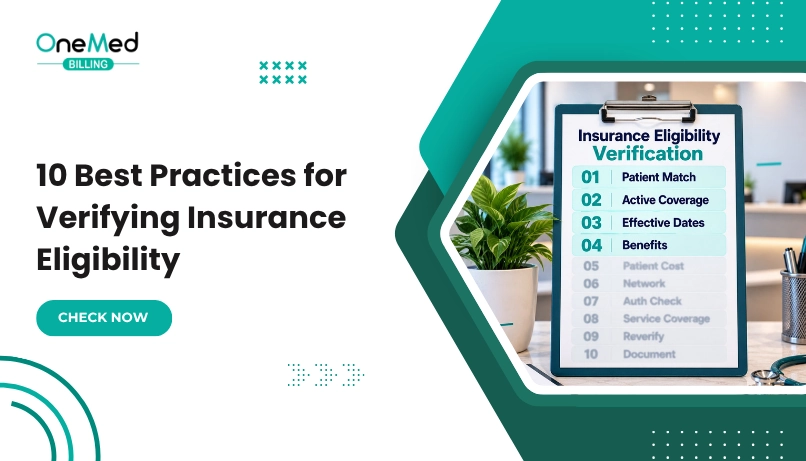
Accurate insurance eligibility verification starts before the patient is seen. The goal is not only to confirm that the policy is active, but also to check whether the planned service is covered, what the patient may owe, and whether any payer rule must be completed before the visit.
1. Verify Coverage Before Every Visit
Do not assume repeat patients have the same insurance plan. Coverage can change because of job changes, plan updates, missed premium payments, or new insurance cards. Checking coverage before every visit helps catch issues before the claim is created.
2. Check Eligibility for the Exact Date of Service
A plan may be active today but inactive on the appointment date. Always verify coverage for the actual date the service will be provided. This helps prevent denials caused by coverage changes between scheduling and the visit.
3. Confirm Benefits, Not Just Active Coverage
Active coverage does not always mean the planned service is covered. Staff should check service-specific benefits, visit limits, exclusions, and coverage rules. This is especially important for imaging, therapy, DME, procedures, and high-cost services.
4. Review Patient Responsibility Early
Confirm copay, deductible, coinsurance, and out-of-pocket details before the visit. This helps the front desk collect the right amount and gives patients a clearer idea of what they may owe.
5. Check Referral and Prior Authorization Needs
Some plans require a referral or prior authorization before care is provided. Missing this step can lead to denials even when the patient has active coverage. Staff should confirm these requirements before the appointment and document any approval numbers.
6. Confirm Provider Network Status
Make sure the provider, facility, or service location is in network with the patient’s plan. Out-of-network issues can affect reimbursement, increase patient responsibility, or lead to claim denial.
7. Update Patient and Insurance Records Regularly
Ask patients to confirm their insurance details at every visit. Old cards, wrong member IDs, incorrect policyholder details, or changed group numbers can cause preventable claim problems.
8. Document Every Verification Clearly
Record the date, method used, payer response, representative name, and reference number when available. Clear documentation helps the billing team if a claim is denied or if the patient questions their bill.
9. Use Technology Where Possible
Real-time eligibility tools, payer portals, clearinghouses, and EHR integrations can make verification faster and reduce manual errors. Technology helps, but staff should still review complex cases carefully.
10. Escalate Unclear Cases Before the Visit
If benefits are unclear, authorization rules are missing, or coverage details do not match, staff should call the payer or escalate the case before care is provided. This avoids last-minute confusion and reduces payment risk.
Common Gaps That Hurt Eligibility Verification
Even when a practice has a verification process, small gaps can still lead to denials, payment delays, and patient billing confusion. Most issues happen when staff check only basic coverage but miss the details that affect claim approval.
- Checking only active coverage is one common gap. A policy may be active, but that does not always mean the planned service is covered. Staff should also check benefits, visit limits, exclusions, copay, deductible, coinsurance, and service-specific rules.
- Using old insurance details can also create problems. Patients may bring an old card, change jobs, switch plans, or update coverage without telling the practice. If the system is not updated, the claim may go to the wrong payer or return as inactive coverage.
- Missing prior authorization or referral rules is another major issue. Some services need approval or a referral before the visit. If this is missed, the claim can be denied even when the patient has active insurance.
- Eligibility should also be checked for the actual date of service, not only the scheduling date. Coverage can change between appointment booking and the day care is provided.
- Network status should not be ignored. The provider, facility, or service location may be out of network for the patient’s plan, which can reduce reimbursement, increase patient balance, or lead to denial.
- Primary and secondary insurance order must also be confirmed when a patient has more than one plan. Billing the wrong payer first can cause rejection, delay, and extra follow-up.
- Poor documentation can make the problem worse. If staff do not record the verification date, method, payer response, representative name, or reference number, it becomes harder to support an appeal or answer patient billing questions.
- There should also be a clear follow-up process for unclear eligibility results. If no one owns the follow-up, open issues can easily turn into denials later.
How Technology Can Improve Eligibility Verification?
Technology helps staff complete eligibility checks faster during daily work. Practices may use different methods to verify patient insurance eligibility, such as payer portals, clearinghouses, real-time eligibility tools, batch checks, phone calls, and EHR-based checks.
This is useful before busy clinic hours. For example, the team can run eligibility checks for the next day’s appointments, flag inactive coverage, find missing member IDs, confirm copays, and identify cases that need prior authorization. Staff can then fix issues before the patient arrives instead of delaying check-in or discovering the problem after the claim is submitted.
Technology also helps by keeping verification notes, payer responses, and reference details in one place. This makes it easier for the front desk, billing team, and providers to work from the same information. It saves time, reduces manual entry errors, and helps the team focus on exceptions that actually need follow-up.
When Should Practices Review Their Verification Workflow?
Practices should review their verification workflow when eligibility issues start showing up repeatedly in claims, patient collections, or front-desk operations. If staff are checking coverage but denials are still happening, the problem may be in the workflow, not just the tools.
A review is needed when claims are denied for inactive coverage, wrong payer details, missing referrals, prior authorization issues, or out-of-network services. It is also worth reviewing the process when staff spend too much time calling payers, patients often question their bills, or high-cost services are being scheduled without clear benefit checks.
If these issues keep happening, it may be time to get support from a company that provides eligibility verification services. A trained team can help check coverage, benefits, patient responsibility, and payer rules before the visit, so fewer issues reach the claim stage.
Conclusion
Insurance eligibility verification works best when it is handled before problems reach the claim stage. By checking coverage, benefits, patient responsibility, network status, referrals, and prior authorization needs early, practices can reduce avoidable denials and keep the billing process cleaner.
The key is consistency. Staff should follow the same steps for every visit, use technology where it helps, document payer responses clearly, and review unclear cases before care is provided. These small habits can save time, protect revenue, and give patients a better understanding of what they may owe.
Frequently Asked Questions
Find quick answers to common questions about this topic, explained simply and clearly.
What should be done to verify insurance eligibility?
Staff should check active coverage, policy effective dates, plan type, deductibles, copays, coinsurance, referral or authorization requirements, and whether the provider is in-network. This can be done through a clearinghouse, payer portal, or integrat
What is the preferred order for insurance verification?
Start by confirming patient demographics, then check insurance policy details, coverage status, benefit limits, and cost-sharing amounts. Finally, verify provider network status and any prior authorization rules.
What is the eligibility verification process?
The process includes collecting insurance information from the patient, entering it into your billing system, and confirming the plan’s active status and coverage specifics directly with the payor—either through real-time systems or payer p
When should insurance verification be done?
Ideally, verification should be completed at least 48 to 72 hours before the scheduled service. For walk-ins or same-day visits, it should be done during check-in to avoid claim issues or surprise patient balances.