
DME Billing Explained Clearly for Healthcare Providers | 2026 Guide
- Updated Date Sep 22, 2026
- Medical Billing
- Follow
Durable Medical Equipment, commonly known as DME, refers to medical equipment that patients use at home to support treatment, recovery, or long-term care. From a billing standpoint, DME is not just about the item itself. It is about whether that item meets strict payor guidelines, including those set by Medicare and commercial insurance plans.
For any equipment to qualify as DME, it must meet a few key conditions. First, it should be durable and designed for repeated use over time. This means it cannot be disposable or intended for short-term use. Second, the equipment must serve a clear medical purpose, not just provide comfort or convenience. Third, it should be suitable for use in a home setting rather than requiring a hospital environment. Finally, it must be prescribed or ordered by a qualified healthcare provider.
Common examples of DME include wheelchairs, walkers, hospital beds, oxygen equipment, CPAP machines, and prosthetic devices. These are not optional items. In many cases, they are essential for a patient’s daily functioning and ongoing care.
Orthotic and prosthetic claims also involve specialized L-codes, medical-necessity documentation, prior authorization, and proof-of-delivery requirements. An experienced orthotics and prosthetics billing team can help suppliers manage these requirements and prevent avoidable denials and payment delays.
At the same time, it is important to understand what does not qualify as DME. Items such as grab bars, air conditioners, or general fitness equipment may appear supportive, but they are typically considered convenience products rather than medically necessary.
From a billing perspective, correct classification is critical. Misclassifying an item as DME when it does not meet payor criteria can lead to claim denials, delayed payments, or even compliance risks. Every item billed must align with payor standards and be supported by proper documentation that clearly establishes medical necessity.
Why DME is Important?
Durable Medical Equipment (DME) is very important in healthcare because it helps patients stay comfortable and manage their health at home. If someone is recovering from surgery or dealing with long-term illness, DME gives that extra support needed for daily life.
Helps in recovery at home
DME helps people recover at home instead of staying longer in the hospital. Things like crutches, wheelchairs, or hospital beds make it easier to rest and heal properly after surgery or injury.
Makes daily life easier for long-term illness
If someone is having a chronic health problem, DME makes daily work a little easier. Like if a person has a breathing issue, they may need an oxygen machine daily. Or someone with sleep apnea needs a CPAP machine every night to sleep properly.
Reduces hospital visits
When patients already have the right equipment at home, they don’t need to go to the hospital again and again. It saves time and money, and also people feel more comfortable staying at home.
Medicare coverage
Medicare also understands how important DME is. That’s why many DME items are covered under Medicare Part B, but only if a doctor says it is needed. For full details, you can check the Medicare website.
How DME Billing Works?
Billing for Durable Medical Equipment (DME) is different from standard medical billing. It involves documentation, eligibility, prior authorization, HCPCS coding, modifiers, rental cycles, claim submission, and payer follow-up. Each step must be handled correctly so the patient receives the right equipment and the supplier gets paid properly. DME suppliers handling this work at scale often use specialized DME billing services to keep these steps connected and prevent avoidable payment delays. Below, we explain how the DME billing process works step by step.
Step 1: Doctor’s Prescription is Required
The first step begins with a doctor’s prescription. The doctor checks the patient and confirms that the equipment is really needed. This is very important because insurance needs this proof. If no prescription, then claim will not get approved and payment also not happen.
Step 2: Selecting a DME Supplier
After the prescription, next you have to choose a DME supplier. This is the company who gives the equipment, either you buy or take on rent. Better to choose supplier who is in your insurance network, otherwise cost can go higher from your pocket. For Medicare patients, if you choose a supplier under the DMEPOS Competitive Bidding Program, cost can be lower. CMS also gives a list of approved suppliers, you can check from there.
Step 3: Getting Prior Authorization
In many cases, you need prior authorization before getting equipment. This means the supplier has to take approval from insurance first. Insurance checks the prescription and medical records to see if the equipment is really needed or not. If you skip this step, your claim will be denied.
Step 4: Submitting the Claim to Insurance
After approval, the supplier gives the equipment to the patient. Then they submit a claim to insurance. In the claim, they include HCPCS codes for equipment, the doctor’s prescription copy, and other documents to show medical need. This helps insurance understand what was given and why they should pay.
Step 5: Payment or Denial Decision
After checking the claim, insurance will either approve and pay, or deny it. Denial can happen if documents are missing, coding is wrong, or they feel the equipment is not needed. In that case, the patient or supplier can appeal again with proper documents.
Also, one important thing, DME billing is not like normal doctor billing. Instead of CPT codes, here mostly HCPCS Level II codes are used for equipment and supplies. Each item has a different code. Like normal wheelchair, a power wheelchair, or a custom device all have separate codes. If you choose the wrong code, payment can get affected.
Modifiers are also very important in DME billing. These tell extra details like whether equipment is new, rented, replaced, or upgraded. If a modifier is missing or wrong, a claim can get rejected quickly. And one more main thing is documentation. If your documents are not proper, then even a correct claim can get denied. Unlike routine office visits, DME claims require:
- Physician orders or prescriptions
- Proof of medical necessity
- Detailed written orders (DWO)
- Face-to-face encounter documentation
- Delivery confirmation
Who Pays for DME?
DME is paid through insurance, and the coverage is determined depending on the type of insurance the patient has. Most people don’t have to pay the full cost out of pocket, but it’s important to understand how coverage works.
Medicare Coverage
For patients who have Medicare, many DME items are covered under Medicare Part B. Mostly Medicare pays around 80% of the approved cost after the patient completes their yearly deductible. The patient has to pay the remaining 20% from their own pocket.But coverage is given only when a doctor has prescribed the equipment, the DME is medically needed and the equipment is taken from a Medicare-approved supplier. You can check more details about what is covered on the official Medicare website.
Medicaid Coverage
Medicaid also pays for DME, but rules are not same everywhere. Every state has its own rules. Some states cover more items, while some have stricter conditions. Medicaid usually asks for same things like Medicare, which is doctor prescription and medical necessity. You can visit the Medicaid website to check what DME services are available in their state.
Private Insurance Coverage
Private insurance companies like Blue Cross Blue Shield, UnitedHealthcare, Aetna, and others also give coverage for DME. But every company has different rules. Some plans may cover the full cost, while some may ask for a co-pay or prior approval. In case of private insurance, sometimes no coverage is given at all. Before you order or rent any equipment, it is better to call the insurance company and confirm if the DME is covered, how much the patient needs to pay and which suppliers are a part of the network.
Out-of-Pocket Payment
If insurance does not approve or the patient doesn’t have insurance, then the patient has to pay out of pocket. In many cases, patients can rent the equipment instead of buying it, especially if they need it for short time only.
Some DME suppliers give rental options for things like wheelchairs, crutches, and hospital beds, so it becomes little more affordable.
What Are DME Billing Codes?
When it comes to billing for Durable Medical Equipment (DME), using the right codes is very important. These special codes are known as HCPCS codes, which stand for Healthcare Common Procedure Coding System. These codes are utilized by healthcare providers, billing companies, and DME suppliers to specify medical equipment when filing insurance claims. Each category of DME is assigned a distinct code. This facilitates insurance companies in comprehending the equipment provided to the patient and the rationale behind the payment request.
Examples of DME HCPCS Codes
Below are several common examples of DME billing codes:
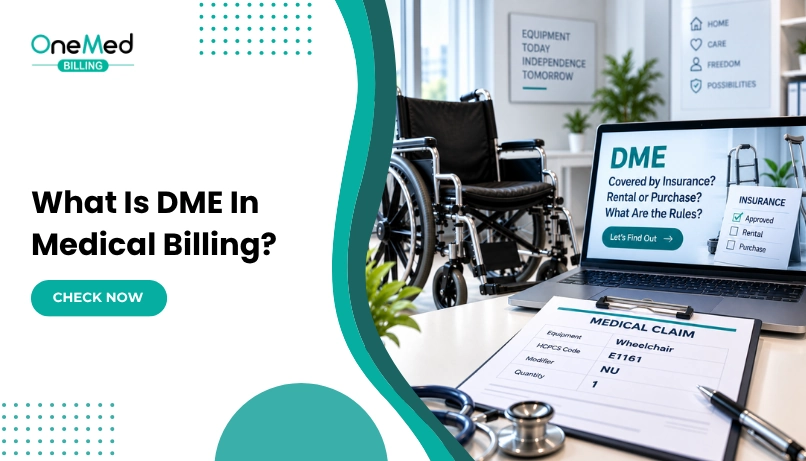
E0601 - This code pertains to a standard CPAP machine, which assists individuals with sleep apnea in breathing more effectively during sleep.
E1161 - This code corresponds to a standard manual adult wheelchair.
There exists a multitude of HCPCS codes, each designated for various medical equipment such as walkers, crutches, oxygen apparatus, hospital beds, and additional items.
The complete list of HCPCS codes can be accessed on the official CMS coding page.
Common Reasons Why DME Claims Get Denied
DME billing is different than regular medical billing in that the HCPCS Level II codes (not CPT codes) are used, and the transactions may take the form of a rental (as opposed to purchase). Payer-specific rules are also a problem. Every insurer will have different policies regarding coverage, rate of billing and documentation. It may be hard to meet these changes without specific resources. This is the reason why a tiny mistake in billing can lead to a denial. The most common reasons for DME claim denials are given below:
1. No Doctor’s Prescription
For any DME claim, a doctor's prescription is must. If the prescription is not there or not properly written, insurance will reject the claim. So always make sure valid and updated prescription is attached before you submit the claim.
2. Missing Prior Authorization
Many insurance companies ask for prior authorization before giving the equipment to the patient. Means you need to take approval first. If you skip this step or forget to take approval, claim will mostly get denied automatically. You can check prior authorization rules for Medicare on CMS website.
3. Incorrect Billing Code
Using the wrong HCPCS code is a very common mistake. Every DME item has its own code, and even small mistake in the code can cause denial. So always double-check billing codes before submitting the claim.
4. Item Not Considered Medically Necessary
Insurance company will not pay if they feel the equipment is not medically needed. This usually happens when proper documents are not there to show why the patient needs that DME. Giving clear and complete medical records helps to avoid this issue.
5. Duplicate Claim Submission
Sometimes a claim gets denied because the same equipment was already billed before. Insurance companies can easily catch duplicate claims. This can happen by mistake when a claim is submitted again without checking previous records.
6. Bundled With Home Health by Mistake
If a patient is also getting home health services at the same time, DME sometimes gets billed as part of that home health episode instead of billed separately under Part B. This is wrong, and it causes denial on both claims, not just one. Home health and DME are two separate payments under Medicare, and mixing them up is one of the most common overlap errors we see. Agencies running home health billing services alongside DME need this boundary handled correctly from the start, not fixed after a denial.
Renting vs. Buying DME: What’s Better?
Deciding between renting and purchasing Durable Medical Equipment (DME) is a significant choice, primarily determined by factors such as the length of use, the type of equipment needed, and the specifics of insurance coverage.
When Should You Rent DME?
Renting DME is most advantageous for short-term requirements, such as recovery after surgery or an injury. This option involves lower initial costs and offers flexibility, as the equipment can be returned once it is no longer necessary.
When Should You Buy DME?
Conversely, buying DME is more suitable for managing chronic or long-term health issues that necessitate daily or extended use of equipment. While this option comes with higher upfront costs, owning DME can be more cost-effective over time by avoiding ongoing rental fees.
Simple Comparison Between Renting and Buying DME
| Renting DME | Buying DME |
| Good for short-term recovery | Best for long-term conditions |
| Cheaper upfront cost | Costs more upfront but saves long-term |
| Common for hospital beds, oxygen tanks | Common for CPAP machines, glucose monitors |
| Offers flexibility, can be returned when no longer needed | Own the equipment and use |
Easy Tips to Avoid DME Billing Problems
Billing for Durable Medical Equipment (DME) can be a little confusing sometimes. But if you just follow few simple things, you can avoid most of the mistakes and also reduce the chances of a claim getting denied. Let me explain in simple way.
Always get a doctor’s prescription
First thing, you need a proper prescription from a doctor. This is very important because insurance will only pay if it is medically necessary. Without a prescription, mostly they will reject it.
Use an in-network DME supplier
Try to go with a supplier who is already connected with your insurance. If you go outside network, cost can be more and also billing becomes messy.
Always ask about prior authorization
Don’t assume everything is approved. Better you ask clearly if prior auth is needed or not. If you skip this, later claim can get denied and then the problem starts.
Keep copies of all paperwork
Always keep all documents with you. Prescription, bills, emails, everything. If something goes wrong, these will help you a lot.
Double-check your insurance benefits
Before moving ahead, just check what your insurance is covering and what not. Also, see how much you need to pay from your side. This will avoid any surprises later.
Conclusion
DME billing requires more than choosing the right HCPCS code. Coverage rules, medical necessity, prior authorization, documentation, modifiers, and payer-specific requirements all play a part in whether a claim is paid correctly.
For DME suppliers and healthcare providers, most billing problems start when one of these steps is missed or handled too late. Reviewing eligibility, authorization, documentation, coding, and claim status early can help reduce avoidable denials and keep reimbursement moving.
If your team is spending too much time correcting DME claims, following up on denials, or managing payer requirements, specialized support may be worth considering. The right billing partner should be able to manage the complete workflow, from eligibility and authorization through claim submission, payment posting, denials, and A/R follow-up.
Frequently Asked Questions
Find quick answers to common questions about this topic, explained simply and clearly.
Do I need a prescription for DME?
Yes, a doctor’s order is always required.
Does Medicare pay for DME?
Yes, Medicare covers 80% after you meet your deductible (details here).
Where can I find approved DME suppliers?
Check out the CMS DME Center.
Can I rent DME instead of buying it?
Yes, especially for short-term needs like hospital beds or crutches.