




What Is a Write-Off in Medical Billing? Stop Losing Money on Claims
- Updated Date Aug 14, 2026
- Medical Billing
- Follow
Write-off in medical billing is a process of eliminating an amount of a charged bill that is not collectible. Once a service has been charged to an insurance company or a patient, some sums might have to be withdrawn on the remaining balance.
These are deductions that are made when the amount paid is less than what is charged or when the amount paid cannot be collected in full. Write-offs are used to maintain the financial records by considering that accounts receivable only represent reasonable collectible revenue.
What Does Write-Off Mean in Medical Billing?
A write-off in medical billing is an amount removed from a patient or insurance balance because the practice does not expect to collect it.
This can happen for different reasons. Some write-offs are expected, such as the difference between a provider’s billed charge and the amount allowed under an insurance contract. Others happen when a claim can no longer be recovered because of missed filing deadlines, authorization issues, billing errors, or an unpaid patient balance.
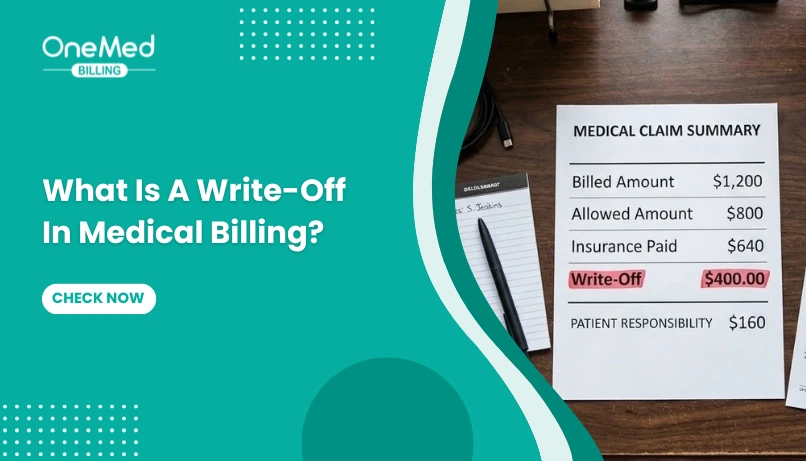
For example, if a practice bills $200 for a service but the payer’s contracted allowed amount is $150, the remaining $50 is adjusted off based on the payer agreement.
Why Do Write-Offs Happen in Medical Billing?
Write-offs happen when part of a billed amount is not expected to be collected from the payer or the patient.
Some write-offs are normal and expected, such as the difference between a provider’s billed charge and the amount allowed under an insurance contract. Others happen because of problems in the billing process, including missed filing deadlines, missing prior authorization, eligibility issues, coding errors, or claims that are not corrected and followed up in time.
Patient balances can also become write-offs when they remain unpaid and are ultimately considered uncollectible.
The important difference is that some write-offs are unavoidable, while others may point to preventable problems in the revenue cycle.
Common Types Of Write-Offs That Actually Happen in Medical Billing
Write-offs in medical billing can happen for different reasons. Some are expected as part of payer contracts, while others result from problems in the billing process or balances that can no longer be collected.
1. Contractual Write-Offs
This is the routine difference between the provider’s billed charge and the payer’s contracted allowed amount.
If the practice bills $200 and the payer allows $150, the remaining $50 is adjusted off according to the payer contract.
2. Timely Filing Write-Offs
These happen when a claim is not submitted, corrected, or appealed within the payer’s filing deadline.
Once the deadline has passed and the payer will no longer reconsider the claim, the practice may have to write off the balance.
3. Missing Prior Authorization Write-Offs
A payer may deny a service because the required authorization was never obtained, expired, or did not cover the procedure performed.
If retroactive authorization or an appeal is not available, the denied amount may become a write-off.
4. Eligibility or Coverage Write-Offs
These happen when the patient’s insurance was inactive, the wrong payer was billed, or coverage details were not identified before the service.
If the issue is discovered too late to bill another payer or collect appropriately from the patient, the balance may have to be written off.
5. Provider Credentialing Write-Offs
A claim may be denied because the rendering provider was not enrolled or credentialed with the payer for the date of service.
If the enrollment cannot be backdated and the claim cannot be rebilled successfully, the practice may lose the payment.
6. Coding and Modifier Write-Offs
Incorrect CPT, ICD-10, HCPCS, or modifier usage can cause a claim to deny or pay incorrectly.
These usually become write-offs when the billing team does not identify and correct the error before the payer’s reconsideration or appeal deadline.
7. Unworked Denial Write-Offs
A valid denial may sit in the billing queue without timely follow-up.
By the time the account is reviewed, the appeal or corrected-claim deadline may have passed, leaving the practice with no remaining recovery option.
8. Uncollectible Patient Balance Write-Offs
After insurance processes the claim, the patient may still owe a deductible, copay, or coinsurance amount.
If the balance remains unpaid after the practice’s normal collection efforts and is considered unlikely to be recovered, it may eventually be written off.
Write-Off vs Adjustment in Medical Billing
A write-off and an adjustment both reduce the balance on an account, but they are used for different reasons.
A write-off usually means the practice has decided that an amount will not be collected from the payer or patient.
An adjustment changes the account balance because of a contractual allowance, correction, payment posting issue, or another billing reason.
| Write-Off | Adjustment |
|---|---|
| Amount is considered uncollectible | Balance is changed for a specific billing reason |
| Often linked to missed filing, denied claims, or unpaid balances | Often linked to contractual allowances or corrections |
| Usually represents revenue the practice will not recover | Does not always represent lost revenue |
| Typically posted after collection options are exhausted | Can be posted during normal claim or payment processing |
For example, if a payer allows $150 on a $200 charge, the $50 difference is usually posted as a contractual adjustment. If a separate denied balance can no longer be recovered because the filing or appeal deadline has passed, that amount may be written off.
Which Medical Billing Write-Offs Can Be Prevented?
Not every write-off can be avoided. Contractual adjustments, for example, are part of the payer agreement. But many operational write-offs happen because something was missed or not corrected in time.
Common preventable write-offs include:
- Missed timely filing deadlines: Claims are not submitted, corrected, or appealed before the payer’s deadline.
- Eligibility verification errors: Coverage is inactive, incorrect, or not verified before the service is provided.
- Missing prior authorizations: Required authorization is not obtained, expires, or does not match the service billed.
- Credentialing issues: The provider is not properly enrolled or credentialed with the payer for the date of service.
- Coding and modifier errors: Incorrect codes or modifiers lead to denials that are not corrected in time.
- Unworked denials: Denied claims remain in the queue until the appeal or reconsideration deadline passes.
- Incorrect patient or insurance information: Errors in demographics, member IDs, payer details, or coordination of benefits can prevent claims from being paid.
These write-offs are usually a sign that part of the revenue cycle workflow needs attention, rather than an unavoidable loss.
How Can Practices Reduce Unnecessary Write-Offs?
Practices can reduce avoidable write-offs by catching billing problems earlier and following up before payer deadlines are missed.
- Verify insurance before care: Confirm active coverage, patient details, and benefits before the service is provided.
- Check authorization requirements: Make sure required authorizations are obtained and match the service, date, and provider.
- Submit claims on time: Track payer filing limits and avoid letting unsubmitted or rejected claims sit in the billing queue.
- Monitor denials regularly: Review denial reasons and work them before appeal or reconsideration deadlines expire.
- Review aging A/R: Identify unpaid claims early instead of waiting until balances become difficult or impossible to recover.
- Correct recurring billing errors: If the same coding, eligibility, authorization, or claim issue keeps appearing, fix the underlying workflow rather than correcting claims one at a time.
The goal is not to eliminate every write-off, since some are expected. It is to prevent revenue from being written off because of avoidable billing or follow-up failures.
Conclusion
Write-offs are part of medical billing, but the important thing is knowing why they are happening. Contractual write-offs may be expected, while losses caused by missed filing deadlines, eligibility problems, missing authorizations, coding errors, or unworked denials often show that something in the billing workflow needs attention.
Practices can reduce unnecessary write-offs by reviewing them regularly, tracking the reason behind each one, and fixing recurring problems at the source instead of adjusting off the same types of balances again and again.
If your practice is seeing frequent write-offs and you are not sure where the revenue is being lost, a detailed review of your eligibility, authorization, claims, denials, and A/R workflow can help identify the gaps. Our team can help you review those areas, find preventable losses, and improve the process so more valid revenue is collected before it reaches the write-off stage.
Frequently Asked Questions
Find quick answers to common questions about this topic, explained simply and clearly.
Are write-offs in medical billing always avoidable?
No. Some write-offs, such as contractual adjustments from insurance agreements, are expected and unavoidable. However, others like timely filing write-offs or administrative errors can often be prevented with stronger billing processes and proper claim
How do write-offs affect a healthcare practice’s revenue?
Write-offs reduce the total amount of revenue a practice can collect. While contractual write-offs are predictable, excessive or unmonitored write-offs may indicate problems in the revenue cycle that can negatively impact cash flow and long-term profit
What is the most common type of write-off in healthcare billing?
Contractual write-offs are the most common. These occur when insurance companies reimburse providers based on negotiated rates that are lower than the original billed charge.
How can healthcare practices reduce unnecessary write-offs?
Practices can reduce avoidable write-offs by verifying insurance eligibility before visits, improving coding accuracy, monitoring claim denials, reviewing accounts receivable regularly, and appealing denied claims promptly.