



Medical Coding vs Medical Billing: Key Differences
- Updated Date Sep 5, 2026
- Medical Billing
- Follow
When a claim is denied or left unpaid, it is not always clear where the problem started. Sometimes the code is wrong. Sometimes the code is right, but the claim was sent to the wrong payer, authorization was missed, or no one followed up after submission.
That is why medical coding and medical billing should not be mixed up. They work on the same claim, but they handle different parts of the payment process.
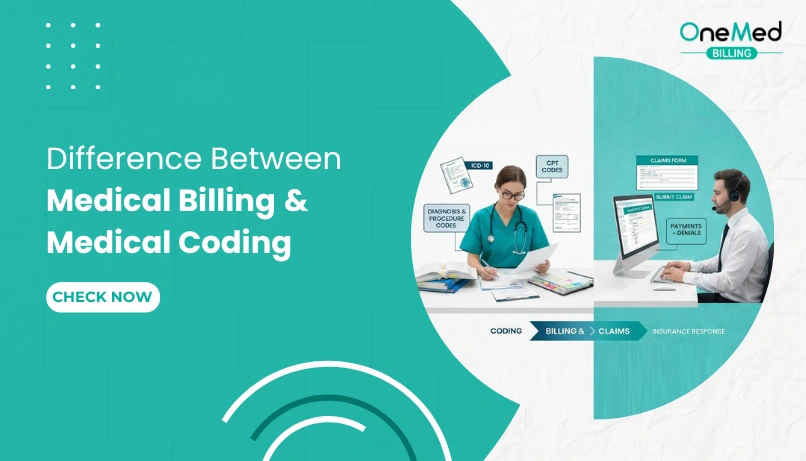
Medical coding turns the provider’s documentation into CPT, ICD-10, HCPCS, and modifier details. Medical billing uses those details to prepare the claim, send it to the payer, post payments, handle denials, and follow up until the balance is resolved.
For a practice, this difference is important because it helps identify the real reason behind payment delays. If the diagnosis does not support the service, it may be a coding issue. If the claim was submitted late or not followed up, it is more likely a billing issue.
What Is Medical Coding?
Medical coding is the process of converting provider documentation into standardized codes used for billing, reporting, and payer review. These codes describe the service performed, the patient’s diagnosis, any procedures completed, and any special billing circumstances.
Medical coders usually work with:
- CPT codes for services and procedures
- ICD-10-CM codes for diagnoses
- HCPCS codes for supplies, DME, drugs, and certain services
- Modifiers for extra claim details
- Provider documentation to support medical necessity
For a deeper look at how these codes, modifiers, and documentation rules work together, you can read our medical coding guide.
Real-world example:
If a provider performs an office visit and orders a diagnostic test, the coder reviews the note and selects the correct CPT and ICD-10 codes. If the documentation does not support the level of service, or if the diagnosis does not support medical necessity, the claim may later be denied or downcoded.
What Is Medical Billing?
Medical billing is the process of preparing, submitting, tracking, and following up on claims so the provider gets paid. Billing starts after coding information is ready, but it also depends on front-end details like insurance, eligibility, authorization, patient demographics, and payer rules.
Medical billers usually handle:
- Claim creation and submission
- Eligibility and insurance checks
- Prior authorization tracking
- Claim rejection correction
- Payment posting
- Denial follow-up
- Appeal support
- A/R follow-up
- Patient billing and statements
Real-world example:
A claim may be coded correctly, but if the patient’s insurance was inactive on the date of service, the wrong payer was selected, or authorization was missing, the claim may still deny. That is a billing or front-end workflow issue, not always a coding issue.
Medical Coding vs Medical Billing: Main Differences
Medical coding and medical billing are connected, but they solve different parts of the revenue cycle. Coding explains what care was provided and why it was medically necessary. Billing uses that coded information to create the claim, send it to the payer, track the payment, and follow up until the provider gets paid.
A coding mistake can cause the claim to be denied, downcoded, or flagged for review. A billing mistake can delay payment even when the coding is correct. That is why practices need both functions to work together.
| Area | Medical Coding | Medical Billing |
|---|---|---|
| Main purpose | Converts provider documentation into standard medical codes | Uses codes and patient data to create, submit, and follow claims |
| Primary focus | CPT, ICD-10-CM, HCPCS, modifiers, documentation, medical necessity | Claims, payer rules, eligibility, authorization, payment posting, denials, and A/R |
| Where it starts | Starts with the provider’s clinical note, diagnosis, procedure, and documentation | Starts with patient information, insurance details, coded services, and payer requirements |
| What it answers | What service was performed? Why was it medically necessary? Which code fits the documentation? | Is the claim complete? Was it sent to the right payer? Was it paid correctly? Does it need follow-up? |
| Main responsibility | Select accurate codes based on documentation and payer rules | Submit claims, correct rejections, post payments, manage denials, and follow unpaid claims |
| Common tools used | Coding books, encoder tools, EHR notes, payer policies, NCCI edits, LCD/NCD rules when applicable | Practice management system, clearinghouse, payer portals, EOBs, ERAs, denial reports, A/R reports |
| Common errors | Wrong CPT code, wrong diagnosis code, missing modifier, unsupported code, upcoding, downcoding, unbundling | Wrong payer, inactive insurance, missing authorization, late submission, rejected claim, missed denial deadline |
| Main risk | Incorrect reimbursement, medical necessity denial, compliance issue, audit risk | Payment delay, claim rejection, unpaid A/R, missed appeal, poor cash flow |
| Impact on revenue | Affects whether the claim is coded correctly and supported by documentation | Affects whether the claim is submitted, paid, followed up, and collected on time |
| Best handled by | Certified coders or trained coding staff with documentation knowledge | Billing team, RCM staff, or medical billing specialists with payer follow-up experience |
| Real-world example | A procedure is documented, but the wrong CPT code or modifier is selected | The correct codes are used, but the claim is sent to the wrong payer or authorization was missed |
| Main goal | Code services accurately and compliantly | Get the claim paid correctly and on time |
How Medical Coding and Billing Work Together?
Medical coding and medical billing work best when they are connected, not handled like two separate tasks. The coder reviews the provider’s documentation and selects the right CPT, ICD-10-CM, HCPCS, and modifier details. The biller then uses that coded information, along with patient insurance details, payer rules, and authorization status, to create and submit the claim.
A smooth workflow usually looks like this:
- The provider documents the visit or procedure
- The coder reviews the note and selects the correct codes
- The billing team checks patient, insurance, payer, and authorization details
- The claim is created and submitted to the payer
- The payer accepts, rejects, pays, or denies the claim
- The billing team posts payment or follows up on unpaid or denied claims
The important point is that one side affects the other. If coding is wrong, the billing team may submit a claim that gets denied for medical necessity, modifier issues, or unsupported services. If billing is weak, a correctly coded claim can still be delayed because of wrong insurance, missed authorization, claim rejection, or poor A/R follow-up.
For providers, coding and billing should work like one revenue cycle process. Coding makes sure the care is reported correctly. Billing makes sure the claim moves through the payer system and gets paid correctly.
How do coding and Billing Affect Payments Differently?
Medical coding and medical billing both affect how and when a practice gets paid, but they affect payment at different points.
Coding affects the payment amount because it tells the payer what service was provided, why it was needed, and how it should be reimbursed. If the CPT code, diagnosis code, HCPCS code, or modifier is wrong, the payer may deny the claim, downcode it, request records, or pay less than expected and this is how incorrect coding can affect revenue, even when the service was provided correctly.
Billing affects the payment process because it controls how the claim is submitted, tracked, corrected, posted, and followed up. Even when coding is correct, payment can still be delayed if the wrong payer is billed, authorization is missing, the claim is rejected, payment is posted late, or unpaid claims are not followed up.
For example, if a procedure is coded incorrectly, the practice may receive a lower payment or no payment at all. That is a coding-related payment issue. But if the procedure is coded correctly and the payer has not paid after 45 days because no one followed up, that is a billing-related payment issue.
Who Is Responsible When a Claim Gets Denied?
When a claim gets denied, the first step is not to blame the coder or the biller. The first step is to find where the problem started. A denial can come from documentation, coding, eligibility, authorization, claim submission, payer rules, or follow-up issues.
For example, if the diagnosis code does not support the CPT code, the issue may be related to coding or provider documentation. If the claim was sent to the wrong payer, the problem is usually billing or eligibility. If prior authorization was required but not obtained, the issue may come from the front-desk or billing workflow.
Here is a simple way to understand it:
| Denial Reason | Usually Connected To | Example |
|---|---|---|
| Diagnosis does not support the service | Coding or documentation | CPT code billed, but ICD-10 does not support medical necessity |
| Missing or incorrect modifier | Coding | Procedure needs modifier 25, 59, or another payer-required modifier |
| Inactive insurance | Eligibility or billing | Patient coverage was not active on the date of service |
| Wrong payer billed | Billing or front-desk data | Claim sent to old insurance instead of current plan |
| Prior authorization missing | Authorization or billing workflow | Service needed approval before treatment |
| Timely filing missed | Billing follow-up | Claim was not submitted within payer deadline |
| Duplicate claim | Billing | Same claim submitted more than once |
| Missing documentation | Provider documentation or coding | Payer asks for notes to support the billed service |
| Underpayment | Payment posting or A/R follow-up | Payer paid less than the contracted amount |
The responsibility depends on the reason for the denial. Some denials are caused before the claim is created, while others happen after submission. That is why practices need a proper review process. The billing team should read the denial code, check the claim history, review documentation, confirm payer rules, and identify whether the issue came from coding, billing, authorization, or front-end data.
Can One Team Handle Both Coding and Billing?
Yes, one team can handle both coding and billing, but it depends on the practice size, specialty, claim volume, and complexity of services. A small primary care practice may manage both with one trained team, while a multi-specialty group, surgical practice, hospital-based provider, or high-volume clinic may need separate coding and billing roles.
Coding and billing require different skills. Coding focuses on documentation, CPT codes, ICD-10 codes, HCPCS codes, modifiers, and medical necessity. Billing focuses on claim submission, payer rules, rejections, denials, payment posting, A/R follow-up, and patient balances. Both are connected, but they are not the same job.
The risk comes when one team is expected to manage everything without review. A claim may be submitted on time but still deny because the code is not supported. Another claim may be coded correctly but sit unpaid because follow-up was missed. This is why practices need clear checks between coding, billing, and denial review.
For any practice, the right setup is the one that protects accuracy and payment. If claim volume is low and services are simple, one trained team may be enough. If denials are increasing, documentation is complex, or A/R is growing, it may be better to separate the roles or bring in outsourced medical coding support alongside your billing workflow.
If your practice is unsure whether the issue is coming from coding, billing, or both, you can contact our team for a free consultation. We can help review where the workflow is breaking and suggest the right support based on your claim volume, denials, and payment delays.
Frequently Asked Questions
Find quick answers to common questions about this topic, explained simply and clearly.
Are medical billing and medical coding the same thing?
No. Medical coding and medical billing are connected, but they are not the same. Coding turns the provider’s diagnosis, treatment, and procedure details into standard codes. Billing uses those codes to prepare claims, submit them to payers, follo
What is the main difference between medical coding and medical billing?
The main difference is their role in the payment process. Medical coding focuses on accurate code selection based on documentation. Medical billing focuses on claim submission, payer follow-up, denial handling, patient billing, and reimbursement.
Which comes first, medical coding or medical billing?
Medical coding usually comes first. The provider’s notes are reviewed, then the correct CPT, ICD-10, and HCPCS codes are assigned. After that, the billing team uses those codes to create and submit the claim.
How do medical coding and billing affect provider payments?
Coding affects whether the services are described correctly. Billing affects whether the claim is submitted, tracked, corrected, and paid properly. If coding is wrong, the claim may be denied or underpaid. If billing follow-up is weak, even a correctly
Why are medical billing and coding often mentioned together?
They are mentioned together because both are part of the same revenue cycle. Coding prepares the claim information. Billing turns that information into a claim and follows it until payment is received. One supports the other.