



What is POA in Medical Billing? Its Importance & Process Explained
- Updated Date Aug 14, 2026
- Medical Billing
- Follow
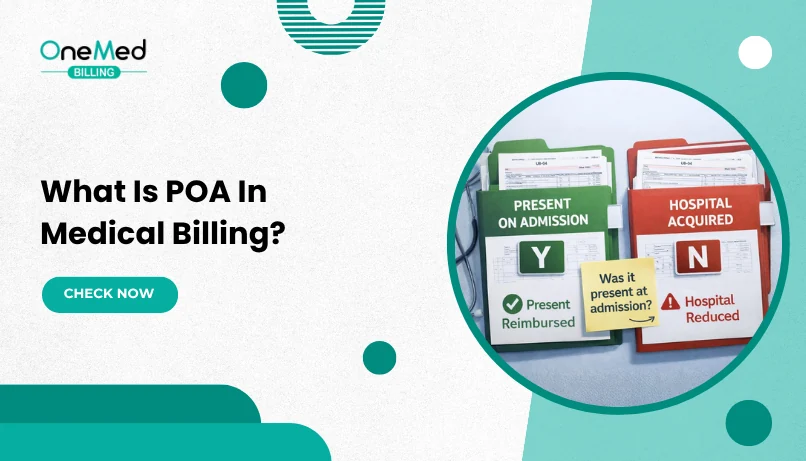
POA is an acronym used to mean Present on Admission. It is a standardized measure that is applied in hospital inpatient coding to determine the presence of a diagnosis or condition in a patient during the time he was admitted to the facility. The key question is whether the patient had this condition when admitted, or did they develop it in the hospital?
This difference might appear to be simple, however, its repercussions can be felt throughout the whole process of billing and reimbursement. When a patient acquires an infection or a complication during his/her stay in a hospital, it will be a reflection of the quality of the care delivered to the patient. Insurers such as Medicare would want to understand whether a health condition was pre-existing or hospital-acquired to know how to make payment, and whether a supplementary payment is justified.
The Inpatient Prospective Payment System (IPPS) has required POA to be a mandatory reporting requirement on all inpatient claims on Medicare since October 2008. The UB-04 claim form, the standard billing form used by hospitals and inpatient facilities, reports it.
The Four POA Indicators Explained
The POA reporting depends on four common codes, each with a specific meaning attached to them. Each of the diagnosis listed on an inpatient claim has to be given one of these indicators, and therefore, it is of the utmost importance that the documentation and coding be done correctly.
| Indicator | Meaning | When It Is Used |
|---|---|---|
| Y | Yes | Condition was present at admission |
| N | No | Condition developed after admission |
| U | Unknown | Documentation is not clear |
| W | Clinically undetermined | Provider cannot clinically determine timing |
All 4 indicators are submitted via UB-04 forms of Medicare inpatient claims submitted using the IPPS system, which ensure standardization throughout the industry.
Why POA Matters for Reimbursement?
POA directly affects how inpatient claims are paid because it tells the payer whether a diagnosis was present when the patient was admitted or developed during the hospital stay. This matters most under the MS-DRG payment system, where diagnoses can influence the final reimbursement amount.
If a condition is marked as hospital-acquired, especially with an N or U indicator, it may not increase the hospital’s payment. For certain Hospital-Acquired Conditions, Medicare may reduce or deny additional reimbursement because the condition was not present at admission.
Incorrect POA reporting can also create denial risk. If the documentation does not clearly support the POA indicator, the claim may be delayed, questioned, or audited. Over time, these errors can lead to lost revenue, payment takebacks, and compliance concerns.
POA Documentation Process
POA documentation starts at the time of admission. The purpose is to confirm whether each condition was already present when the patient entered the hospital or developed later during the stay.
1. Review admission records
Check the H&P, emergency notes, consult notes, and admission order to identify conditions present at admission.
2. Confirm the timing of each condition
The documentation should clearly show whether the condition was present before admission or appeared after admission.
3. Track new findings during the stay
Review progress notes, lab results, imaging, and procedure notes for any new or updated diagnosis.
4. Capture all reportable diagnoses
Make sure the principal diagnosis and all secondary diagnoses are correctly listed before coding.
5. Assign the correct POA indicator
Use Y, N, U, or W based on what the medical record supports.
6. Query the provider if unclear
If the timing is not clear, the coder should ask the provider instead of guessing.
Common POA Reporting Mistakes
POA reporting errors usually happen when the medical record does not clearly show when a condition started. Even small documentation gaps can lead to wrong indicators, claim delays, or payment issues.
1. Unclear admission notes
If the admission record does not clearly mention the patient’s existing conditions, coders may struggle to decide whether the condition was present on admission.
2. Missing provider query
When documentation is unclear, the coder should ask the provider for clarification. Skipping this step can lead to unsupported POA reporting.
3. Using the wrong POA indicator
Assigning Y, N, U, or W incorrectly can affect reimbursement, trigger denials, or create audit risk.
4. Confusion with late diagnoses
Some conditions are confirmed after admission through labs, imaging, or specialist review. Coders must check whether the condition existed at admission or truly developed later.5.
5. Weak CDI process
If the CDI team does not review documentation early, POA gaps may be found too late. A strong CDI process helps catch unclear records before the claim is submitted.
How Providers Can Improve POA Accuracy?
POA accuracy improves when documentation is clear from the start. Providers, coders, and CDI teams must work together to confirm when each condition began and make sure the correct POA indicator is reported before the claim is submitted.
- Document the patient’s condition clearly at the time of admission.
- Mention whether the condition was present on admission or developed later during the stay.
- Use clear terms like “present on admission,” “pre-existing,” “developed after admission,” or “unable to determine.”
- Make sure providers respond to coder queries when the documentation is unclear.
- Train coders, CDI teams, and providers on POA rules and payer requirements.
- Review records early so documentation gaps can be fixed before claim submission.
- Audit POA reporting regularly to find repeated mistakes.
- Check claims for missing or incorrect POA indicators before submission.
Conclusion
POA may look like a small part of inpatient billing, but it has a direct impact on reimbursement, denials, audits, and compliance. When admission documentation is clear and the right POA indicator is assigned, hospitals can reduce payment risk and protect revenue.
If your team is facing POA-related errors, claim delays, or documentation gaps, OneMed can help review the process and improve coding accuracy before claims go out.
Frequently Asked Questions
Find quick answers to common questions about this topic, explained simply and clearly.
What is POA in medical terms?
POA stands for Present on Admission. It is used in medical billing to show whether a condition was already present when the patient was admitted to the hospital. This helps separate pre-existing conditions from those that developed dur
What does POA mean after a diagnosis?
After a diagnosis, POA indicates if that condition was already present at the time of admission or developed later. It helps coders and payors understand the timing of the condition for accurate billing and reporting.
What are the 4 types of POA?
The four main POA indicators are: Y (Yes): Condition was present at admission N (No): Condition developed after admission U (Unknown): Not enough documentation t
How does POA affect reimbursement?
POA affects reimbursement by showing whether a condition was hospital-acquired or pre-existing. Payors may reduce or deny payment for conditions not present on admission, especially hospital-acquired conditions. Accurate POA reporting