

Real Reasons Behind Claim Denials in Medical Billing
- Updated Date Sep 9, 2026
- Denial Management
- Follow
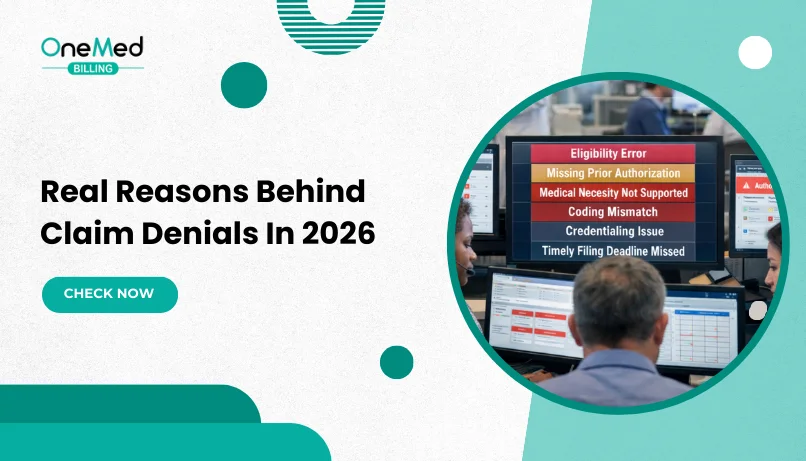
Claim denials in medical billing remain a significant barrier to consistent reimbursement and stable cash flow. While denial codes explain why a claim was rejected, they do not address the underlying causes. In most cases, denials stem from eligibility verification gaps, incomplete claim information, missing prior authorizations, documentation deficiencies, coding errors, or payer-specific compliance requirements.
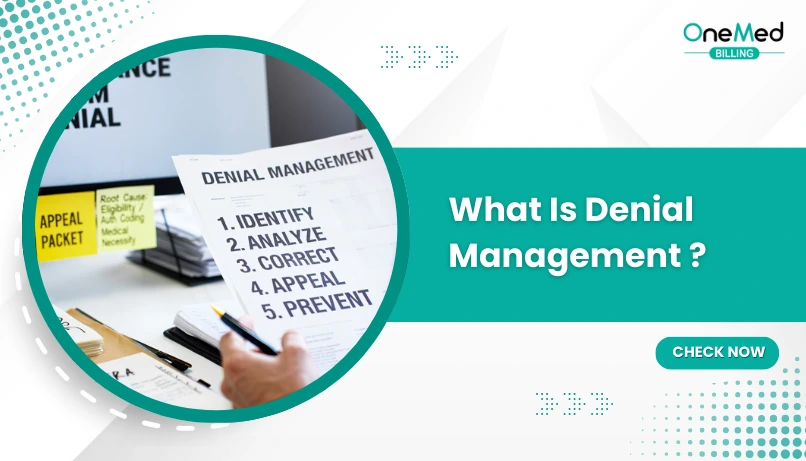
With increasing payer oversight and stricter reimbursement policies, preventing denials requires more than reviewing codes after rejection. Effective denial management involves identifying root causes, strengthening front-end processes, and implementing structured follow-up to prevent recurring issues.
This guide outlines the real reasons behind claim denials in medical billing and provides practical prevention strategies to improve claim acceptance rates and overall revenue cycle performance.
What Are Medical Claim Denials?
Medical claim denials occur when an insurance payer refuses to reimburse a healthcare provider for services that were submitted for payment. Unlike claim rejections, which happen before processing due to technical errors, denials occur after the claim has been reviewed and determined not payable based on coverage rules, documentation, coding, or policy requirements.
In simple terms, a denial means the payer has reviewed the claim and decided not to issue payment unless corrections, additional documentation, or an appeal is submitted.
Why Claim Denials Are Increasing in Medical Billing?
Claim denials are rising across the healthcare industry due to tighter payer controls, evolving reimbursement rules, and increasing documentation scrutiny. What was once a routine billing process has become a highly monitored financial checkpoint where even minor errors can result in nonpayment.
Several key factors are driving this increase.
- Stricter Payer Policies and Edits: Insurance companies are applying more automated claim edits, bundling rules, and medical necessity reviews to control costs. Claims that previously passed may now trigger payment reductions or denials
- Increased Documentation Requirements: Payers require more detailed clinical documentation to support medical necessity. Incomplete or inconsistent charting often results in post-review denials.
- Complex Coding and Modifier Rules: CPT, ICD-10, and modifier guidelines continue to evolve. Even small coding inaccuracies can cause claims to be flagged or downcoded.
- Prior Authorization Expansion: More services now require pre-authorization. Missing or improperly documented authorizations are a growing source of denials.
- AI and Data Analytics in Payer Review: Many payers now use predictive analytics and automated systems to detect patterns, identify high-risk claims, and apply stricter review criteria.
- Provider Enrollment and Network Updates: Credentialing errors, contract changes, and payer network adjustments can trigger unexpected denials.
As payer oversight becomes more data-driven and policy-driven, denial management requires structured follow-up, ongoing monitoring, and proactive workflow adjustments rather than reactive corrections.
The Real Reasons Behind Claim Denials in Medical Billing
Claim denials rarely happen in isolation. In most cases, they are the visible outcome of breakdowns that occur earlier in the revenue cycle during patient intake, eligibility verification, authorization tracking, coding, or documentation. While denials may appear to be payer decisions, they often reflect internal process gaps that compound over time.
Across the healthcare industry, denial rates continue to rise as payers implement stricter edits, automated review systems, and more detailed documentation requirements. Even small workflow inconsistencies can trigger nonpayment, increase rework costs, and push claims into aging accounts receivable. The sections below outline the most common denial categories, what drives them, and how practices can reduce preventable revenue loss.
1. Eligibility and Coverage Verification Failures
Eligibility-related denials occur when claims are submitted for patients whose insurance coverage is inactive, terminated, or incorrectly identified. Although these denials appear administrative, they usually reveal breakdowns in front-end verification processes rather than payer issues.
Common root causes include outdated insurance cards, failure to reverify coverage at recurring visits, incorrect identification of primary versus secondary plans, and incomplete coordination of benefits documentation. In practices with high patient volume, eligibility verification may be rushed or performed only at scheduling, increasing risk at the time of service.
From a financial perspective, eligibility denials immediately delay reimbursement and often require rebilling to a different payer. If not corrected quickly, they push claims into older AR buckets, increasing days in accounts receivable and administrative rework costs.
Prevention requires real-time eligibility checks on the day of service, confirmation of payer hierarchy, and standardized intake protocols that reduce reliance on manual verification alone.
2. Missing or Incomplete Claim Information
Denials due to missing or invalid claim data occur when required submission elements are incomplete, inaccurate, or formatted incorrectly. Payers rely heavily on automated claim-editing systems, and even minor discrepancies can trigger denial before manual review.
These errors commonly involve invalid NPIs, missing modifiers, incorrect place-of-service codes, mismatched diagnosis-to-procedure pairings, or incomplete demographic information. Often, these denials are not clinical in nature but administrative, reflecting weaknesses in pre-bill validation processes.
Financially, incomplete claim denials lower first-pass acceptance rates and increase labor costs due to resubmission and correction efforts. Over time, high volumes of preventable data errors create avoidable AR backlog.
Prevention depends on structured pre-submission workflows, automated claim scrubbing tools, required field validation, and periodic review of recurring submission errors.
3. Prior Authorization Not Obtained or Improperly Documented
Authorization-related denials occur when required payer approval was not secured before rendering services, expired before claim submission, or was improperly documented on the claim.
These denials often arise when scheduling teams, clinical staff, and billing departments operate in silos. Authorization requirements vary by payer and procedure, and without centralized tracking, approvals may be missed or applied incorrectly.
Operationally, authorization denials are costly because they frequently affect higher-value procedures such as imaging, surgeries, or specialty consultations. If approval was not obtained in advance, appeals are often unsuccessful.
Preventing these denials requires a centralized authorization tracking system, clearly assigned responsibility for obtaining approvals, verification of authorization numbers before billing, and monitoring visit limits for recurring services.
4. Coding Errors and Diagnosis-Procedure Mismatches
Coding-related denials occur when CPT, ICD-10, or modifier combinations fail to meet payer requirements. These issues typically arise from incompatible diagnosis codes, overuse of unspecified codes, or incorrect modifier application.
As payers increasingly rely on automated edits and policy-based reimbursement systems, coding precision has become critical. Even when a service is clinically appropriate, a claim may still be denied if the documentation and code selection do not align with payer coverage rules.
When billing teams review denial reports, these issues frequently show up under the most common denial codes tied to medical necessity, bundling, or invalid information. Recognizing those patterns early allows practices to address the underlying coding or documentation gap before it affects additional claims.
Preventing coding-related denials requires continuous coder education, routine internal audits, careful validation of diagnosis-to-procedure linkage, and ongoing monitoring of payer-specific policy updates.
5. Medical Necessity and Insufficient Documentation
Medical necessity denials occur when the clinical documentation does not adequately justify the billed service under payer guidelines. This is one of the most scrutinized areas in medical billing and frequently triggers audits.
Denials may result from vague provider notes, unsupported diagnosis codes, failure to meet Local Coverage Determinations (LCDs), or insufficient clinical rationale linking the service to the patient’s condition.
Operationally, these denials require coordination between billing and providers to gather additional documentation for appeal. They often signal gaps in documentation training rather than billing errors.
From a financial standpoint, repeated medical necessity denials increase payer scrutiny and raise compliance risk. In some cases, insufficient documentation may result in permanent nonpayment, or in recoupment if the payer reviews a claim after payment and decides the documentation did not support it.
Prevention involves educating providers on documentation standards, aligning coding with clinical notes, reviewing payer coverage policies regularly, and conducting structured documentation audits.
6. Timely Filing Limit Exceeded
Timely filing denials occur when claims are submitted after the payer’s allowed timeframe. Most commercial payers require submission within 60 to 180 days from the date of service, while Medicare typically allows one calendar year. When this deadline is missed, the claim is often automatically denied with little opportunity for appeal.
These denials usually reflect internal workflow breakdowns rather than payer issues. Common causes include delayed charge entry, documentation not finalized on time, backlog in AR review, or failure to monitor payer-specific deadlines. Practices experiencing staffing shortages or high denial volumes often see timely filing denials increase because attention shifts toward newer claims while older ones age unnoticed.
A key contributor is the lack of consistent tracking of payer-specific claim filing time limits. When these limits are not clearly documented and monitored, older claims can quietly move beyond allowable submission windows before corrective action is taken.
Financially, timely filing denials are among the most damaging because many are non-recoverable. Once the deadline passes, revenue is permanently lost, increasing write-offs and reducing net collection rates.
Prevention requires proactive deadline tracking. Practices should maintain payer-specific filing limits, implement internal submission targets shorter than payer windows, and monitor aging reports weekly to identify claims approaching deadline thresholds.
7. Coordination of Benefits (COB) Errors
Coordination of Benefits denials occur when patients have multiple insurance plans and claims are billed in the wrong order. Insurance carriers require primary payers to process the claim before secondary plans are billed. When this sequence is incorrect, the claim is denied until proper coordination is completed.
COB issues often arise when patient insurance information changes and is not updated, when secondary coverage is not documented accurately, or when the explanation of benefits from the primary payer is not attached to the secondary submission. These errors are particularly common among patients with employer-based coverage combined with Medicare or Medicaid.
Operationally, COB denials increase AR complexity because billing teams must interact with multiple payers and track sequential reimbursement. Delays compound as each payer requires documentation from the other.
Preventing COB denials requires verifying insurance hierarchy at each visit, confirming which plan is primary, and collecting accurate policy information upfront. Structured intake workflows significantly reduce these avoidable delays.
8. Duplicate Claim Submission
Duplicate denials occur when a payer believes the same claim has already been processed. While sometimes caused by payer system errors, duplicate denials frequently result from internal resubmission practices.
Billing staff may resubmit claims prematurely without confirming claim status, or corrected claims may be submitted without using proper replacement frequency codes. Clearinghouse retransmissions can also unintentionally duplicate submissions if monitoring controls are weak.
The financial impact is indirect but significant. Duplicate denials increase follow-up workload, slow reimbursement cycles, and clutter AR reports with unnecessary rework. Over time, inefficient resubmission workflows reduce billing team productivity.
Prevention involves implementing structured claim lifecycle tracking. Before resubmitting, staff should verify claim status with the payer. Corrected claims must be properly marked as replacements or adjustments to avoid triggering duplicate edits.
9. Bundling and NCCI Edit Violations
Bundling denials occur when a payer determines that one service is included within another and should not be billed separately. These denials often stem from National Correct Coding Initiative edits or payer-specific bundling policies.
Common triggers include failure to apply appropriate modifiers, misunderstanding procedure relationships, or billing services that are considered incidental to a primary procedure. High-volume specialties are particularly vulnerable to recurring bundling denials if coding education is not continuously reinforced.
Unlike eligibility denials, bundling issues often result in systematic underpayment rather than full rejection. This means revenue may be reduced consistently without being immediately obvious.
Preventing bundling denials requires ongoing review of coding guidelines, proper modifier validation, and periodic audits to ensure compliance with payer edit rules.
10. Provider Enrollment and Credentialing Issues
Credentialing-related denials occur when services are billed under a provider who is not properly approved by the payer at the time of service. Even when the claim itself is accurate and medically necessary, payment may still be withheld because the provider’s status with the insurer is not active or fully recognized.
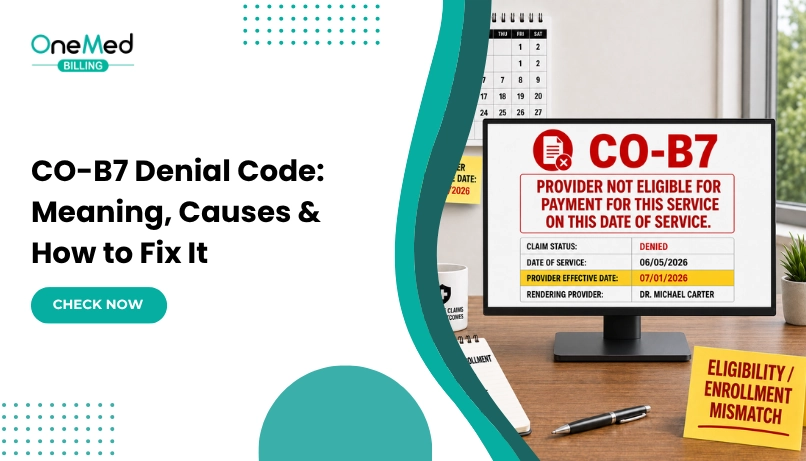
Common causes include billing before enrollment approval is finalized, mismatched effective dates, group affiliation errors, or lapses in recredentialing. Confusion between provider enrollment and credentialing often contributes to these denials, since enrollment refers to registering the provider so claims can be submitted and paid, while credentialing involves the payer’s review and approval of the provider’s qualifications and participation status. These denials typically arrive as CO-B7, which tells the practice the provider was not recognized as credentialed or enrolled for the billed service on that date. A breakdown in either process can result in nonpayment.
From a revenue standpoint, these denials can create significant delays. In some cases, retroactive enrollment may allow recovery, but in others, claims may be permanently denied if effective dates do not align with the date of service.
Preventing these denials requires maintaining a detailed tracking system that monitors enrollment submissions, credentialing approvals, effective dates, and renewal timelines. Billing teams should verify both enrollment status and credentialing approval before claims are submitted.
The Most Common Claim Denial Codes (With Examples)
Insurance companies use standardized Claim Adjustment Reason Codes to explain why a medical claim was denied or adjusted. These codes provide insight into where breakdowns are occurring in the revenue cycle. Understanding not just what the code means, but why it happens and how it affects collections, is essential for reducing denial rates.
CO-18 - Duplicate Claim or Service
CO-18 is issued when a payer believes the same claim or service has already been submitted or processed. While this may appear minor, duplicate denials often signal gaps in internal claim tracking or resubmission workflows. These errors can occur when corrected claims are submitted without the proper frequency code, when clearinghouses retransmit claims automatically, or when staff resubmit without confirming payer processing status.
From an operational standpoint, repeated CO-18 denials indicate that claim lifecycle tracking is weak. Billing teams may be reacting to unpaid claims without verifying whether they are pending, processed, or previously adjusted. This creates unnecessary payer follow-up and delays reimbursement.
Example: A claim is denied due to a modifier error. The billing team corrects the issue and resubmits the claim, but forgets to mark it as a replacement claim. The payer processes it as a duplicate and issues a CO-18 denial, requiring clarification and further delay before payment is released.
CO-29 - Timely Filing Limit Exceeded
CO-29 indicates that a claim was submitted after the payer’s defined filing deadline. Every insurance company sets specific time limits, often ranging from 60 to 180 days from the date of service. Missing this window typically results in non-recoverable denial.
Timely filing denials are rarely random. They often reflect deeper workflow inefficiencies such as delayed charge entry, incomplete documentation, eligibility errors that stall submission, or AR backlogs caused by staffing shortages. When claims age internally before submission, the risk of permanent revenue loss increases.
Example: A practice delays submitting a surgical claim while waiting for operative notes. The documentation is finalized, but the claim is submitted 110 days after the procedure. The payer’s policy requires submission within 90 days, resulting in a CO-29 denial that cannot be appealed successfully.
CO-97 - Payment Included in Another Service (Bundling)
CO-97 occurs when the payer determines that the billed service is included within another procedure and is not separately reimbursable. This typically relates to National Correct Coding Initiative edits or payer-specific bundling policies.
Bundling denials often stem from incorrect modifier usage or misunderstanding payer edit rules. If not monitored, they can result in consistent underpayment across high-volume procedures, significantly affecting overall net collections.
Example: A minor procedure is performed on the same day as a comprehensive surgical service. The claim is submitted without the appropriate modifier to indicate a distinct service. The payer considers the procedure bundled into the primary surgery and issues a CO-97 denial, reducing reimbursement.
PR-204 - Service Not Covered Under Patient’s Plan
PR-204 indicates that the service provided is not covered under the patient’s insurance policy. Unlike coding-related denials, this code shifts financial responsibility toward the patient and often reflects gaps in eligibility and benefits verification processes.
When coverage limitations are not confirmed before the visit, practices may struggle to collect balances directly from patients. This can increase bad debt ratios and strain patient relationships.
Example: A patient receives a diagnostic screening without prior confirmation that the service is covered under their plan. The payer denies the claim under PR-204, stating the benefit is excluded. The practice must now bill the patient directly, increasing collection complexity and risk of nonpayment.
How to Prevent Medical Claim Denials?
Reducing medical claim denials requires more than correcting errors after they occur. Prevention depends on structured controls across the entire revenue cycle, from patient intake to final reimbursement. The following framework outlines the key areas practices must strengthen to lower denial rates and protect revenue.
1. Front-End Verification Controls
Many denials originate before a claim is ever submitted. Front-end controls focus on collecting accurate patient information, verifying insurance details, and confirming coverage at the time of scheduling or check-in. Inaccurate demographics, incorrect policy numbers, and outdated insurance data often lead to avoidable denials.
Strengthening front-end processes includes standardized intake checklists, mandatory insurance verification protocols, and pre-service benefit confirmation. When front-end controls are consistent, eligibility-related denials and demographic errors decrease significantly.
2. Documentation and Coding Audits
Clinical documentation and coding accuracy are critical in preventing medical necessity and bundling denials. Incomplete provider notes, unsupported diagnosis codes, or incorrect modifier usage frequently trigger payer scrutiny.
Routine internal audits help identify recurring documentation gaps and coding inconsistencies before claims are submitted. Practices that conduct regular coding reviews and educate providers on payer-specific requirements experience fewer repeat denials and reduced audit risk.
3. Real-Time Eligibility Checks
Eligibility verification must go beyond confirming that a patient has active insurance. Real-time checks should validate coverage type, benefit limits, deductible status, and network participation.
Failure to confirm eligibility details often results in PR-204 denials or coordination of benefits conflicts. Implementing real-time eligibility systems at the point of scheduling or registration reduces coverage-related denials and improves upfront financial clarity.
4. Prior Authorization Workflow Controls
Many high-value procedures now require prior authorization. Missing, expired, or incorrectly documented authorizations are a growing cause of claim denials.
A structured authorization workflow includes tracking required approvals, documenting authorization numbers accurately, and confirming payer requirements before services are rendered. Clear internal responsibility for authorization management reduces preventable denials tied to administrative oversight.
5. Denial Tracking and Root Cause Analysis
Tracking denials without analyzing patterns limits improvement. Effective denial management requires categorizing denials by payer, code, and reason to identify recurring issues.
Root cause analysis helps determine whether problems originate in intake, coding, documentation, or payer policy changes. When denial data is reviewed regularly and corrective actions are implemented, repeat errors decline and overall denial rates stabilize.
6. Structured AR Follow-Up Strategy
Even with strong preventive measures, some denials will occur. A structured accounts receivable follow-up strategy ensures timely appeals and consistent payer communication.
AR follow-up should prioritize aging claims, track appeal deadlines, and document every payer interaction. Without a structured follow-up process, denied claims can move into older aging buckets, reducing recovery likelihood and increasing write-off risk. This is why many practices outsource appeal management services once denial volume outgrows what the internal team can chase.
Conclusion
Ultimately, reducing claim denials requires more than correcting individual claims after they are rejected. It involves strengthening verification processes, improving documentation accuracy, and establishing clear ownership of denial follow-up within the revenue cycle.
For practices experiencing persistent denial rates or limited internal bandwidth, working with companies providing structured denial oversight can help introduce consistency and accountability. Many healthcare organizations turn to specialized denial management services to implement data-driven tracking, root cause analysis, and disciplined follow-up that prevents recurring issues from impacting long-term revenue performance.
Frequently Asked Questions
Find quick answers to common questions about this topic, explained simply and clearly.
What are the top reasons for claim denials?
Claims are most often denied due to eligibility errors, missing information, lack of authorization, coding issues, documentation gaps, or late submission.
What are the types of claim denials?
Common types include eligibility denials, authorization denials, coding and medical necessity denials, timely filing denials, and credentialing denials.
How can I prevent common denial codes?
Verify insurance, confirm authorizations, submit clean claims, use correct codes, and track filing deadlines to prevent most denial codes.
What are the most common denial codes in medical billing?
The most common denial codes relate to missing information, non-covered services, diagnosis mismatches, lack of authorization, timely filing, and provider enrollment.