



What Is a CLIA Number in Medical Billing?
- Updated Date Sep 5, 2026
- Medical Billing
- Follow
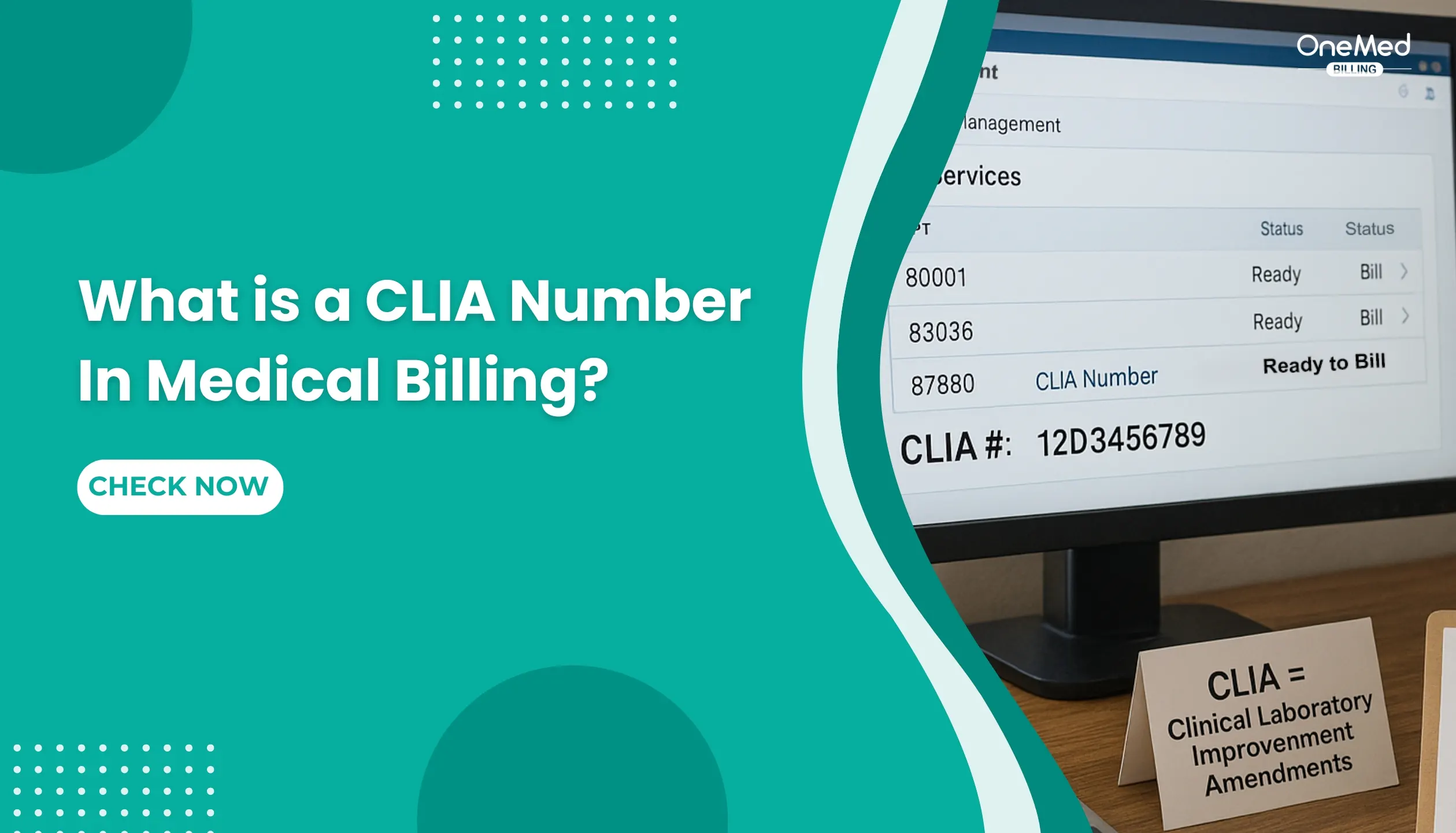
A CLIA number is a unique identifier assigned to a laboratory under the Clinical Laboratory Improvement Amendments program. In medical billing, it is used to identify the testing facility and confirm that the laboratory is authorized to perform the billed test.
This guide explains when a CLIA number is required, where it is reported on a claim, and how to avoid CLIA-related billing errors.
What Is a CLIA Number?
A CLIA number is a unique 10-character identification number assigned to a laboratory testing location. It connects that location to its CLIA certificate and shows what level of testing the site is approved to perform.
In medical billing, payers use the CLIA number to verify that the test was performed at an authorized location with an active certificate. Each testing site generally needs its own CLIA number.
Why Is a CLIA Number Required?
A CLIA number shows that the testing location is approved to perform the laboratory service being billed. Payers use it to confirm that the certificate was active on the date of service and covered the level of testing performed.
If the CLIA number is missing, expired, entered incorrectly, or does not match the testing site, the claim may be rejected or denied. Using the correct CLIA number helps payers verify the service and process the claim without unnecessary delays.
When Is a CLIA Number Needed on a Claim?
A CLIA number is required when a healthcare provider or laboratory bills for testing performed on human specimens, such as blood, urine, tissue, or other patient samples.
It is commonly needed for:
- Laboratory tests billed to Medicare
- Tests performed in a physician’s office
- CLIA-waived tests
- Provider-performed microscopy procedures
- Moderate- and high-complexity laboratory tests
- Tests sent to or performed by an outside laboratory
The number reported on the claim should belong to the location that actually performed the test. The laboratory must also hold the correct certificate type for the service being billed.
For some CLIA-waived tests, the claim may also require modifier QW along with the laboratory’s CLIA number. Payer requirements can vary, so the billing team should confirm the latest rules before submission.
Where Is the CLIA Number Entered on the Claim?
For professional claims submitted on the CMS-1500 form, the CLIA number is generally entered in Box 23. For electronic 837P claims, it is reported in the claim-level REF segment using qualifier X4.
The CLIA number should match the location that performed the test. Because requirements may vary by payer and claim type, billing teams should confirm the correct placement before submission.
How to Verify a CLIA Number?
Use the official CMS CLIA Laboratory Lookup to confirm whether a testing location has a valid CLIA record. Search using the laboratory’s CLIA number, name, location, or other available details.
Check that the result matches:
- The laboratory or facility name
- The physical testing address
- The certificate type
- The current certificate status
- The effective and expiration dates
The CLIA number should match the exact location that performed the test, not only the organization’s main office. If the record is inactive, expired, or linked to a different location, verify the information with the laboratory before submitting the claim.
CLIA Number vs NPI
A CLIA number and an NPI serve different purposes in medical billing.
| CLIA number | NPI |
|---|---|
| Identifies the laboratory where testing is performed | Identifies a healthcare provider or organization |
| Confirms the laboratory’s CLIA certification status | Identifies the provider in standard healthcare transactions |
| Used mainly for laboratory testing and related claims | Used across claims, referrals, prescriptions, and other transactions |
| Usually linked to a specific laboratory location | May identify an individual provider or healthcare organization |
| Contains 10 alphanumeric characters | Contains 10 numeric digits |
A laboratory claim may require both identifiers. The NPI identifies the provider or organization submitting or performing the service, while the CLIA number identifies the certified laboratory location where the test was performed. One cannot be used in place of the other.
Keep CLIA Details From Holding Up Payment
CLIA-related denials are often preventable. The key is to confirm that the number is active, tied to the correct testing location, and valid for the service being billed before the claim is submitted.
For practices that regularly bill laboratory services, our clinical laboratory billing team can review claim setup, identify recurring CLIA errors, and help correct the billing process before those issues continue across more claims.
Call (315) 366-8242 or contact us to discuss your laboratory billing needs.
Frequently Asked Questions
Find quick answers to common questions about this topic, explained simply and clearly.
What is a CLIA number in medical billing?
A CLIA number is a unique identifier assigned to a laboratory. It confirms that the testing location is certified to perform laboratory tests on human specimens.
Can a claim be denied for an incorrect CLIA number?
Yes. A missing, invalid, expired, or location-mismatched CLIA number can cause a laboratory claim to be rejected or denied.
How long is a CLIA certificate valid?
CLIA certificates are generally renewed every two years while the facility continues performing laboratory testing.
Where does the CLIA number go on a CMS-1500 claim?
The CLIA number is generally reported in Item 23 of the paper CMS-1500 form. Electronic claims use the applicable CLIA reference fields in the 837P transaction.
Who needs a CLIA number?
Any facility that performs testing on human specimens for diagnosis, prevention, treatment, or health assessment generally needs an appropriate CLIA certificate.