
15
RCM functions
30+
Specialties served
75+
EMR / PM platforms
250+
Providers supported
Revenue cycle management is everything between the appointment and the deposit.
A billing company signs a twelve-provider group and has six weeks to find coders who know the specialty, an AR caller who can hold a payer line, and a supervisor to check the work. Recruit too slowly and service slips in month one. Recruit ahead of the win and payroll eats the margin before the revenue arrives.
That timing problem is what caps most billing companies. Not demand, not sales — the gap between signing an account and being able to serve it properly. Growth stalls at the size the existing team can absorb.
White-label delivery removes the gap. You sell without checking headcount first, because the team is already trained, already covered, and already sitting in the systems your clients use.

Where the money actually goes missing.
Six stages, and the specific failure each one produces. Read down the middle column — if you recognise two or more, that's where an assessment should start.
Scheduling &
registration
Wrong plan captured, subscriber mismatch, stale demographics. The claim is already wrong before the patient is seen.
Verified intake. Structured demographic and insurance capture with a second check against the payer record.
Eligibility &
authorisation
Coverage confirmed as active but the specific service isn't covered, or authorisation is missing and nobody notices until the denial.
Benefit-level verification. Service-specific benefits, visit limits and authorisation status confirmed before the appointment.
Documentation
& coding
Under-coding that never gets rejected, unsupported specificity that invites audit, missed modifiers on legitimate work.
Specialty-assigned coders. CPT, ICD-10 and HCPCS with documented QA sampling and query loops back to the provider.
Charge capture
& submission
Services rendered but never billed. Claims held in a scrubber queue nobody monitors. Timely filing quietly expiring.
Reconciled charges. Encounters matched to charges, payer-specific edits applied, filing deadlines tracked as a queue.
Denials &
rejections
Denials worked one at a time with no root-cause tracking, so the same error is re-created upstream every week.
Categorised rework. Root cause logged, appeal filed within payer windows, and the cause fed back to the originating stage.
AR follow-up &
patient balances
Aged buckets worked newest-first because it feels productive. Small balances written off in bulk. Patient responsibility never pursued.
Prioritised by recoverability. Worked by payer and value rather than by age alone, with a defined patient balance sequence.
Denials are the visible loss. Underpayments, silent write-offs and claims never filed are usually larger — and they don't appear in a denial report at all.
Fifteen services across the cycle
Take the whole cycle, or the one stage that's costing you most. Each links to a detailed page.
Three ways practices work with us
Most organisations don't need full outsourcing on day one. We'll tell you which of these fits rather than defaulting to the largest.
| Model | What we take on | Fits you when | What stays with you |
|---|---|---|---|
| Full-cycle outsourcing | Every stage from eligibility to final resolution, with a named account owner. | Billing is consuming clinical attention, or turnover keeps resetting your team. | Clinical documentation and final approval on write-off policy. |
| Single-stage support | One function — commonly coding, AR follow-up or credentialing. | The rest of your cycle works and one stage is the bottleneck. | All other stages, unchanged. |
| Co-sourced / extended team | Dedicated staff working inside your process alongside your team. | You want to keep control and institutional knowledge but lack headcount. | Process ownership, supervision and client-facing communication. |
Changing billing partners without losing a month of cash flow
The fear that keeps practices with an underperforming vendor is the switch itself. This is how we handle it.
Assessment and baseline
We review current AR, denial patterns and system configuration, and record a baseline so improvement can be measured honestly rather than claimed.
Access and documentation
BAA executed, user accounts provisioned under your control, and your existing workflow documented as it actually runs.
Parallel run
We work live volume alongside your current process with output reviewed, so problems surface before anything depends on us.
Cutover by stage
Functions transfer in sequence rather than all at once, with the legacy AR backlog worked in parallel so nothing ages while attention moves.
Steady state and reporting
Agreed SLAs, a named account owner, and reporting against the week-one baseline on a fixed cadence.
Inside your systems, alongside your team
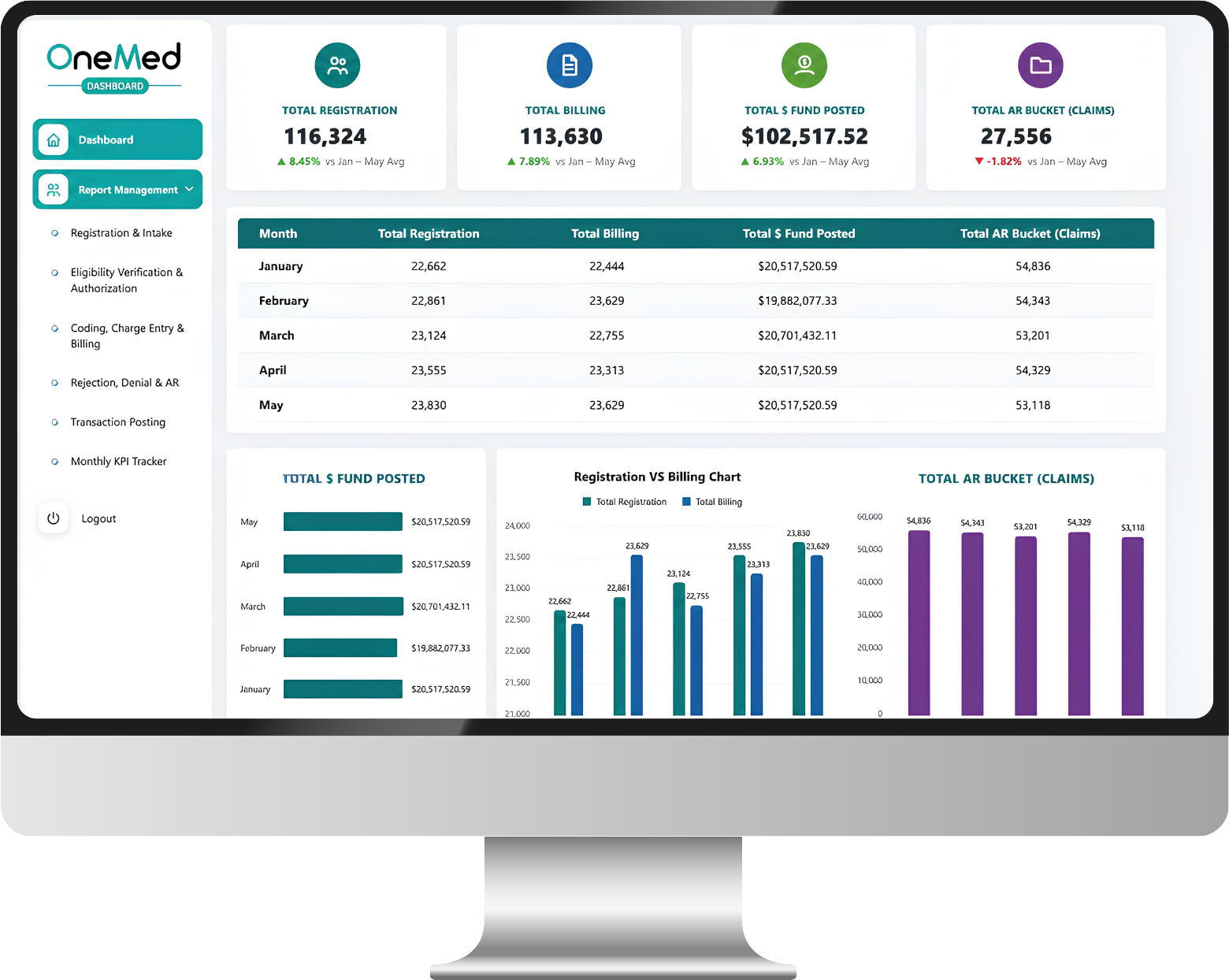
We operate as an extension of your existing team, using the systems, workflows and controls you already have in place.
- No migration. We work in the PM and EHR you already use, under accounts you control and can revoke.
- A named owner, not a queue. You get specific people who learn your payers, not a rotating support pool.
- Specialty context. Documentation patterns and payer scrutiny differ by specialty; coders are assigned accordingly.
- Denials fed back upstream. Root causes are returned to the front end so the same denial stops recurring.
- Reporting you can act on. Agreed metrics on a fixed cadence, with the uncomfortable numbers included.
Publish only if real: Name any formal certification you hold, such as SOC 2 or ISO 27001, with its date and scope. Remove any badge you cannot evidence on request.
Who we serve
The same cycle, calibrated to the scale and complexity of the organisation running it.
Independent practices
Lean teams where one departure resets the billing knowledge entirely.
Multi-site groups
Consistent standards applied across locations that currently each do it their own way.
Hospitals & health systems
High-volume, multi-department cycles where losses are hard to trace to a stage.
Specialty providers
Authorisation-heavy, documentation-sensitive workflows that need specialty context.
Billing changes shape by specialty
Documentation patterns differ and payer scrutiny shifts. Find yours for the detail that applies.
Find out which stage is costing you.
We review a sample of your recent claims and AR and come back with the specific stages where revenue is being lost — including the ones you can fix internally without hiring us.
- A BAA is executed before any data is shared.
- Findings by stage, with the largest loss named first.
- Written recommendations you keep either way.
- No obligation and no automatic follow-up sequence.
Request your free assessment
We'll respond within one business day.
Straight answers.
What exactly is included in revenue cycle management?
Everything between the appointment being booked and the balance being fully resolved — eligibility and authorisation, coding, charge capture, claim submission, denial and appeal work, payment posting, AR follow-up, patient balances and credentialing. You can take all of it or any single stage.
Do we have to switch systems?
No. We work inside your existing PM and EHR under user accounts you create, which means no migration, no retraining for your staff, and no data sitting in a platform you don't control.
How is this priced?
It depends on the model and volume, so we quote after the assessment rather than publishing a rate that wouldn't apply to you. What we will commit to up front is that the basis is fixed in writing before you sign — no variable fees appearing later.
Will we lose visibility into our own revenue?
You shouldn't, and that's a fair concern with any outsourcing. You keep full system access, reporting comes on an agreed cadence against a baseline recorded in week one, and the reports include the metrics that make us look worse as well as better.
What happens to our existing aged AR?
It's worked in parallel during transition rather than abandoned. Old AR is where most switching losses actually occur — a vendor focused on new claims lets the backlog age past recovery, so we scope it explicitly at the start.
How long before we see a difference?
Front-end changes such as eligibility and coding show up within one or two claim cycles. AR recovery and denial-rate improvement take longer because they depend on payer response times. Anyone promising a specific percentage in a specific month before seeing your data is guessing.
Can we start with just one part of the cycle?
Yes, and often that's the better decision. If your only real problem is aged AR or credentialing, taking the whole cycle would be an expensive way to fix a narrow issue.
Who owns the data if we leave?
You do. Notice period, handover scope, documentation return and data deletion are written into the agreement at signing rather than negotiated at the point you want to exit.