
Home Specialities Behavioral Health

Solo to group
right-sized billing
Therapy CPT depth
coded right, every session
Telehealth-native
modifiers & POS handled
Clean claims
fewer denials, faster pay
In behavioral health, the revenue losses are small. That is exactly why they go unnoticed.
A surgical practice notices a $6,000 shortfall the day it lands. A therapy practice never notices a $30 one. Losing $30 a session across a full caseload week after week can add up to a clinician’s salary over time. Month-end reports rarely flag the issue because those claims still show as paid.
Behavioral health also has quirks nothing else does: session codes tied to documented time, extra payer scrutiny on 90837, plan session limits, shifting telehealth rules, and credentialing lag that can delay a new clinician's first paid claim by weeks.These losses are small and specific, and they will be missed unless someone is watching for them.
See where yours leaksHow the small stuff adds up
Illustrative examples of common behavioral-health leaks — not a quote or a guarantee. Actual amounts depend on your payers, contracts, and documentation.
Seven places therapy revenue quietly slips.
These are common behavioral health billing risks. They are specific issues that standard reports do not show until a claim is denied, delayed, or underpaid.
Session-length code mismatch
90832 (30 min), 90834 (45), and 90837 (60) each pay differently. When documentation does not support the time billed, or the practice defaults to a single code, you are either leaving revenue behind or inviting an audit. Payers review 90837 claims closely.
Missing add-on codes
Interactive complexity (90785) and crisis (90840) are billable alongside the session, but routinely forgotten in the moment. Every un-billed add-on is revenue simply left uncaptured.
Intake coding (90791 vs 90792)
The diagnostic evaluation is often mis-coded or under-documented. 90792 (with medical services) pays more when a prescriber is involved, but only if the documentation supports it.
Telehealth modifier & POS mismatch
Modifier 95 and the correct place of service code, such as 10 for home or 02 for other telehealth locations, must match each payer’s current policy. If they do not, the claim will deny or pay at a reduced rate.
Session-limit & authorization denials
Many plans cap sessions or require authorization. When the auth doesn't match the sessions actually delivered, or a cap is hit unnoticed, the claim denies after the work is already done.
Start/stop time documentation
Time-based codes require documented session length. Without start and stop times, a 90837 can't be defended and gets downcoded on review.
Credentialing lag
A new clinician's claims can't be paid until they're credentialed with each payer. Every week of lag is a week of unbillable — or later clawed-back — sessions.
Every service you offer has its own soft spot.
The leak looks a little different depending on what you're billing.
Diagnostic evaluations
Intake coding (90791 / 90792) and documentation that supports the level billed.
Individual therapy
Session-length accuracy (90832 / 90834 / 90837) and holding up to 90837 scrutiny.
Family & couples
Billing 90847 when the patient is present versus 90846 when the patient is not present requires care because many payers cover these services differently.
Group & specialized
90853 group therapy, plus trauma and EMDR documentation that supports the claim.
Telehealth
Modifiers, place of service, and payer-by-payer telehealth parity rules.
Patient responsibility
Copays, coinsurance, and patient balances collected before they quietly age.
Billing infrastructure that grows with your practice.
Whether you are a solo clinician or a multi-site group, we manage eligibility, coding, claims, denials, and credentialing. You get clear visibility into performance instead of a month-end report that is too late to act on.
As you add clinicians, the billing scales with you. You do not get enterprise machinery you do not need. You get the right support for the size your practice is right now.
- Eligibility & benefits verified before the first session
- Correct session and add-on coding, every time
- Authorization & session-limit tracking, so nothing lapses
- Telehealth modifiers & place of service kept current
- Credentialing support, so new clinicians get paid sooner
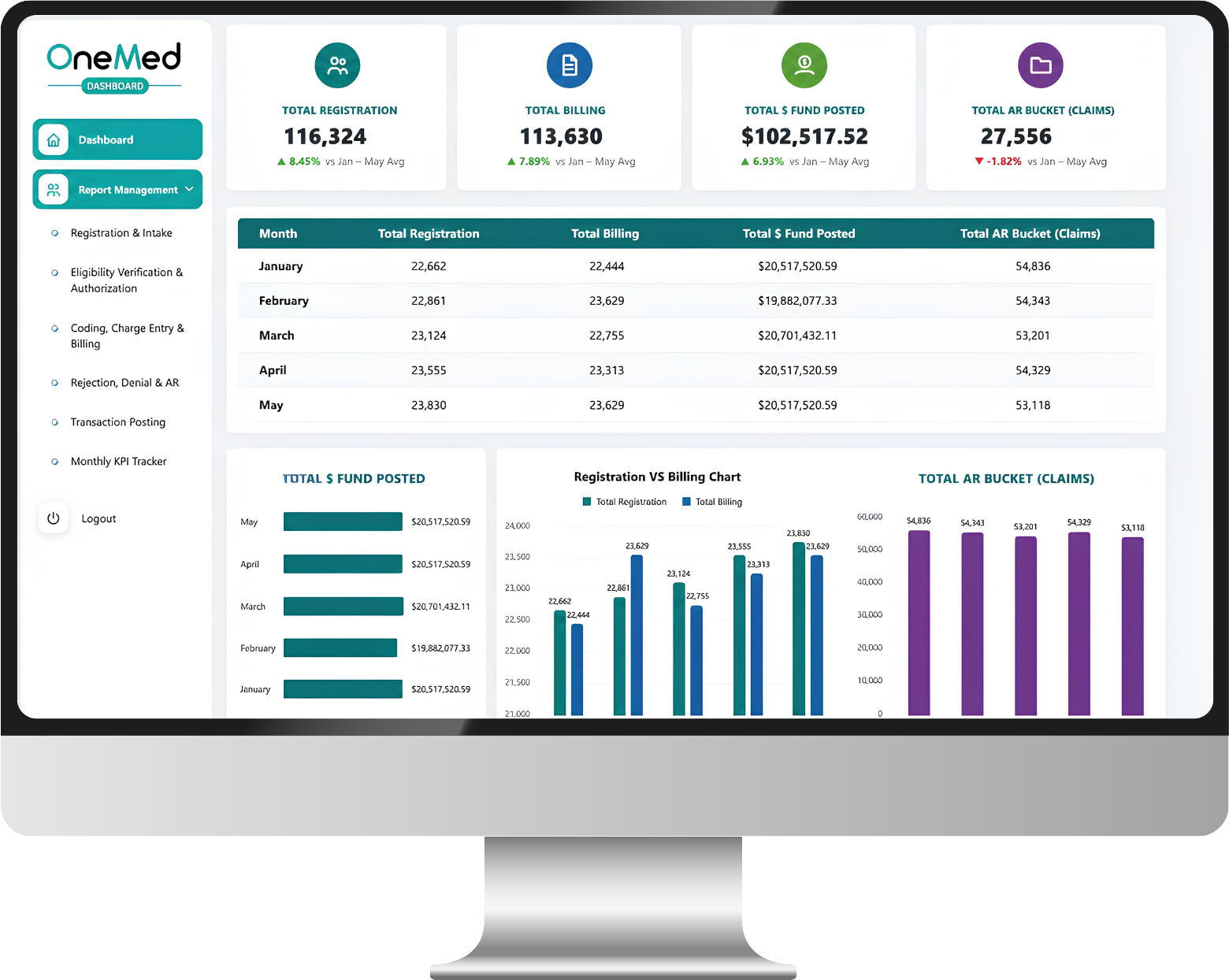
- Our simple dashboard shows claims, denials, and AR clearly.
Who We Serve?
Right-sized billing for behavioral & mental health practices.
Solo & independent therapists
Single-clinician practices that need billing handled so they can focus on clients, not claims.
Group counseling practices
Growing practices adding clinicians who need coding, denials, and credentialing kept in order.
Multi-clinician / multi-site groups
Larger groups that need consistent coding and clean claims across every clinician and location.
Teletherapy & virtual practices
Virtual-first practices navigating telehealth modifiers, place of service, and payer rules.
Your clients' information, protected
Behavioral health carries some of the most sensitive records in medicine. Everything is handled in a controlled, auditable, HIPAA-compliant environment, with a BAA in place before any data is shared.
Tell us about your clinicians and session types, and we will tailor the review.
No spreadsheets to send, no big commitment. In a short conversation about how your practice bills, we will show you where therapy revenue is most likely slipping and what it takes to fix the problem.
- A look at your session coding, add-ons, and telehealth setup
- Where authorizations and session limits may be costing you
- The support is sized to fit your practice, whether you are solo, in a group, or growing.
- HIPAA-compliant, with a BAA before anything is shared
Request received.
Thank you. A member of our team will review your information and be in touch within one business day. We look forward to showing you what your practice should be collecting.
Common questions.
Do you work with solo therapists, or just groups?
We support both. From a single clinician to a multi-site group, the billing service scales as you grow, keeping the support matched to where your practice is today.
Which session and add-on codes do you handle?
Individual therapy (90832/90834/90837), intakes (90791/90792), family and couples (90846/90847), group (90853), and add-ons like interactive complexity (90785) and crisis (90840).
Can you handle telehealth billing?
Yes. We keep Modifier 95, place of service codes, and specific payer telehealth rules current so claims are not denied or underpaid.
Do you help with credentialing?
Yes. We support payer credentialing so new clinicians start getting paid sooner, and we track re-credentialing so it doesn't lapse.
How do you handle authorizations and session limits?
We track each client's authorization and session count against what's actually delivered, so claims don't deny after the work is already done.
Do we have to switch our EHR?
No. We work with your existing system and adapt to how your practice already runs.
Get paid fully for the work you already do
In a short conversation about how your practice bills, we will show you where therapy revenue may be quietly slipping away.