

GV vs GW Modifier: When to Use Each in Hospice Billing
- Updated Date Sep 4, 2026
- Medical Coding
- Follow
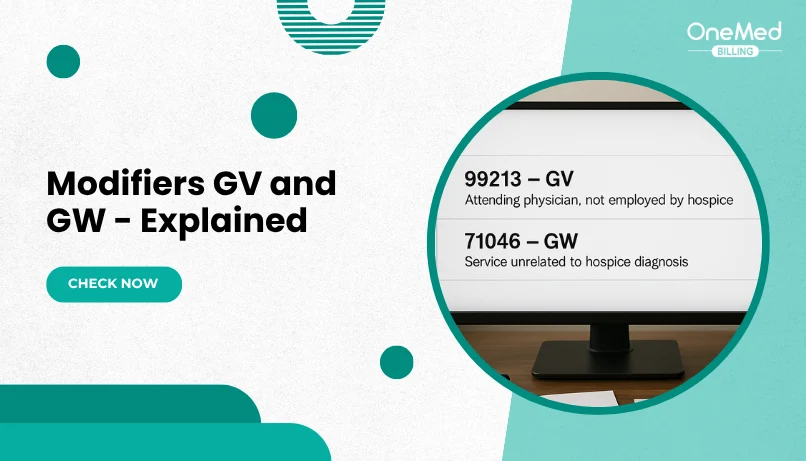
GV and GW are both Medicare hospice modifiers, but they answer different questions about a service.
GV is about who provided the care. It's used when the patient's designated attending physician bills for a service, and that physician is not employed or paid under arrangement by the hospice. It tells Medicare the service is being billed separately from the hospice itself.
GW is about what the care was for. It's used when a service is unrelated to the patient's terminal illness or related conditions, meaning it should be paid outside the hospice benefit rather than folded into it.
Mixing the two up sends the claim down the wrong payment path, which usually means a denial or a delay while it gets corrected. This guide covers when each modifier applies, when they don't, and how to report them correctly on both professional and institutional claims.
GV vs GW Modifier: What’s the Difference?
GV and GW are both used in hospice billing, but they apply to different situations.
- GV is tied to the patient’s designated attending physician when that physician is not employed or paid under arrangement by the hospice.
- GW is used when the service is unrelated to the patient’s terminal illness or related conditions.
A simple way to decide is to ask:
Is this the designated attending physician, and is the service related to the hospice condition? - If yes, GV may apply.
Is the service unrelated to the terminal illness? - If yes, GW may apply on the professional claim.
| Area | GV Modifier | GW Modifier |
|---|---|---|
| Main purpose | Identifies services by the designated attending physician | Identifies services unrelated to the terminal illness |
| Main focus | Provider relationship to the hospice patient | Whether the service is related or unrelated |
| Professional claim | Used when GV requirements are met | Used for unrelated services |
| Provider status | Attending physician is not employed or paid under arrangement by the hospice | Provider employment status is not the main issue |
| Simple example | Attending physician provides applicable related care | Patient receives treatment for an unrelated injury |
For unrelated facility claims, the reporting is different. Condition Code 07 may be used on the UB-04/837I instead of GW.
What Is a GV Modifier?
The GV modifier is used when a hospice patient’s designated attending physician provides a professional service and that physician is not employed by or paid under arrangement by the hospice.
It tells Medicare that the service is being billed separately by the patient’s attending physician rather than by the hospice itself.
For example, if the patient’s designated attending physician provides applicable care during the hospice election period and meets the GV requirements, the professional claim may be reported with the GV modifier.
Keep the claim-placement details, Q5/Q6 rules, and facility-claim instructions in separate sections so this definition stays clear and easy to understand.
What Is the GW Modifier?
The GW modifier is used when a service provided to a hospice patient is unrelated to the patient’s terminal illness or related conditions.
It tells Medicare that the service should be considered separately from the hospice benefit because it addresses a different medical problem.
Example: If a patient is receiving hospice care for terminal cancer but is treated for an unrelated ankle injury, the professional claim may use the GW modifier to show that the service is unrelated to the hospice condition.
When Should You Use GV vs GW?
The choice between GV and GW depends on who provided the service and whether the service is related to the patient’s terminal illness.
Use GV when:
- The patient has elected hospice
- The provider is the patient’s designated attending physician
- The physician is not employed by or paid under arrangement by the hospice
- The professional service is being billed separately under the applicable hospice rules
Use GW when:
- The patient is currently receiving hospice care
- The service is unrelated to the terminal illness or related conditions
- The service is appropriately billed outside the hospice benefit
A simple rule is: GV is mainly about the attending physician relationship, while GW is mainly about whether the service is unrelated to the hospice condition.
Can GV and GW Be Used Together?
GV and GW generally should not be reported together on the same service line because they describe different billing circumstances. GV identifies the designated attending physician relationship, while GW indicates that the service is unrelated to the patient’s terminal illness or related conditions.
The modifier reported should match the circumstances of that specific service.
When Should You Not Use GV or GW?
The modifier should match the provider’s role and whether the service is related to the patient’s terminal illness.
Do not use GV when:
- The provider is not the designated attending physician
- The physician is employed by or paid under arrangement by the hospice
- The service does not meet the requirements for separate billing with GV
Do not use GW when:
- The service is related to the terminal illness or related conditions
- The documentation does not support the service as unrelated to hospice care
For institutional claims, different reporting requirements may apply. Certain unrelated services may require Condition Code 07 instead of GW.
Where Do You Report GV and GW on a Claim?
On professional claims, GV or GW is reported with the applicable CPT/HCPCS service line on the CMS-1500 or 837P claim.
For institutional claims, the reporting is different. GW is not used in the same way on a UB-04/837I. For certain services unrelated to the hospice patient’s terminal illness, Condition Code 07 may be used instead.
This is a natural place for that internal link because the reader may reasonably want to understand what Condition Code 07 means and how condition codes work.
What About Q5 or Q6 With GV?
If another physician provides services on behalf of the patient’s designated attending physician, Q5 or Q6 may be reported with GV when the applicable Medicare requirements are met.
Q5 is used for certain reciprocal billing arrangements, while Q6 is used for certain fee-for-time compensation arrangements. In those cases, the coverage modifier is typically reported along with GV to show both the covering arrangement and the attending physician relationship.
What Documentation Supports GV or GW?
The documentation should clearly support who provided the service and whether the service was related or unrelated to the hospice patient’s terminal illness.
Keep the following in the record:
- Hospice election or current hospice status
- Designated attending physician information when GV is used
- Documentation showing whether the service is related or unrelated to the terminal illness
- Diagnosis and clinical notes supporting the service provided
- Clear support for why the service is unrelated when GW is used
The claim and medical record should tell the same story. If the documentation does not support the modifier, the billing team should review the claim before submission.
When a Patient Moves from Home Health to Hospice
Some patients receiving home health services later elect hospice for a terminal diagnosis. When that happens, the home health episode covering that condition generally has to stop, since Medicare doesn't pay two benefits for the same condition at the same time. Care for unrelated conditions can sometimes continue, which is part of why GW exists in the first place.
This transition is where documentation gaps tend to show up. If the hospice election date and the home health discharge date don't line up, claims on either side can get denied or flagged later. If your agency runs both service lines, this handoff is exactly where the right support for home health billing makes the difference between a clean claim and a denial.
Common GV and GW Billing Mistakes
GV and GW errors usually happen when the modifier does not match the provider’s role, the hospice status, or the reason for the service.
Common mistakes include:
- Using GV for a physician who is not the designated attending physician
- Using GW for care that is related to the terminal illness or related conditions
- Failing to document why a service is unrelated when GW is used
- Using professional-claim modifiers incorrectly on institutional claims
- Reporting GV or GW on the wrong service line
Before submitting the claim, confirm the hospice relationship, the reason for the service, and the correct claim type so the modifier matches the actual billing situation.
Conclusion
GV and GW serve different purposes in hospice billing. GV is tied to services provided by the patient’s designated attending physician when Medicare requirements are met, while GW identifies services that are unrelated to the terminal illness or related conditions.
Before submitting the claim, confirm the provider’s relationship to the hospice, whether the service is related or unrelated, and whether the modifier is being reported on the correct claim type and service line. If your team is regularly dealing with hospice modifier questions, documentation gaps, or repeat coding corrections, getting support from a team experienced in medical coding services can be a practical way to review the workflow and catch issues before they turn into denials or rework.
Frequently Asked Questions
Find quick answers to common questions about this topic, explained simply and clearly.
What is the GV modifier for?
GV tells the payor the billing doctor is the hospice patient’s attending physician, not employed by the hospice or paid under arrangement, and the service is related to the terminal illness. Add GV on each related service line in Box 24D on the C
What does the GV modifier mean?
GV identifies related care by the named attending during a hospice episode when the attending is not employed by the hospice. Place GV on the line in Box 24D so the claim matches the note.
What modifier to use when a patient is in hospice?
Use GV when the attending bills for care related to the terminal illness and is not employed by the hospice. Use GW when the service is not related to the terminal illness. On facility claims for unrelated care, use Condition Code 07 instead of GW.
Does the GW modifier affect payment?
Yes. GW tells the payor the line is unrelated to the hospice terminal illness, so it is processed outside the hospice bundle if coverage rules are met. Missing GW on unrelated care can trigger a denial or recoupment.