

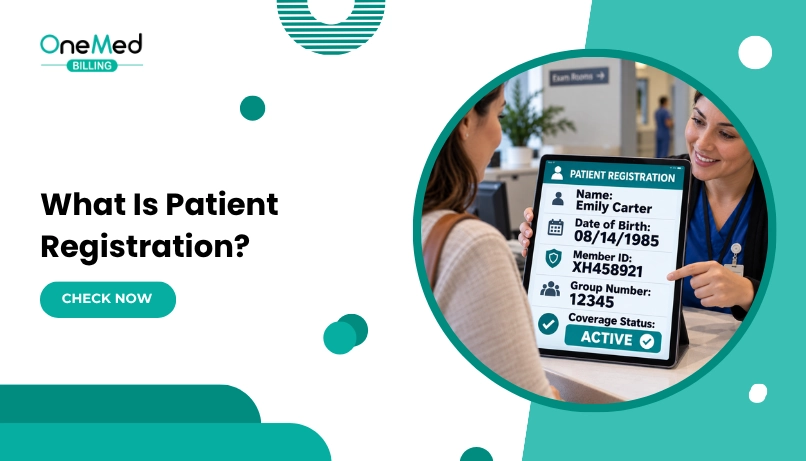
What is Patient Registration in Medical Billing?
- Updated Date Sep 16, 2026
- Patient Registration
- Follow
Patient registration is the process of collecting a patient's demographic, insurance, and consent information before care is delivered. It creates the record that everything downstream depends on: the claim, the eligibility check, the authorization request, and the patient balance.
It is also where a large share of denials begin. A misspelled name, an expired policy number, or a missed authorization requirement does not surface at the front desk. It surfaces weeks later as a rejected claim, and by then it costs staff time to fix rather than seconds to prevent.
What Patient Registration Covers
Registration happens at scheduling or check-in and produces three things.
The first is a patient record the clinical team works from, holding demographics, contact details, medical history, and emergency contacts. The second is an insurance profile the billing team bills against, covering carrier, policy and group numbers, subscriber details, and any secondary coverage. The third is signed consent that gives the practice legal permission to treat the patient, share information under HIPAA, and bill the payer directly.
Those three outputs are why registration sits in the revenue cycle rather than in administration. The clinical record affects care quality. The insurance profile determines whether the claim can be submitted at all. The consent forms decide whether the practice can bill the payer or has to collect from the patient.
Every claim that leaves the practice carries data collected in this step. Nothing downstream can correct what was wrong at the start without rework.
Important Details to Collect During Registration
During patient registration, several important details are collected to make sure both patient care and billing are handled correctly. Collecting complete and correct information at this stage helps reduce billing errors, avoid claim denials, and improve patient safety.
Here's what should always be collected:
Personal and Demographic Information
This includes the patient's full name, date of birth, gender, address, phone number, and email. It helps create the patient's record and ensures all communication is sent to the right place. Correct demographic details are also needed to match insurance information and avoid payment issues.
Insurance Coverage Details
This includes insurance company name, policy number, group number, and the name of the person who holds the insurance if it is not the patient. Collecting this information helps the billing team submit claims properly and check what services are covered before treatment. Secondary coverage should be recorded here too, since a missed second plan means billing the patient for a balance another payer would have covered.
Referring Provider Information
If the patient was referred by another doctor or specialist, their name, contact details, and referral notes should be recorded. This is especially important for specialist visits, procedures, or lab tests where insurance companies require proof of referral to approve payment.
Emergency Contacts and Guardianship Information
Patients should provide at least one emergency contact, like a family member or close friend, in case something urgent happens during the visit. For children or adults with guardians, legal guardianship details should also be collected to ensure proper consent for care.
Medical History
Some practices collect brief medical history during registration, such as past surgeries, allergies, or current medications. This helps doctors prepare for the visit and can also prevent treatment mistakes. While it may be optional in some clinics, it is often recommended to improve care quality.
Consent Forms and HIPAA Compliance Documentation
Before treatment, patients must sign certain forms. This includes consent to receive care, acknowledgment of privacy policies under HIPAA, and permission to bill insurance. These forms protect both the patient and the practice by ensuring legal and privacy rules are followed. Without assignment of benefits on file, the practice cannot bill the payer directly.
Why Registration Determines Whether Claims Get Paid
Registration data flows into every step that follows. Eligibility verification uses the insurance details collected here. Authorization requests use the diagnosis and payer information. The claim itself carries the demographics.
That means a registration error does not stay a registration error. It becomes a claim error, and claim errors are expensive to fix.
The practical effect shows up in three places:
Clean claim rate. Claims with accurate patient and insurance data pass payer edits on the first submission. Claims without it return as rejections, which often go unreported in denial metrics even though they consume the same staff time.
Days in A/R. Every rejected claim that has to be corrected and resubmitted adds days to the payment cycle.
Patient collections. Copays and deductibles identified at registration can be collected at the visit. Balances discovered after the claim processes have to be chased, and collection rates drop sharply once the patient has left the building.
Common Registration Errors That Cause Denials
Most registration errors are small at the point they happen and expensive by the time anyone notices. These six account for the majority of denials that trace back to the front desk.
Name and date of birth mismatches. The record has to match the payer's file exactly. Nicknames, maiden names, and transposed birth dates all fail the same way.
Expired or incorrect insurance. Coverage changes at plan year boundaries, after job changes, and during Medicaid redetermination. An insurance card on file from a previous visit is not current information.
Missed authorization requirements. Some services require approval before care. If registration does not flag it, the service happens and the claim denies with nothing to appeal.
Coverage limits not checked. Visit caps, frequency limits, and non-covered services all deny after the fact if nobody checks first.
Copays and deductibles not collected. Money left uncollected at the desk becomes a patient statement, then a follow-up call, then often a write-off.
Secondary insurance skipped. When a second active plan is not recorded, the balance that plan would have covered lands on the patient instead.
How to Prevent Registration Errors
Move it earlier. Pre-registration through a patient portal gives staff time to resolve problems before the appointment rather than while the patient waits.
Verify insurance electronically, every visit. Real-time eligibility checks catch inactive coverage before care, not after billing. Repeat verification for returning patients rather than assuming last visit's coverage still applies.
Standardise what gets collected. A fixed checklist prevents the gaps that appear when different staff handle registration differently.
Track errors back to their source. Denial reports broken down by cause will show which registration fields fail most often. That tells you what to fix rather than that something is wrong.
For the process itself broken down in order, the patient registration process steps cover it from pre-registration through insurance verification and consent.
Conclusion
Patient registration looks like an administrative task and functions as a financial one. The data collected in those few minutes determines whether the claim passes on first submission, how long payment takes, and how much of the patient balance ever gets collected.
Practices that treat it as the first step in billing rather than the last step in scheduling see fewer denials and cleaner A/R. If front desk volume makes that difficult to sustain, patient registration services can handle the data capture and verification before the visit.
Frequently Asked Questions
Find quick answers to common questions about this topic, explained simply and clearly.
What does patient registration mean?
Patient registration is the process of collecting and entering a patient’s demographic, insurance, and contact information before care is provided. It ensures accurate billing and proper identification of the patient.
Who is responsible for patient registration?
Front desk staff or registration coordinators are typically responsible. They gather patient details, verify insurance, and update records to support billing and clinical documentation.
What is a function of the patient registration form?
The registration form captures essential information such as name, date of birth, insurance details, and consent. It helps create a complete and accurate patient record.
What is included in the patient registration record?
It includes the patient’s personal details, insurance information, emergency contacts, consent forms, and any required legal or financial disclosures.