

How OASIS Affects Home Health Reimbursement Under PDGM
- Updated Date Sep 17, 2026
- Medical Billing
- Follow
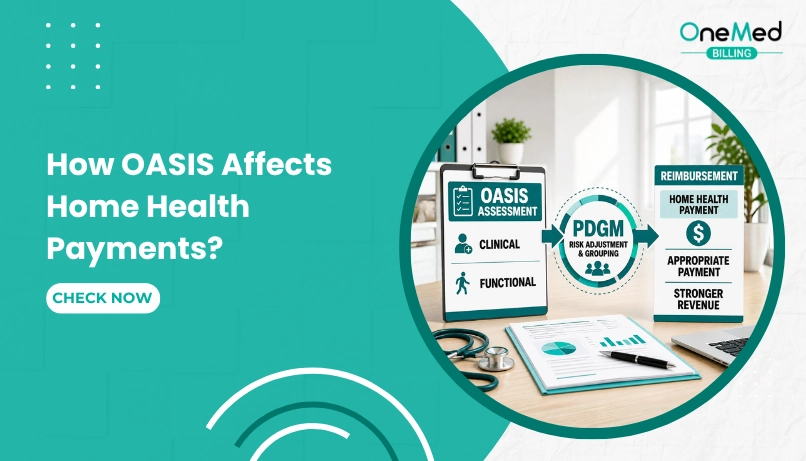
OASIS affects home health reimbursement under PDGM mainly by helping determine the patient's functional impairment level. Seven OASIS functional items and the M1033 Risk for Hospitalization item are converted into points. Those points place the 30-day payment period in a low, medium or high functional impairment group.
OASIS also supports accurate diagnosis selection, the plan of care and documentation of the patient's clinical needs. However, it does not independently determine every part of the PDGM payment. The primary and secondary diagnosis codes reported on the Medicare claim determine the clinical group and comorbidity adjustment. Medicare claims data helps determine admission source and timing.
That distinction matters. A home health agency can complete OASIS on time and still receive the wrong payment if the assessment, coding and claim do not agree.
2026 update: OASIS-E2 replaced OASIS-E1 for assessments with an M0090 completion date on or after April 1, 2026. The core OASIS items used for the PDGM functional impairment calculation remain the M1800 series items and M1033.
What Is OASIS in Home Health?
The Outcome and Assessment Information Set, or OASIS, is a standardized patient assessment used by Medicare-certified home health agencies. It captures information about a patient's clinical condition, functional ability, risk factors, living situation and care needs at defined points during a home health episode.
OASIS serves several purposes. Its data supports:
- Comprehensive patient assessment and care planning
- Home health quality measurement
- Home Health Value-Based Purchasing calculations
- Risk adjustment
- PDGM payment classification for specific items
- Federal reporting through iQIES
OASIS is not simply a billing form. It is a clinical assessment with payment and quality consequences. The responses must describe the patient's actual condition during the applicable assessment period and follow CMS coding guidance.
The current CMS OASIS-E2 manual identifies which items are used for administration, quality, risk adjustment, PDGM payment and Home Health Value-Based Purchasing.
How Does PDGM Determine Home Health Payment?
The Patient-Driven Groupings Model pays Medicare home health agencies for 30-day periods of care. CMS places each period into one of 432 case-mix groups.
According to the CMS PDGM overview, the case-mix group is built from five categories:
| PDGM category | Possible classification | Main data source |
|---|---|---|
| Admission source | Community or institutional | Medicare claims history and patient record |
| Timing | Early or late | Sequence of the 30-day payment period |
| Clinical group | One of 12 clinical groups | Primary diagnosis on the home health claim |
| Functional impairment | Low, medium or high | Selected OASIS responses |
| Comorbidity adjustment | None, low or high | Secondary diagnoses on the home health claim |
The combination produces a Home Health Resource Group and an associated case-mix weight. That weight adjusts the national standardized 30-day payment amount. Wage-index adjustments and other payment rules are then applied.
OASIS directly contributes to one of these five categories: functional impairment. It also provides important clinical documentation for the diagnoses and care needs reported elsewhere in the record and on the claim.
Which OASIS Items Directly Affect PDGM Reimbursement?
The OASIS-E2 manual marks eight items for PDGM payment use:
| OASIS item | What it measures |
|---|---|
| M1800 | Grooming |
| M1810 | Current ability to dress the upper body |
| M1820 | Current ability to dress the lower body |
| M1830 | Bathing |
| M1840 | Toilet transferring |
| M1850 | Transferring |
| M1860 | Ambulation and locomotion |
| M1033 | Risk for hospitalization |
CMS assigns points to selected responses from these items. The total is evaluated against thresholds for the patient's clinical group. The result is a low, medium or high functional impairment level.
The same OASIS answer does not necessarily produce the same overall payment effect in every case. Functional thresholds and case-mix weights vary by clinical group and payment year. Agencies should use the current CMS grouper and current-year tables instead of relying on an old scoring sheet.
What the functional level means for payment
A higher functional impairment category generally reflects greater expected resource use and carries a different case-mix weight. Moving from low to medium or medium to high can therefore change the expected reimbursement for the 30-day period.
It is not appropriate to score a patient as more dependent to obtain a higher payment. OASIS responses must reflect the patient's actual ability and the CMS item guidance. Unsupported scoring can create overpayment, audit and compliance risk.
Understating a patient's limitations creates a different problem. If the assessment shows more independence than the patient actually has, the PDGM group may not reflect the resources needed to provide care.
How the Seven Functional OASIS Items Change the PDGM Score
The M1800 through M1860 items examine how the patient safely completes common daily activities. The focus is the patient's ability, not simply whether a caregiver is available or usually performs the task.
The OASIS-E2 manual instructs clinicians to consider physical, cognitive, emotional, behavioral, sensory and environmental barriers. Observation or demonstration is preferred where the item guidance calls for it.
M1800: Grooming
M1800 looks at the patient's ability to complete personal hygiene tasks such as washing the face and hands, combing hair, shaving and oral care. Bathing, shampooing hair and toileting hygiene are excluded from this item.
The clinician should evaluate whether the patient can access grooming items, use them safely and complete the activity without another person's help.
M1810 and M1820: Dressing
These items separate upper-body and lower-body dressing. The assessment considers whether the patient can obtain clothing, put it on and remove it safely.
A patient may have different abilities for upper- and lower-body dressing. For example, limited shoulder movement may affect M1810, while balance problems or hip precautions may create greater difficulty with M1820.
M1830: Bathing
Bathing is often one of the most misunderstood items because the response depends on how safely the patient can access and use the bathing location. The clinician must consider transfers, equipment, assistance and whether bathing occurs in a shower, tub, sink or bedside setting.
The answer should describe the patient's ability under the OASIS guidance, not simply the agency's planned bathing intervention.
M1840: Toilet transferring
M1840 evaluates the patient's ability to reach and transfer on and off the toilet or bedside commode. It does not measure toileting hygiene, which is addressed separately in M1845 and is not marked as a direct PDGM functional item.
M1850: Transferring
This item addresses the patient's ability to move between surfaces, such as from a bed to a chair. The correct response depends on the type of assistance, equipment and support required.
M1860: Ambulation and locomotion
M1860 evaluates how the patient moves safely once standing or, when applicable, how the patient uses a wheelchair. The clinician should consider assistive devices, human assistance, endurance, cognition and safety.
An inaccurate assumption about device use can change the response. The presence of a walker in the home does not by itself establish that the patient can use it safely and independently.
How M1033 Risk for Hospitalization Affects Payment
M1033 asks which defined factors place the patient at risk for hospitalization. Examples include a recent history of falls, unintentional weight loss, multiple hospitalizations, decline in mental or behavioral status and difficulty following medical instructions.
The item contributes to the PDGM functional score, even though it is not an activity of daily living item. This is why referring to the payment calculation as based only on seven ADLs is incomplete.
The clinician should assess every M1033 response using the time period and definitions in the current OASIS manual. Checking a risk because it seems clinically plausible is not enough. The patient's record must support the selected response.
Does Section GG Affect the PDGM Functional Score?
Not directly under the current CMS classification.
Section GG measures self-care and mobility. It is important for quality reporting, risk adjustment and Home Health Value-Based Purchasing. However, the OASIS-E2 manual does not mark GG0130 or GG0170 as direct PDGM payment items.
The direct PDGM functional inputs remain:
- M1800
- M1810
- M1820
- M1830
- M1840
- M1850
- M1860
- M1033
This distinction is especially important in 2026 because home health agencies are working with both PDGM and expanded quality programs. A Section GG response may affect quality or value-based payment performance without changing the PDGM functional impairment level for the claim.
Agencies should still investigate inconsistencies between Section GG, the M1800 items and the clinical record. Conflicting answers may signal an assessment or documentation problem, even when the items feed different calculations.
How OASIS Diagnoses Affect PDGM Reimbursement
OASIS contains the patient's primary home health diagnosis in M1021 and other active diagnoses in M1023. These items are essential to the clinical record. They describe the chief reason for home care and the conditions that affect the plan of care or the patient's response to treatment.
However, the PDGM grouper uses the diagnosis codes reported on the home health claim to determine:
- The clinical group
- Whether the period receives no, low or high comorbidity adjustment
The OASIS-E2 manual does not label M1021 and M1023 as direct PDGM payment items. This does not make them unimportant. It means the claim, not the OASIS transmission by itself, supplies the diagnoses to the payment grouper.
The practical requirement is alignment. The referral, face-to-face documentation, OASIS, plan of care, coding worksheet and claim should tell the same clinical story.
Primary diagnosis and clinical grouping
The primary diagnosis on the claim places the 30-day period into one of 12 PDGM clinical groups. These include musculoskeletal rehabilitation, neuro or stroke rehabilitation, wounds, behavioral health, complex nursing interventions and several medication management, teaching and assessment groups.
If the principal diagnosis is not accepted by the grouper, the claim may receive a questionable encounter edit or require correction before payment. If the code is valid but does not accurately represent the main reason for care, the case may be placed in an inappropriate clinical group.
Secondary diagnoses and comorbidity adjustment
Secondary diagnoses on the claim are evaluated against CMS comorbidity subgroups. A qualifying single subgroup can support a low comorbidity adjustment. Certain qualifying combinations of subgroups can support a high adjustment.
Simply listing more diagnoses does not increase payment. The conditions must be current, supported, relevant to the patient's care and coded according to ICD-10-CM rules. Only diagnoses recognized by the current PDGM grouper contribute to the comorbidity adjustment.
Does OASIS Determine Admission Source or Timing?
Not by itself.
PDGM classifies the admission source as community or institutional. Institutional periods generally involve an acute or post-acute stay within the applicable lookback period. Medicare uses claims data when determining this classification.
OASIS items such as M1000 document recent inpatient facility use and help the agency understand the patient's history. However, the payment classification may depend on institutional claims that were not available when the clinician completed the assessment.
Timing is also separate from functional scoring. The first 30-day period in a sequence is early. Later contiguous periods are classified as late under PDGM rules.
An agency should therefore reconcile referral information, OASIS history and Medicare eligibility or claims information. OASIS accuracy alone cannot correct missing or incorrect institutional data.
How a Follow-Up OASIS Can Change a Later 30-Day Payment Period
A Medicare home health certification period generally contains two 30-day payment periods. One assessment may support the functional classification used across those periods, but a later qualifying OASIS assessment can change the case-mix group.
CMS explains that when an Other Follow-Up assessment is completed before a subsequent contiguous 30-day period and changes the functional impairment level, the later claim should be grouped using the updated information. The agency must update the assessment completion date reported on that claim.
This does not mean an agency should complete a follow-up assessment solely to seek a different payment. CMS requires an updated comprehensive assessment when there has been a major improvement or decline that was not anticipated in the original plan of care. Agency policy should define when an Other Follow-Up assessment is required.
The operational risk is failing to connect clinical reassessment with billing. If the clinical team completes an assessment but the billing team uses the earlier assessment date or case-mix information, the second 30-day claim may be grouped incorrectly.
How OASIS Errors Lead to Lost or Incorrect Reimbursement
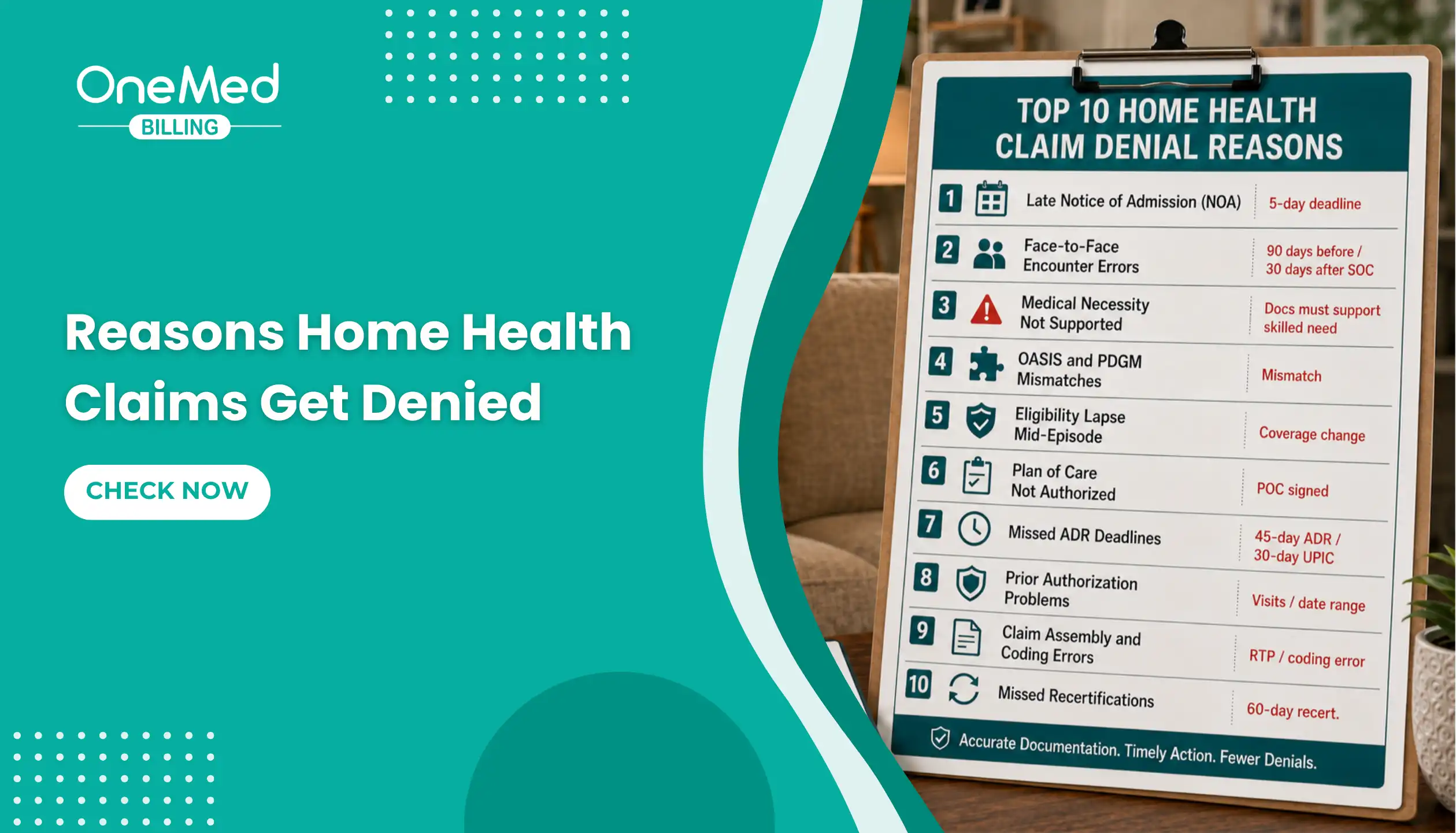
OASIS errors can affect reimbursement when the assessment does not accurately reflect the patient’s functional status, uses outdated scoring logic, or conflicts with coding and claim data. These inconsistencies can also contribute to several common home health billing denial reasons, including unsupported diagnoses, documentation gaps and claim information that does not match the clinical record.
Scoring the care provided instead of the patient's ability
OASIS functional items generally measure what the patient can safely do, not what a caregiver happens to do or what the plan of care expects after treatment.
If a family member dresses the patient out of habit, the clinician still needs to determine what the patient is able to do. The opposite is also true. A patient who attempts a task alone may still require assistance because the performance is unsafe.
Relying only on patient or caregiver statements
Interviews are important, but self-reported ability may not match observed performance. When CMS guidance identifies observation or demonstration as the preferred approach, the clinician should use it whenever possible and document why another source was necessary.
Missing cognitive or safety limitations
Physical strength is only one part of functional ability. Poor judgment, memory loss, impulsivity, pain, fear and environmental barriers can affect whether a patient completes an activity safely.
Ignoring these factors may understate impairment. Assuming they prevent all activity without assessment may overstate it.
Using outdated scoring tools
CMS updates PDGM grouper files, diagnosis assignments, case-mix weights and functional thresholds. A worksheet from an earlier payment year can produce an incorrect expected payment even if the OASIS responses are accurate.
The CMS Home Health PPS Grouper Software page contains the current grouper materials and updates.
Treating OASIS and coding as separate workflows
The clinician may identify conditions during the assessment that are absent from the referral. The coder may find diagnosis specificity that requires clarification. If these teams do not communicate, OASIS, the plan of care and the claim can conflict.
Confusing payment items with quality items
OASIS contains many items that affect quality measures, risk adjustment or Home Health Value-Based Purchasing without directly changing the PDGM case-mix group. Agencies should know which calculation each item supports instead of assuming every OASIS response changes the 30-day payment.
Updating one record but not the others
A corrected OASIS assessment may require corresponding review of the plan of care, coding and claim. Changing one document without checking the full record can create a new inconsistency.
How to Improve OASIS Accuracy Without Creating Compliance Risk
The goal is not to obtain the highest functional score. The goal is to obtain the correct score supported by the patient's condition.
Train clinicians on item-specific guidance
General OASIS training is not enough. Clinicians should understand the response-specific rules for grooming, dressing, bathing, toileting transfers, transfers, ambulation and hospitalization risk.
Training should use real patient scenarios. It should show how equipment, cueing, safety, cognition and the home environment affect the response.
Assess the patient in the actual home environment
Functional ability can look different in a controlled setting. The height of the bed, location of the bathroom, stairs, narrow walkways and availability of equipment may change how safely the patient performs a task.
A structured room-by-room assessment can help the clinician observe the activities measured by OASIS rather than relying on general questions.
Review high-risk assessments before claim submission
Not every chart needs the same level of review. Agencies can prioritize:
- Cases close to a functional threshold
- Assessments with internal inconsistencies
- High or low scores that differ from the narrative
- Patients with several hospitalization risk factors
- Cases where the diagnosis changed after start of care
- Follow-up assessments affecting the second 30-day period
The reviewer should not change a response simply because another answer produces more reimbursement. Any correction must be supported by the assessment, record and CMS guidance.
Reconcile OASIS, coding and the claim
Before final claim submission, confirm that:
- The assessment date is correct.
- The primary diagnosis reflects the main reason for home health care.
- Secondary diagnoses are active and supported.
- OASIS functional responses agree with the narrative and plan of care.
- The expected clinical group and functional level match the grouper output.
- The admission source and timing classification are reasonable.
- Any follow-up assessment affecting the period has been included.
Monitor patterns by clinician and branch
Useful measures include:
- Percentage of periods in low, medium and high functional groups
- Frequency of each M1033 risk response
- Corrections to M1800 through M1860
- OASIS-to-claim diagnosis mismatches
- Questionable encounter edits
- Difference between expected and remitted case-mix payment
- Functional patterns by clinician, team and branch
A sudden shift does not automatically prove inaccurate coding. It identifies where focused review or education may be needed.
What Changed With OASIS-E2 in 2026?
OASIS-E2 became effective April 1, 2026. CMS describes it as a minor revision. Changes include replacing M0069 Gender with A0810 Sex, replacing A1250 Transportation with A1255, removing O0350 COVID-19 Vaccination, adding selected items to the Resumption of Care time point and incorporating OASIS questions and answers into the manual.
The update did not replace the established direct PDGM functional inputs. The OASIS-E2 Appendix B continues to mark M1800, M1810, M1820, M1830, M1840, M1850, M1860 and M1033 for PDGM payment use.
Agencies should verify that their EHR, assessment forms, validation edits, training materials and audit tools are using OASIS-E2 for assessments completed on or after the effective date. CMS publishes the current technical specifications on its Home Health OASIS Data Specifications page.
OASIS, PDGM and LUPA: Are They the Same Payment Issue?
No. They can affect the same claim, but they work differently.
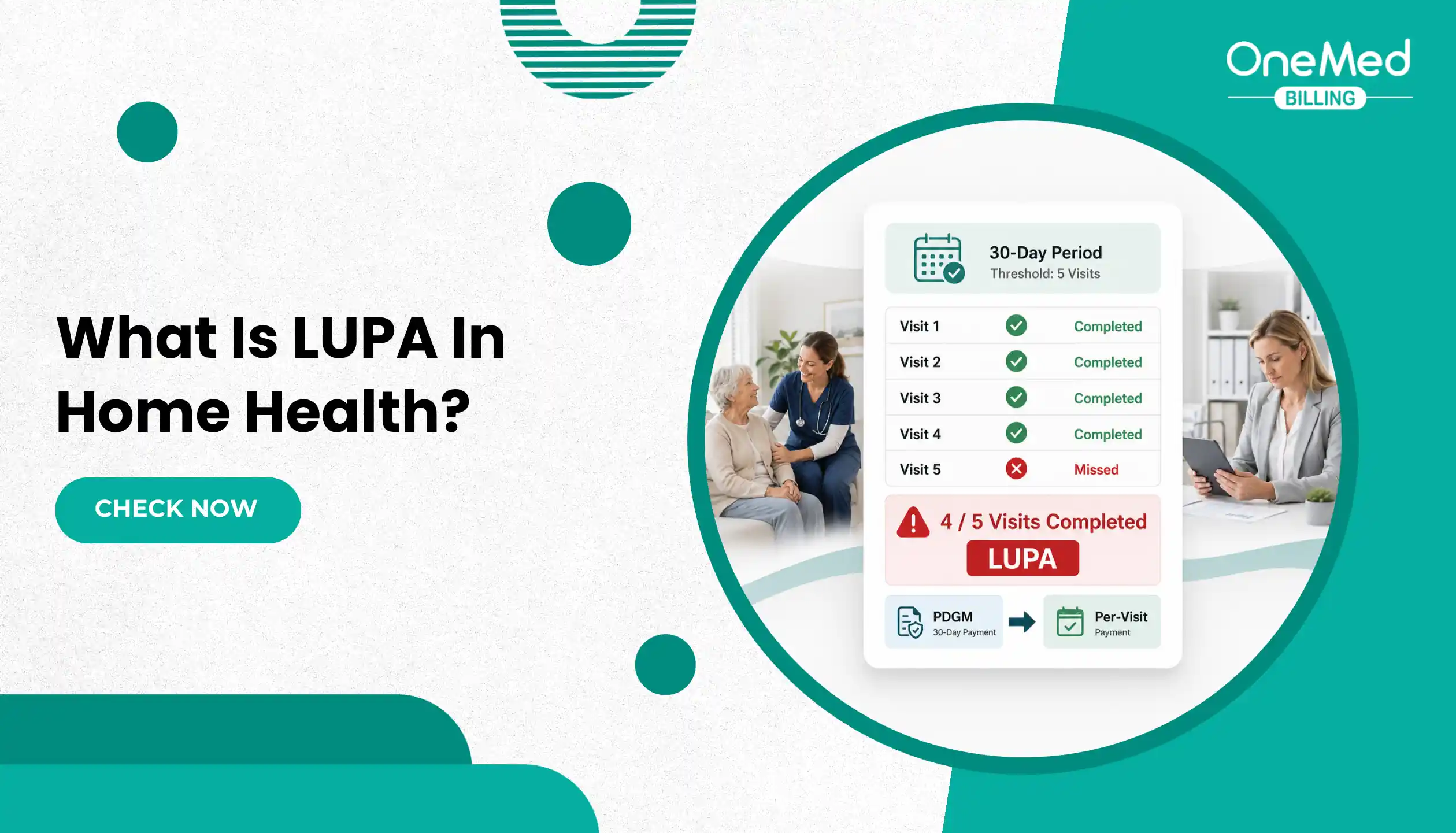
OASIS contributes to the case-mix classification through functional impairment. A Low Utilization Payment Adjustment, or LUPA, occurs when the number of qualifying visits during a 30-day period falls below the threshold assigned to the PDGM group. Understanding how LUPA works in home health can help agencies connect the threshold to visit planning, episode monitoring and payment.
Accurate OASIS and diagnosis coding help identify the correct group and its LUPA threshold. They do not replace visit planning and monitoring. An accurately grouped period can still become a LUPA if the agency delivers fewer visits than the applicable threshold.
This is why OASIS review, coding review and episode management should connect. The clinical picture establishes patient need, the grouper establishes the payment category and operations must ensure that ordered, medically necessary care is delivered and documented.
Conclusion
OASIS affects home health reimbursement under PDGM most directly through the functional impairment calculation. Seven M1800-series functional items and M1033 Risk for Hospitalization help classify each 30-day period as low, medium or high functional impairment.
OASIS also supports the diagnoses and clinical documentation behind the plan of care. However, the Medicare claim supplies the diagnosis codes used for the PDGM clinical group and comorbidity adjustment. Claims history and period sequence help determine admission source and timing.
The strongest process connects assessment, coding, care planning and billing before the claim is submitted. Accurate OASIS documentation protects appropriate reimbursement. It also reduces the risk of underpayment, overpayment, record conflicts and audit findings.
For agencies that struggle with OASIS-to-claim mismatches, recurring grouper errors or unexplained differences between expected and received payment, a focused prebilling review can help identify where the workflow is breaking down before the problem reaches accounts receivable. When the internal team cannot maintain these checks consistently, structured home health billing services can provide additional support across PDGM grouping, claims, LUPA monitoring and payment review.
Frequently Asked Questions
Find quick answers to common questions about this topic, explained simply and clearly.
Does every OASIS item affect PDGM payment?
No. The OASIS-E2 manual specifically marks M1800, M1810, M1820, M1830, M1840, M1850, M1860 and M1033 for PDGM payment use. Other items may affect quality measures, risk adjustment or Home Health Value-Based Purchasing.
Which OASIS items determine functional impairment under PDGM?
Seven functional items, M1800 through M1860, and M1033 Risk for Hospitalization contribute to the PDGM functional score. The score places the 30-day period in a low, medium or high functional impairment level.
Does a higher OASIS functional score always mean higher reimbursement?
Not in a simple or uniform amount. Payment depends on the full PDGM group, current case-mix weight and other claim adjustments. Functional thresholds also vary by clinical group. The correct goal is accurate, supported scoring rather than the highest possible category.
Did OASIS-E2 change the PDGM functional items?
OASIS-E2 took effect April 1, 2026, but the direct PDGM functional inputs remain the seven M1800-series items and M1033.
Can a corrected OASIS change reimbursement?
It can. If a valid correction changes a PDGM payment item before the applicable claim is finalized, the case-mix group may change. Agencies must follow CMS correction rules and maintain documentation supporting the corrected response.