

What Is LUPA in Home Health? Thresholds & Payment Impact
- Updated Date Aug 27, 2026
- Medical Billing
- Follow
LUPA can significantly change how a Medicare home health period is reimbursed. Under PDGM, each 30-day payment period has a specific visit threshold, and if the number of qualifying visits falls below that threshold, the payment shifts from the standard 30-day amount to a per-visit basis.
That makes it important for home health agencies to understand how LUPA thresholds work, how payment is calculated, and why some periods may be reimbursed differently than expected.
What Does LUPA Mean in Home Health?
LUPA stands for Low Utilization Payment Adjustment. It applies when a Medicare home health patient receives fewer visits during a 30-day payment period than the LUPA threshold assigned to that patient’s PDGM case-mix group.
When a period qualifies as a LUPA, Medicare does not pay the agency using the normal case-mix-adjusted 30-day payment. Instead, the agency is generally paid on a per-visit basis for the qualifying home health visits actually provided.
The important point is that there is no single LUPA visit threshold for every patient. The threshold depends on the PDGM payment group assigned to that 30-day period.
A LUPA also does not mean the agency receives no reimbursement. It means the payment method changes from a full 30-day period payment to per-visit reimbursement because utilization fell below the applicable threshold.
How Does the LUPA Threshold Work?
Under PDGM, each 30-day home health payment period is assigned to a case-mix group, and each group has its own LUPA visit threshold.
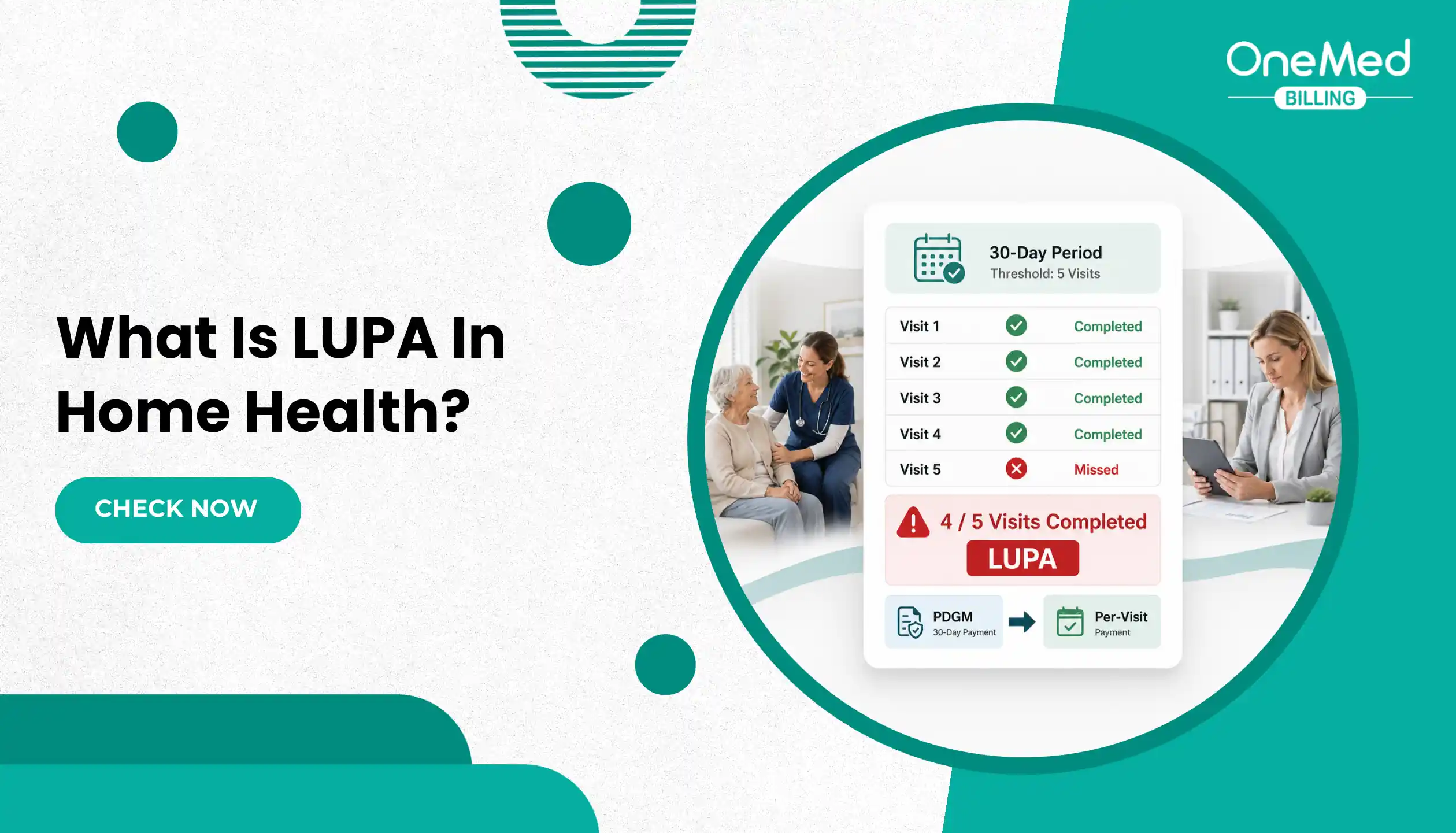
If the number of qualifying visits provided during that 30-day period falls below the assigned threshold, the period is paid as a LUPA on a per-visit basis rather than under the normal 30-day payment methodology.
For example, if a payment group has a LUPA threshold of 5 visits:
- 5 or more visits: The period does not become a LUPA based on visit count.
- 4 or fewer visits: The period falls below the threshold and is paid under LUPA rules.
The threshold is not the same for every patient. It depends on the PDGM group assigned to that specific payment period, so agencies need to check the applicable threshold rather than assume one standard visit number applies to all cases.
Example: If a patient’s PDGM group has a LUPA threshold of 5 visits, the period would not be treated as a LUPA if 5 or more qualifying visits are provided. If only 4 qualifying visits are provided, the period falls below the threshold and is paid under LUPA rules.
How Does LUPA Affect Home Health Reimbursement?
When a 30-day payment period falls below the applicable LUPA threshold, Medicare changes how that period is paid.
Instead of receiving the normal case-mix-adjusted 30-day PDGM payment, the home health agency is generally paid per visit for the qualifying services that were actually provided during the period.
That means reimbursement can look very different from a standard PDGM period. A low-visit period may result in a lower total payment because the agency is no longer being paid under the full 30-day payment methodology.
The actual LUPA payment depends on factors such as:
- The number of qualifying visits completed
- The discipline providing the service, such as skilled nursing or therapy
- The applicable Medicare per-visit payment rate
- Whether the period qualifies for a LUPA add-on payment
It is important not to treat every LUPA as a billing mistake or lost revenue. In some cases, a lower number of visits may simply reflect the patient’s actual clinical needs. The key is making sure the agency understands the threshold, tracks completed visits accurately, and knows when a period is likely to be paid under LUPA rules.
How Is LUPA Payment Calculated?
When a home health period qualifies as a LUPA, Medicare generally pays the agency based on the individual visits provided rather than the normal case-mix-adjusted 30-day payment.
The payment is based on the number of qualifying visits and the applicable per-visit rate for each discipline, such as:
- Skilled nursing
- Physical therapy
- Occupational therapy
- Speech-language pathology
- Medical social services
- Home health aide services
So, if a LUPA period includes several visits from different disciplines, the total payment is generally built from the applicable per-visit amounts for those services.
Some first or only 30-day periods may also qualify for a LUPA add-on payment, which increases payment for certain initial visits to account for the extra assessment and administrative work involved in starting care.
Because per-visit rates and add-on factors can change by year, agencies should use the current CMS home health payment rates when estimating LUPA reimbursement.
LUPA Payment = Sum of Each Qualifying Visit × Applicable Per-Visit Rate
For example:
- 2 skilled nursing visits
- 1 physical therapy visit
- 1 occupational therapy visit
The basic calculation would be:
(2 × SN per-visit rate) + (1 × PT per-visit rate) + (1 × OT per-visit rate)
If the period qualifies for a LUPA add-on, Medicare applies the applicable add-on factor to the eligible first skilled visit. For CY 2026, CMS lists add-on factors such as 1.7200 for skilled nursing, 1.6225 for physical therapy, 1.7238 for occupational therapy, and 1.6696 for speech-language pathology.
So an eligible skilled nursing first visit would conceptually be:
First SN visit payment = SN per-visit rate × 1.7200
The remaining qualifying visits would then generally be paid at their applicable per-visit rates, subject to geographic wage adjustment and other Medicare payment rules.
What Is the LUPA Add-On Payment?
The LUPA add-on payment is an additional Medicare payment that may apply when a LUPA occurs in the first or only 30-day payment period in a sequence of home health care.
The purpose is to recognize that the beginning of care often involves extra assessment, care planning, and administrative work, even when the total number of visits is low enough for the period to qualify as a LUPA.
The add-on is applied to the first eligible skilled visit based on the discipline providing that visit. CMS publishes separate add-on factors for disciplines such as:
- Skilled nursing
- Physical therapy
- Occupational therapy
- Speech-language pathology
Not every LUPA qualifies for this additional payment. The agency must meet the applicable Medicare requirements for the first or only 30-day period, so the current CMS rules and annual payment factors should be checked when calculating reimbursement.
Why Does a Home Health Period Become a LUPA?
A home health period becomes a LUPA when the number of qualifying visits completed during the 30-day payment period falls below the LUPA threshold assigned to that PDGM case-mix group.
This can happen for several reasons:
- The patient needs fewer visits than originally expected
- The patient cancels or refuses scheduled visits
- A hospitalization interrupts the home health plan
- Visits are missed because of scheduling or staffing issues
- The patient’s condition improves and the plan of care is reduced
- The agency does not closely track completed visits against the applicable LUPA threshold
- A planned visit is not completed before the end of the 30-day period
A LUPA should not be viewed as something to avoid by adding unnecessary visits. Visit frequency should still be based on the patient’s clinical needs and plan of care. The practical goal is to understand when a period is approaching the threshold so the agency is not surprised by the reimbursement outcome.
How Can Home Health Agencies Monitor LUPA Risk?
Home health agencies can monitor LUPA risk by comparing the number of completed visits in each 30-day payment period with the LUPA threshold assigned to that PDGM case-mix group.
The most useful things to track are:
- The applicable LUPA threshold for each 30-day period
- Visits that have actually been completed, not just scheduled
- Canceled or refused visits
- Hospitalizations or other interruptions in care
- Periods that are approaching the end of the 30-day window
- Changes in the patient’s plan of care or visit frequency
- Whether clinical and billing teams are working from the same visit data
The goal is not to add visits simply to avoid a LUPA. Visit frequency should still be based on the patient’s clinical needs and plan of care. Monitoring helps the agency understand which periods may be approaching LUPA status so the expected reimbursement does not come as a surprise.
LUPA vs Normal PDGM Payment
The main difference is how Medicare calculates payment for the 30-day period.
| Area | Normal PDGM Payment | LUPA Payment |
|---|---|---|
| Visit threshold | Meets or exceeds the applicable LUPA threshold | Falls below the applicable LUPA threshold |
| Payment basis | Case-mix-adjusted payment for the 30-day period | Per-visit payment |
| Payment amount | Based on the assigned PDGM case-mix group and other applicable adjustments | Based on the number and type of qualifying visits provided |
| Add-on payment | Not applicable as a LUPA add-on | May apply in certain first or only 30-day periods |
| Practical impact | Agency receives the standard PDGM period payment methodology | Reimbursement may be lower because payment shifts to a per-visit basis |
The important point is that a LUPA does not mean the claim is unpaid. It means the period is reimbursed differently because the number of qualifying visits fell below the threshold for that PDGM group.
Conclusion
LUPA applies when the number of qualifying home health visits in a 30-day payment period falls below the threshold assigned to that PDGM case-mix group. When that happens, Medicare shifts from the normal case-mix-adjusted 30-day payment to a per-visit payment methodology.
For home health agencies, the practical focus should be on knowing the correct threshold, tracking completed visits, and understanding how each period is likely to be reimbursed before billing is finalized. If unexpected LUPA periods or underpayments keep occurring, reviewing the workflow with a team experienced in home health billing services can help identify where visit tracking, claim data, or reimbursement monitoring may need closer attention.
Frequently Asked Questions
Find quick answers to common questions about this topic, explained simply and clearly.
How many visits is a LUPA?
There is no single visit number for every case. Under PDGM, each 30-day payment period has its own LUPA threshold, which generally varies by case-mix group.
What is LUPA used for?
LUPA is used by Medicare to adjust payment when a home health patient receives fewer visits than the threshold for that 30-day period.
How can home health agencies avoid unexpected LUPA periods?
Agencies should track completed visits, know the LUPA threshold for each period, monitor cancellations and hospitalizations, and review periods approaching the end of the 30-day window. Visits should still be based on the patient’s clinical needs.
How does LUPA work in home health?
If the number of qualifying visits falls below the applicable LUPA threshold, Medicare pays the agency on a per-visit basis instead of using the normal case-mix-adjusted 30-day payment.