

10 Home Health Denial Reasons and How to Prevent Them
- Updated Date Sep 3, 2026
- Medical Billing
- Follow
Most home health claim denials trace back to paperwork, not to genuinely unnecessary care. According to CMS, insufficient documentation accounted for 51.4% of improper payments in home health during the 2024 reporting period, with medical necessity documentation responsible for another 33.7%. Together, those two categories explain more than 85% of the problem and both are addressed before a claim is ever transmitted.
The scale is significant. CMS put the home health improper payment rate at 6.7% for 2024, a projected $1.1 billion. For an individual agency, industry benchmarks generally place an acceptable denial rate around 3%, with anything above 8% pointing to a systemic issue rather than isolated claim errors.
The specific failures repeat: an NOA submitted on day six instead of day five, a face-to-face note missing an encounter date, an OASIS assessment that doesn't match the diagnosis on the claim. This guide covers the ten most common denial reasons, the rules and timeframes behind each, and the process changes that stop them from recurring.
How Common Are Home Health Denials?
CMS reported a 6.7% improper payment rate for home health in 2024, a projected $1.1 billion. At agency level, industry benchmarks put an acceptable denial rate at around 3%. Above 8%, the problem is systemic, not claim-by-claim.
CMS breaks down what caused those improper payments:
| Cause of Improper Payment | Share |
|---|---|
| Insufficient documentation | 51.4% |
| Medical necessity | 33.7% |
| Other errors | 9.2% |
| Incorrect coding | 3.4% |
| No documentation | 2.3% |
Documentation and medical necessity account for 85.1% combined. Both are decided before the claim is transmitted.
Medicare Advantage is the growing pressure. MA plans set their own authorization and medical-necessity rules, and Experian found MA denial rates exceed 17%, more than double traditional Medicare. A growing MA census can raise your denial rate without anything changing internally.
Four things are driving denials up: PDGM coding scrutiny, where unspecified diagnoses break grouping logic; more aggressive MAC audits targeting F2F gaps and weak medical necessity; authorization layers added by MA and commercial plans; and staffing shortages that delay notes and signatures.
Quick Reference: Home Health Denial Reasons at a Glance
Most home health denials come from a short list of repeating causes. The table below maps each one to the codes you are likely to see on the remittance, what actually triggered it, and what to do to stop it.
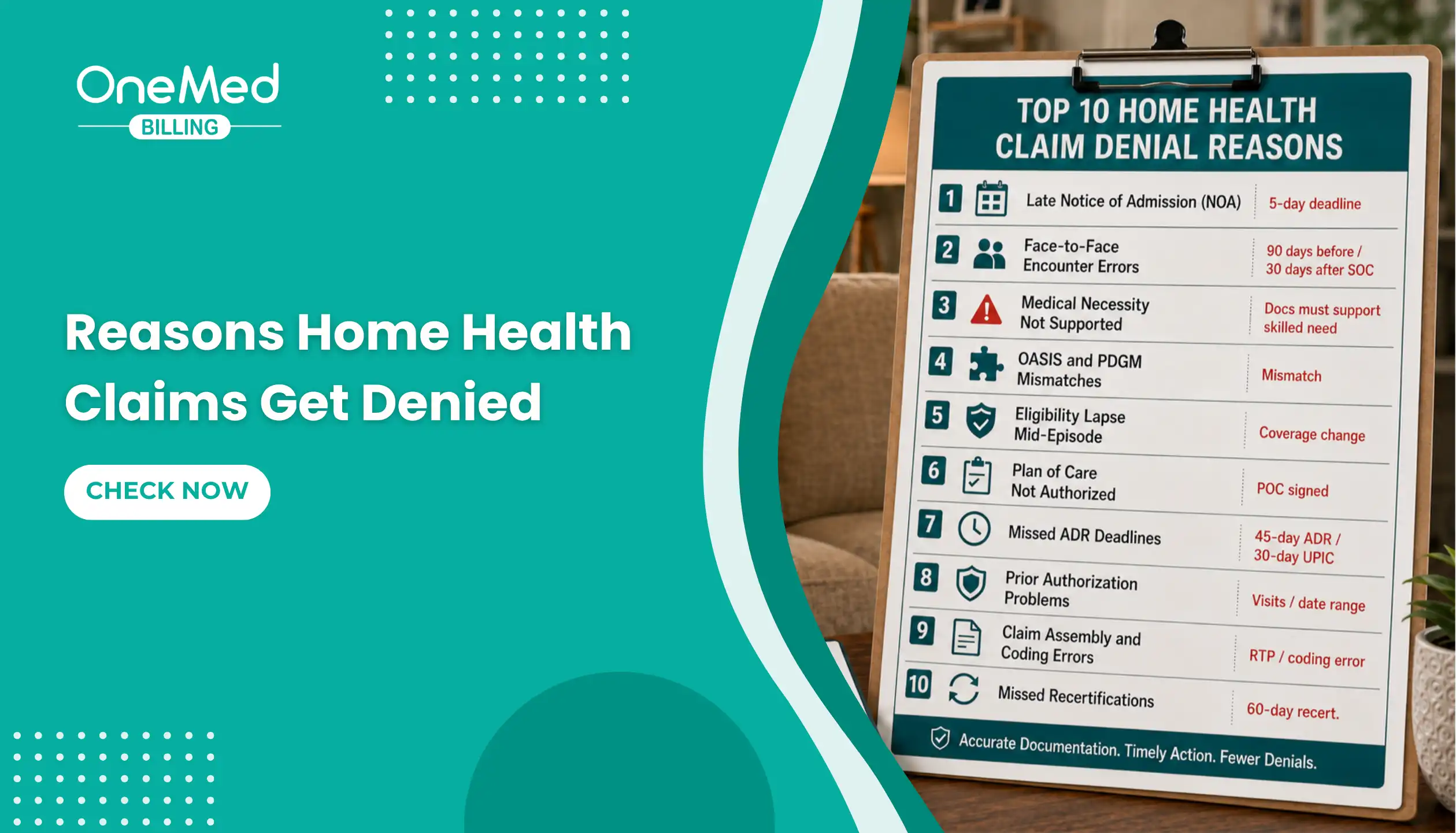
| Denial Reason | Common Codes | Root Cause | Prevention |
|---|---|---|---|
| Late Notice of Admission | CO-29 | NOA filed after the 5-day window from start of care | Submit the NOA at admission and run a day 3 check before the window closes |
| Face-to-face encounter error | CO-16 with N706, CO-50 | Missing date, missing signature, or uncertified practitioner | Check the date, signature, homebound statement and skilled need before you bill |
| Medical necessity not supported | CO-50, CO-55 | Visit notes show service occurred but not why skilled care was required | Write measurable goals and clinical reasoning into the note, not just the activity |
| Homebound status not established | CO-50 | Documentation does not support confinement to the home | State homebound status explicitly and tie it to the skilled need |
| OASIS and PDGM mismatch | CO-16, CO-11 | Diagnosis on claim conflicts with OASIS assessment | Cross-check OASIS against the ICD-10 codes before submission |
| Eligibility lapse mid-episode | CO-27, CO-31, CO-109 | Coverage ended, patient moved to an MA plan, or claim sent to the wrong payer | Verify eligibility at admission, at recertification, and on any plan change |
| Plan of care not authorized | CO-197 | Missing physician signature, or visit frequencies do not match billing | Confirm the POC is signed and the frequencies match what you are billing |
| ADR not returned in time | CO-50, CO-16 with N102 | Documentation packet incomplete or submitted after the deadline | Log every ADR centrally and return the full packet well inside the deadline |
| Prior authorization problem | CO-197, CO-15 | Auth expired, visits exceeded, or wrong codes authorized | Track auth expiry dates and visit counts against what was authorized |
| Claim assembly or coding error | CO-16, RTP edit | Wrong Type of Bill, or ungroupable ICD-10 code | Run claims through pre-bill edits and validate codes in the PDGM grouper |
| Missed recertification | CO-50, CO-29 | Recert not completed within the certification period | Set recert reminders early in the period, not at the deadline |
| Duplicate claim | CO-18 | Same episode billed twice, or corrected claim read as a duplicate | Track submitted claims and flag corrected claims clearly before resending |
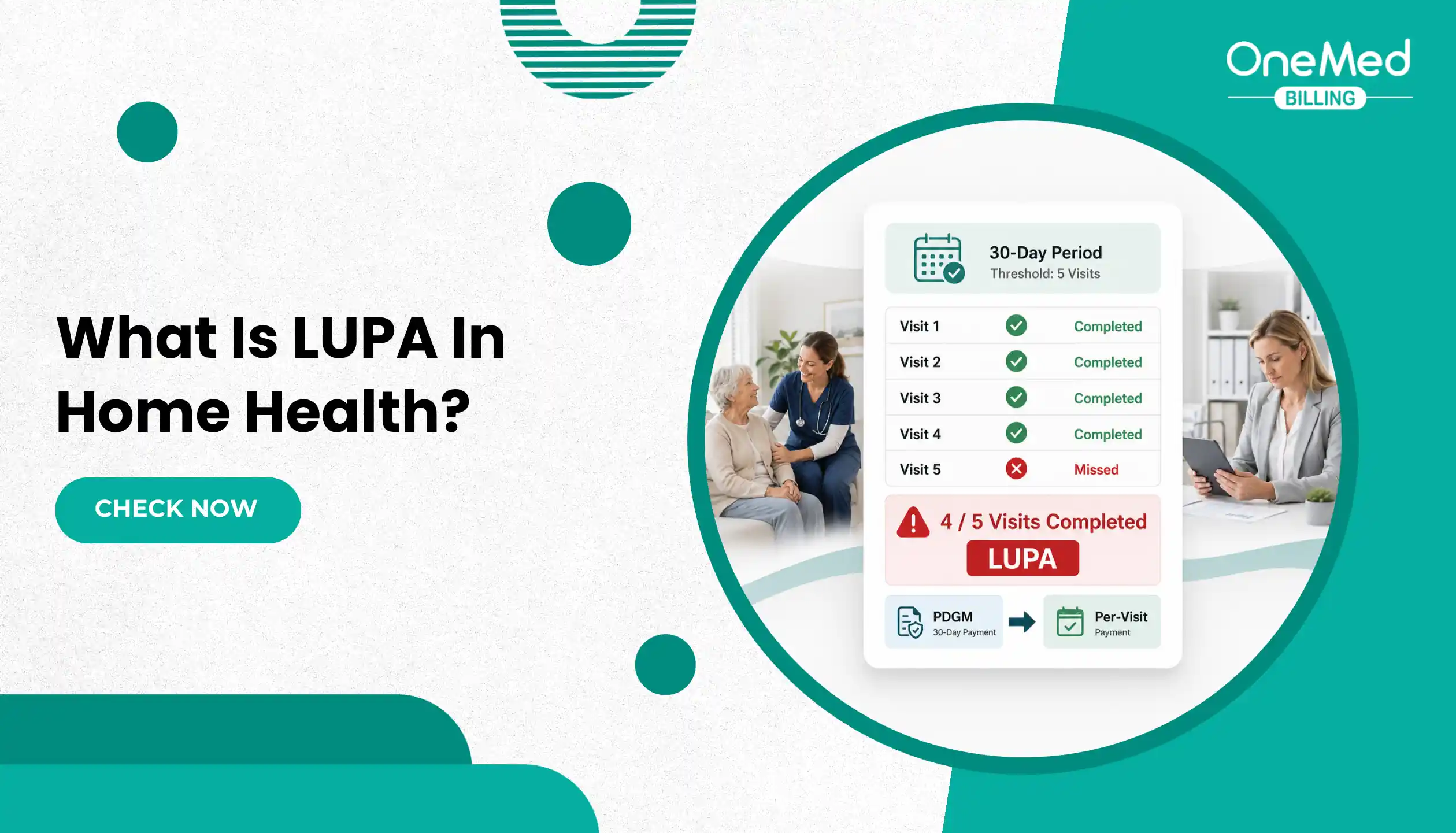
| LUPA visit threshold missed | No denial code, paid at LUPA rate | Episode falls one visit short and drops to a per-visit rate | Monitor visit counts during the period and act before it closes |
The last row is the one most agencies never work. A LUPA episode is not denied, it is paid, just at a per-visit rate instead of the full case-mix rate. Because it clears cleanly and posts as paid, it leaves the work queue and the shortfall is never questioned. In our own home health audits, LUPA visit-threshold triggers accounted for 31% of all recovered value, more than any denial category.
Top 10 Home Health Claim Denial Reasons
These are the denials home health agencies hit most often. Each one below covers what the rule actually requires, the timeframe attached to it, and the step that stops it from repeating.
1. Late Notice of Admission (NOA)
The NOA must be submitted within five calendar days of the start of care. Each day late reduces payment for that period. Exceptions are narrow: MAC system outages or retroactive Medicare eligibility, documented at the time.
Prevent it: Tie NOA submission to the admission record, not to someone remembering. Run a day 3 check so delays surface with two days left to fix.
2. Face-to-Face Encounter Errors
The encounter must happen within 90 days before or 30 days after start of care, and be signed and dated by an authorized practitioner. Four elements must be present: encounter date, signature, homebound statement, skilled-need description. An undated or illegible signature makes the certification invalid.
Prevent it: Run a four-point check before billing. Verify practitioner NPI and credentials at referral, not at denial.
3. Medical Necessity Not Supported
Documentation has to show why a skilled professional was required. "Patient tolerated therapy well, no new issues" describes a visit but proves nothing. Compare: "Instructed on insulin injection. Patient performed with 70% accuracy. Goal: independent by week two." Medical necessity is 33.7% of CMS improper payments.
Prevent it: Rewrite note templates to prompt for progress and reasoning, not activity.
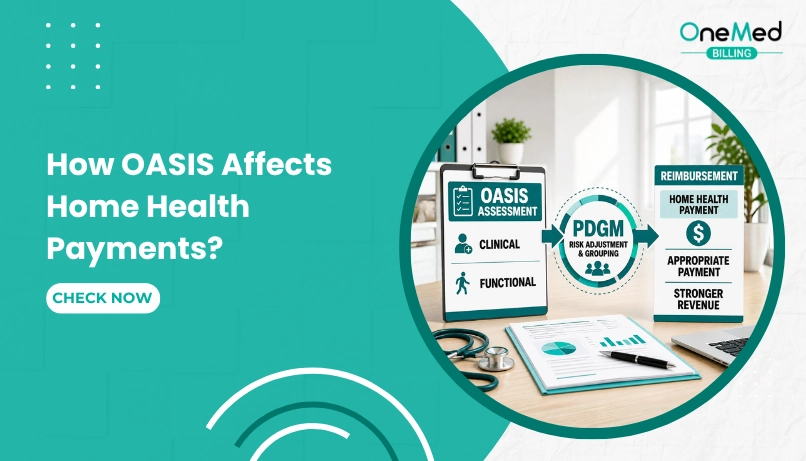
4. OASIS and PDGM Mismatches
OASIS says wound care with infection, the claim codes a noninfected wound. The episode groups into the wrong HIPPS code. Often it does not deny, it just pays less.
Prevent it: Cross-check OASIS against ICD-10 codes before submission and revalidate in the CMS grouper. Watch unspecified codes, which break grouping entirely.
5. Eligibility Lapse Mid-Episode
Coverage is not static across a 60-day period. Medicaid redeterminations and MA plan switches happen mid-episode, and a claim sent to the wrong payer denies regardless of documentation quality.
Prevent it: Verify at admission, at recertification, and on any plan change.
6. Plan of Care Not Authorized
Visit frequencies, disciplines and goals must match what you bill, and the POC must be signed and dated. Bill more visits than the POC authorizes and the excess is denied.
Prevent it: Reconcile billed visits against POC frequencies as a standing pre-bill step.
7. Missed ADR Deadlines
MACs, RACs and SMRCs generally allow 45 calendar days to respond. UPICs typically require 30. An incomplete packet fails as surely as a late one, and one unsigned plan of care can sink the whole submission.
Prevent it: Log every ADR the day it arrives. Build a standard packet: F2F, OASIS, POC, visit notes, discharge summary.
8. Prior Authorization Problems
Traditional Medicare rarely requires prior auth for home health, but MA and commercial plans do. Authorizations are specific to visit counts, disciplines and date ranges. Exceed any and the excess is not payable.
Prevent it: Track expiry dates against the episode calendar and reconcile visit counts weekly, not at the end.
9. Claim Assembly and Coding Errors
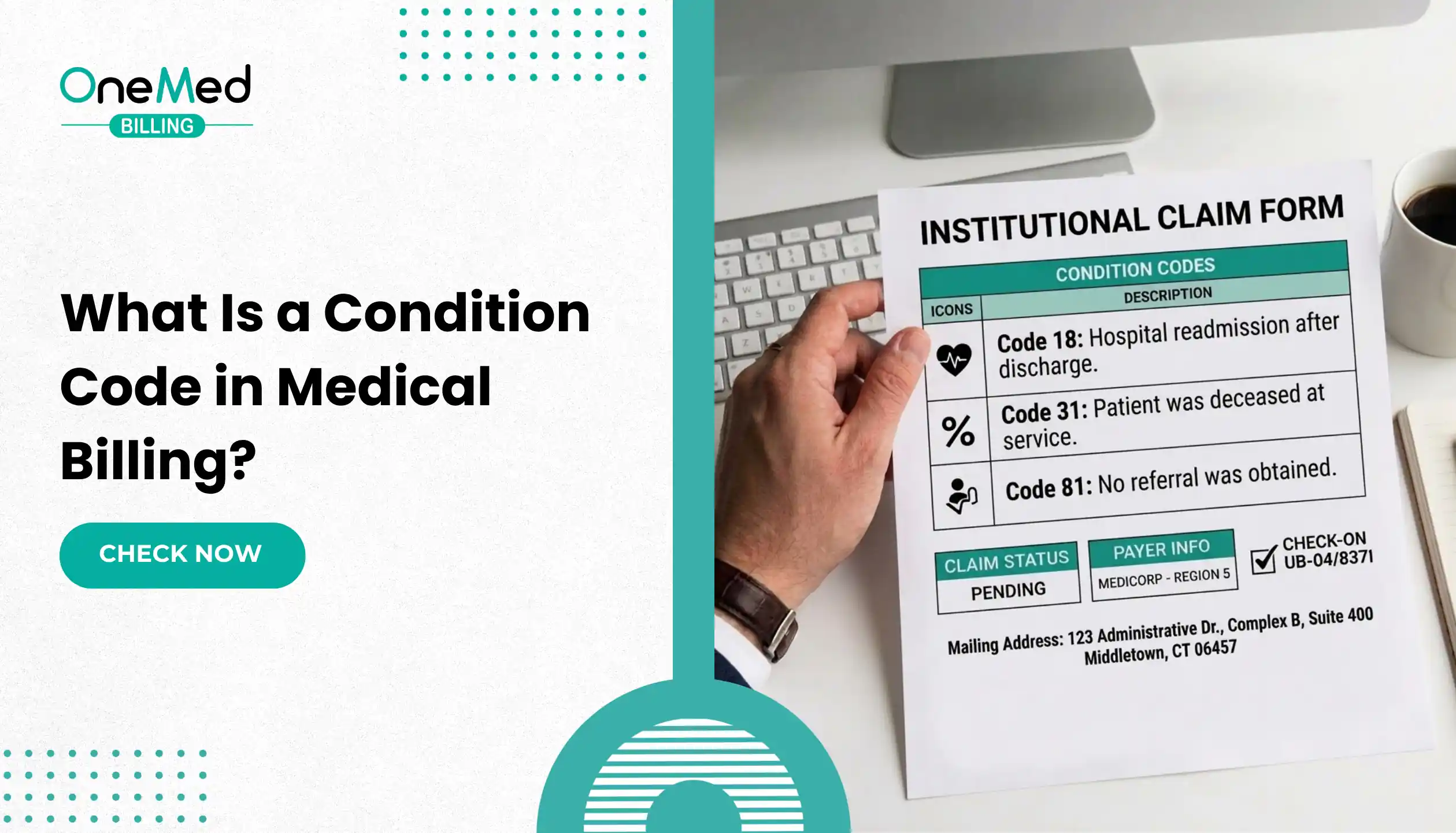
Wrong Type of Bill, an ungroupable ICD-10 code, a bad revenue or condition code. These usually return to provider rather than deny, so they consume staff time without appearing in denial reports.
Prevent it: Run pre-bill edits and validate every primary diagnosis in the PDGM grouper.
10. Missed Recertifications
Each certification period runs 60 days. A late recert can invalidate the entire following episode even when care was appropriate. This is the highest-cost denial here because it takes out a full episode.
Prevent it: Set reminders around day 45, not day 58. Treat an unsigned recert as blocking.
How to Build a Denial Prevention Workflow
Fixing denials one claim at a time does not reduce the rate. The ten reasons above repeat because the process allows them to, so prevention has to sit in the workflow rather than in individual effort.
Four things do most of the work:
A. Catch NOAs before day five, not after. A dashboard flagging open admissions without a filed NOA turns a deadline into a visible queue.
B. Make pre-bill review a fixed step. F2F elements, POC signature and frequencies, OASIS to ICD alignment, and TOB validation checked before submission rather than after rejection.
C. Report denials by payer and by clinician monthly. Aggregate denial counts tell you there is a problem. Broken out by payer and clinician, they tell you where it is. A single payer or a single clinician usually accounts for a disproportionate share.
D. Set an internal ADR deadline shorter than the payer's. MACs allow 45 days, UPICs 30. Assembling records across clinical and billing always takes longer than expected, so working to your own shorter deadline leaves room when it does.
The pattern in all four is the same: move the check upstream of the claim, and make it a step in the process rather than something a person remembers.
When to Outsource Home Health Billing
If your denial rate sits above 8%, the problem is systemic and claim-by-claim rework will not move it. The same applies if denials cluster in one payer or one clinician, or if ADR deadlines are being missed because records take too long to assemble.
There is also a category most agencies never work at all. An episode can clear cleanly, post as paid, and still be paid less than it should have been. One visit short of the threshold drops it to a per-visit LUPA rate. An OASIS that understates acuity assigns a lower case-mix group. Nothing looks wrong, because the payment matches what was submitted.
Across 31 home health revenue cycles and more than 37,200 episodes we have audited, that pattern accounted for 4.2 to 8.1% of gross revenue. On an $8M agency, that is $336K to $648K a year, compounding episode after episode. LUPA visit-threshold triggers alone made up 31% of the $1.89M we have recovered, with an 88.3% success rate on appeals.
Our home health billing services cover the full episode, from NOA submission and OASIS coordination through claims, denials, and underpayment recovery. We work inside your existing software, and a BAA is executed before any data is shared. If you would rather test it before committing anything, pull ten recent episodes, redact the identifiers, and we will show you the LUPA triggers and case-mix downgrades in fifteen minutes using your own data.
Frequently Asked Questions
Find quick answers to common questions about this topic, explained simply and clearly.
What is an acceptable denial rate for a home health agency?
Around 3% is the benchmark most agencies work to. Once you cross 8%, the same errors are repeating across many claims, so fixing them one at a time will not bring the rate down.
How many days do I have to submit a Notice of Admission?
Five calendar days from the start of care. Every day past that reduces payment for the period. The only accepted exceptions are things outside your control, such as a MAC system outage, and they need documenting at the time.
What is the face-to-face encounter timeframe?
The encounter must happen within 90 days before or 30 days after the start of care. It also needs a date, a signature from an authorized practitioner, a homebound statement, and a description of the skilled need. Missing any one of those invalidates the certification.
How long do I have to respond to an ADR?
MACs, RACs and SMRCs generally allow 45 calendar days. UPICs typically require 30. An incomplete packet fails the same as a late one, so a single unsigned plan of care can sink the whole submission.
What happens if a recertification is late?
It can invalidate the entire following episode, even when the care was appropriate and fully documented. That makes it one of the most expensive denials in home health, because you lose a full episode rather than a single claim.