




What Is a Condition Code in Medical Billing?
- Updated Date Aug 27, 2026
- Medical Billing
- Follow
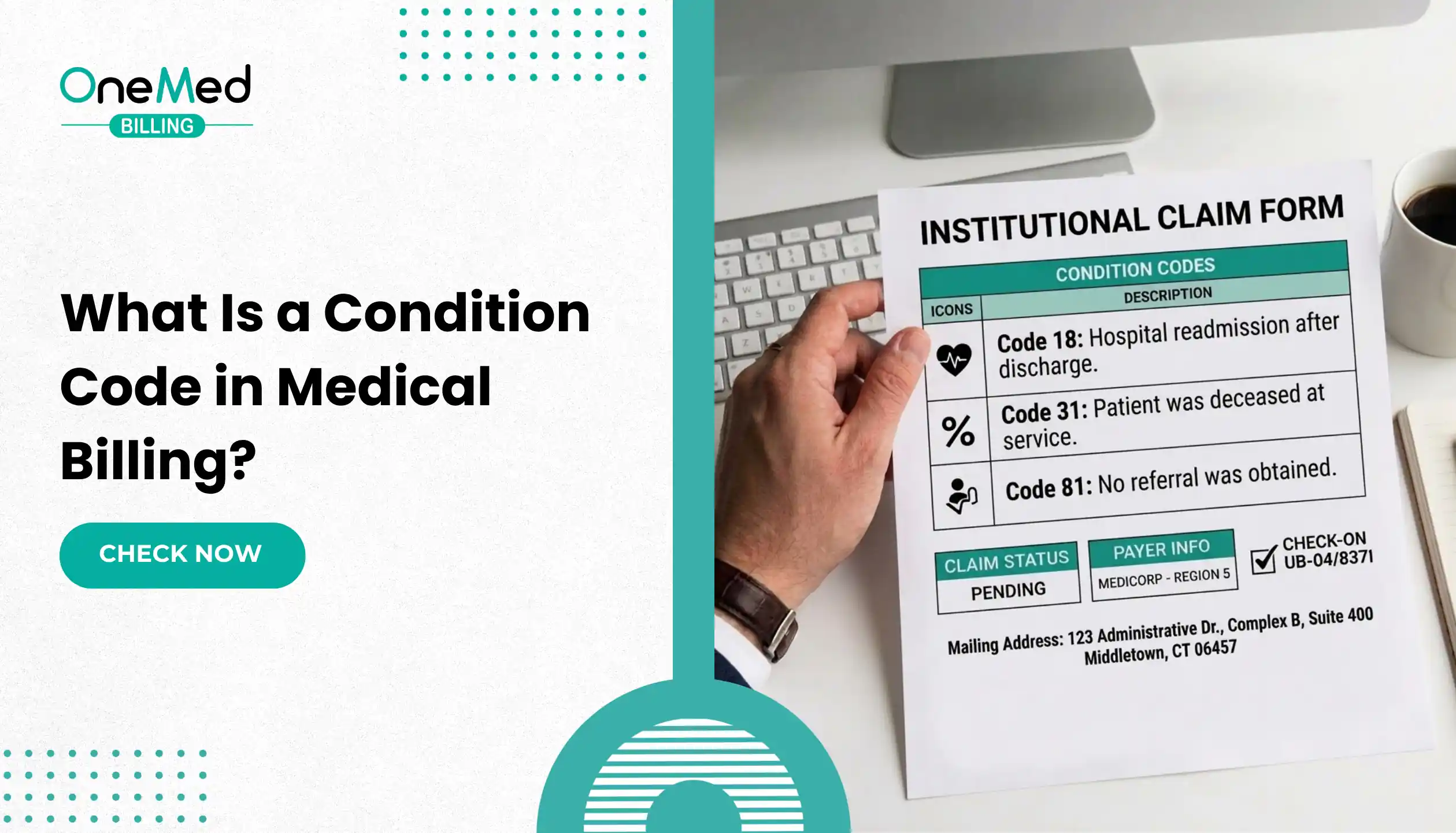
A condition code in medical billing is a two-character code used on institutional claims to provide additional information about circumstances that may affect how the payer processes the claim.
Condition codes are commonly used on UB-04/CMS-1450 paper claims and 837I electronic institutional claims. They help communicate billing situations that are not fully explained by diagnosis or procedure codes alone.
These codes are typically used by hospitals and other institutional providers and may describe situations involving insurance coverage, employment-related conditions, hospice care, dialysis, admission status, or other claim-processing circumstances.
Where Are Condition Codes Used on a Medical Claim?
Condition codes are mainly used on institutional claims, including the UB-04/CMS-1450 paper claim form and the 837I electronic claim format.
They are commonly reported by hospitals and other institutional providers to give the payer additional information about circumstances that may affect how the claim should be processed.
On the UB-04 form, condition codes are reported in Form Locators 18–28. More than one condition code may be reported when multiple circumstances apply to the same claim.
Condition codes are not used in the same way on professional claims such as the CMS-1500.
Common Condition Codes in Medical Billing
Condition codes identify specific circumstances that may affect how an institutional claim is processed. The code used depends on the billing situation, provider type, and payer requirements.
Here are some commonly used examples:
| Condition Code | General Meaning |
|---|---|
| 01 | Military service related |
| 02 | Condition is employment related |
| 03 | Patient may have other insurance coverage not reflected on the claim |
| 04 | Information-only bill |
| 06 | ESRD patient with employer group health coverage during the applicable Medicare coordination period |
| 07 | Treatment of a nonterminal condition for a hospice patient |
| 44 | Inpatient admission changed to outpatient before the initial claim was submitted |
| 59 | Non-primary ESRD facility |
| 74 | Home dialysis |
| 84 | Dialysis for acute kidney injury (AKI) |
For example, Condition Code 44 is used on an outpatient claim when a hospital initially ordered inpatient care but, after internal review and before submitting the original claim, determined that the services did not meet its inpatient criteria.
Some condition codes apply only to very specific situations. Codes related to ESRD, hospice, Medicare Secondary Payer rules, or particular payer programs should only be reported when the claim meets the applicable requirements. CMS also notes that some condition codes are reserved or payer-specific, so providers should verify the current CMS, NUBC, and payer instructions before using a code.
How Are Condition Codes Different From Diagnosis Codes?
Condition codes and diagnosis codes serve different purposes on a medical claim. A condition code gives the payer additional information about a billing circumstance that may affect claim processing, while a diagnosis code identifies the patient’s medical condition or reason for receiving care.
| Area | Condition Code | Diagnosis Code |
|---|---|---|
| Purpose | Provides information that may affect claim processing | Identifies the patient’s diagnosis or medical condition |
| Typical format | Two-character code | ICD-10-CM code |
| Used for | Billing circumstances and claim-processing situations | Clinical diagnoses and medical necessity |
| Example | Condition Code 02 | An ICD-10-CM diagnosis code such as I10 |
A condition code does not replace a diagnosis code. Both may appear on the same institutional claim, but they communicate different information to the payer.
Condition Code vs Occurrence Code vs Value Code
These codes can all appear on institutional claims, but they communicate different types of information to the payer.
| Code Type | What It Tells the Payer |
|---|---|
| Condition Code | Describes a circumstance that may affect how the claim is processed |
| Occurrence Code | Identifies a significant event and usually the date associated with it |
| Value Code | Reports a specific amount, quantity, or other value relevant to the claim |
Condition codes are also different from revenue codes in medical billing, which identify the type of service, department, or accommodation associated with charges on an institutional claim.
CMS treats condition codes, occurrence codes, and value codes as separate data elements on CMS-1450/UB-04 and 837I institutional claims. They may appear together on the same claim, but each serves a different purpose.
How Do You Know Which Condition Code to Use?
The correct condition code depends on the specific billing situation and the payer’s requirements. It should be selected based on the circumstances of the claim, not simply because a certain code may help the claim process.
A practical approach is to:
- Identify the billing situation that needs to be reported.
- Check the payer’s current requirements for that type of claim.
- Review CMS instructions when submitting Medicare claims.
- Confirm that the condition code applies to the provider type and claim type.
- Use only codes that accurately describe the claim circumstances, rather than using a condition code simply to bypass an edit or obtain payment.
The National Uniform Billing Committee (NUBC) maintains the official UB-04 data specifications, while CMS publishes Medicare-specific billing instructions. Because some condition codes apply only in certain settings or payer situations, billing teams should verify the current guidance before submitting the claim.
What Happens if the Wrong Condition Code Is Used?
Using an incorrect condition code can affect how the payer interprets and processes the claim. Depending on the code and the payer’s rules, the issue may lead to:
- Incorrect claim processing
- A claim rejection or denial
- Delayed payment
- Incorrect coordination-of-benefits handling
- A corrected claim or resubmission being required
Not every incorrect condition code will automatically cause a denial. In some cases, the claim may still process but with the wrong billing outcome. That is why condition codes should be checked against the actual claim circumstances and current payer requirements before submission.
Conclusion
Condition codes give payers additional information about specific circumstances that may affect how an institutional claim is processed. They are different from diagnosis codes, which identify the patient’s medical condition, and they should not be used interchangeably.
Because condition code requirements can vary by claim type and payer, billing teams should select them based on the actual billing situation and current CMS, NUBC, or payer guidance. Using the correct code helps support accurate claim processing and reduces avoidable corrections or delays. If your practice needs additional support with coding accuracy and claim preparation, our medical coding services can help review coding and claim information before submission.
Frequently Asked Questions
Find quick answers to common questions about this topic, explained simply and clearly.
What is a condition code in medical billing?
A condition code is a two-character code used on institutional claims to tell the payer about a specific situation that may affect claim processing.
What is Condition Code 20 or 21?
20: Beneficiary Requested Billing. Used when the patient wants Medicare to make a coverage decision. 21: Billing for Denial Notice. Used when a provider needs Medicare to issue a denial for services considered noncovered.
What is Condition Code 40?
Condition Code 40 means Same Day Transfer. It shows that the patient was transferred between participating facilities on the same day.
What is Condition Code 10?
Condition Code 10 means the patient or spouse is employed, but there is no Employer Group Health Plan coverage.