
APC Billing Explained: How Medicare Calculates Outpatient Payment
- Updated Date Aug 14, 2026
- Accounts Receivable
- Follow
Outpatient hospital billing is not paid the same way as a regular physician office claim. When Medicare pays for hospital outpatient services, it uses a specific payment system that groups services, applies payment rules, and decides how much the facility should receive.
That is where Ambulatory Payment Classification, or APC, comes in. APC is one of the key parts of Medicare outpatient reimbursement, especially for hospitals, outpatient departments, emergency visits, observation services, and certain procedures.
What Is Ambulatory Payment Classification?
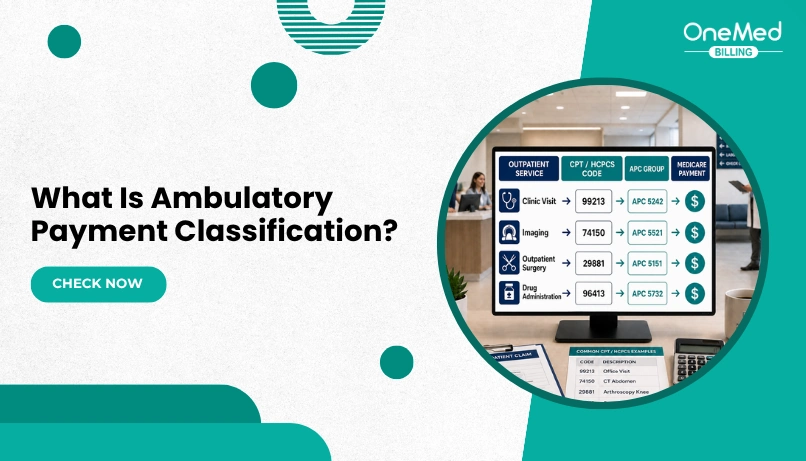
Ambulatory Payment Classification, or APC, is a Medicare payment method used for hospital outpatient services under the Outpatient Prospective Payment System, also known as OPPS.
In simple terms, APC groups similar outpatient services together so Medicare can decide how much a hospital should be paid for those services. These may include outpatient procedures, tests, treatments, emergency department visits, and other hospital-based outpatient care.
APC is important in medical billing because it directly affects outpatient reimbursement. The final payment depends on the reported CPT or HCPCS code, the assigned APC group, Medicare payment rules, and whether the service is paid separately or packaged into another payment.
How Does APC Work in Medical Billing?
APC works by connecting the outpatient service reported on a hospital claim with Medicare’s outpatient payment rules. The hospital does not directly choose the APC payment. Instead, the hospital reports the correct CPT or HCPCS code, and Medicare uses that code to assign the service to an APC group under OPPS.
Once the APC group is assigned, Medicare applies the payment rate for that group. The final payment may also depend on whether the service is separately payable, packaged into another service, or adjusted based on Medicare rules.
The process works like this:
- The outpatient service is documented in the medical record.
- The hospital reports the correct CPT or HCPCS code on the claim.
- Medicare maps that code to an APC group.
- The APC group determines the base outpatient facility payment.
- Medicare applies packaging rules, status indicators, and payment adjustments before final reimbursement.
What Services Are Paid Under APCs?
APCs are used for many hospital outpatient services paid under Medicare OPPS. These are services provided to patients who visit a hospital outpatient department but are not admitted as inpatients.
Common services paid under APCs include:
- Emergency department visits
- Hospital outpatient clinic visits
- Outpatient surgical procedures
- Observation services
- Diagnostic tests
- Imaging services, such as X-rays, CT scans, and MRIs
- Certain therapy services
- Drug administration and infusion services
- Blood products
- Certain drugs, biologicals, and medical supplies
Not every outpatient service is paid separately. Some services are packaged into the payment for the main procedure or treatment. This is why billing teams need to understand which services are separately payable and which ones are bundled under OPPS rules.
How Is APC Payment Calculated?
APC payment is calculated from the outpatient service reported on the hospital claim. The hospital submits the correct CPT or HCPCS code, and Medicare maps that code to an APC group under OPPS.
Each APC group has a set payment rate. Medicare then applies payment rules such as status indicators, packaging rules, wage adjustments, and other OPPS updates to decide the final reimbursement.
In simple terms:
CPT/HCPCS code → APC group → APC payment rate → Medicare adjustments → final payment
Packaged APC vs Comprehensive APC
Packaged APC and Comprehensive APC both affect how Medicare pays hospital outpatient claims, but they are not the same.
A packaged APC means certain related services are not paid separately. Medicare includes them in the payment for the main outpatient service. These may include supplies, minor services, or supporting items connected to the primary procedure.
A Comprehensive APC, also called C-APC, is broader. It combines payment for a major outpatient service and most related services reported on the same claim into one single payment. This usually applies to higher-cost outpatient procedures where Medicare treats the main service as the primary reason for the visit.
| Point | Packaged APC | Comprehensive APC |
|---|---|---|
| Meaning | Related services are bundled into another payment | One main payment covers the primary service and most related services |
| Scope | Usually applies to specific supporting items or services | Applies to a larger outpatient procedure or primary service |
| Separate payment | Some services may not be paid separately | Most related services are included in one payment |
| Billing impact | Billing teams must know what is bundled | Billing teams must identify the main service correctly |
APC vs DRG: What Is the Difference?
APC and DRG are both Medicare payment grouping systems, but they are used in different care settings.
APC is used for hospital outpatient services. It helps Medicare decide payment for services such as outpatient procedures, emergency department visits, imaging, observation, and other hospital-based outpatient care.
DRG, or Diagnosis-Related Group, is used for inpatient hospital stays. It groups a hospital admission based on the patient’s diagnosis, procedures performed, severity, and discharge status.
| Point | APC | DRG |
|---|---|---|
| Used for | Hospital outpatient services | Inpatient hospital stays |
| Payment system | OPPS | IPPS |
| Main basis | CPT/HCPCS codes and outpatient service type | Diagnosis, procedures, severity, and discharge status |
| Claim type | Outpatient claim | Inpatient claim |
| Example | Outpatient surgery or ED visit | Hospital admission for surgery or serious illness |
APC vs CPT and HCPCS: How Are They Different?
APC, CPT, and HCPCS work together in hospital outpatient billing, but each one has a different job.
CPT and HCPCS codes are used to report what was provided to the patient. They describe the outpatient procedure, service, drug, supply, test, or treatment listed on the claim. APC is different. APC is not the code the hospital usually submits on the claim. It is the Medicare payment group assigned after the CPT or HCPCS code is processed under OPPS.
For example, a hospital outpatient department may report a CPT code for a procedure or a HCPCS code for a drug or supply. Medicare then checks that code under OPPS, assigns it to the correct APC group, reviews the status indicator, and applies the payment rule for that service.
APC Billing Mistakes That Can Affect Reimbursement
APC billing mistakes usually happen when the code, documentation, or payment rule does not support how the outpatient service was billed. These errors may not always lead to a full denial, but they can change the payment amount, delay reimbursement, or trigger claim review.
Some APC billing mistakes to watch for include:
- Reporting a CPT or HCPCS code that does not match the medical record
- Missing procedure details needed to support the billed service
- Using the wrong number of units
- Missing a billable outpatient service during charge capture
- Expecting separate payment for a service that Medicare packages into another APC payment
- Not checking status indicators before submitting the claim
- Confusing hospital outpatient APC payment with inpatient DRG payment
- Using outdated OPPS rules after quarterly or annual CMS updates
In APC billing, the issue is not only whether the claim gets accepted. The bigger risk is whether the claim is priced correctly. A service may be listed on the claim but still receive no separate payment if Medicare considers it packaged. That is why billing teams need to review documentation, codes, units, status indicators, and packaging rules before claims are submitted.
Frequently Asked Questions
Find quick answers to common questions about this topic, explained simply and clearly.
What does APC stand for?
APC stands for Ambulatory Payment Classification. It is a Medicare payment system used to group outpatient hospital services that are clinically similar and require similar resources.
How does Ambulatory Payment Classification affect outpatient billing?
Ambulatory Payment Classification affects how Medicare pays hospitals for outpatient services. Each APC group has a set payment rate, so correct coding and documentation are important for accurate reimbursement.
Is APC the same as CPT or HCPCS?
No. CPT and HCPCS codes describe the service or procedure performed, while APC determines how Medicare groups and pays for that outpatient service.
Why is APC important for hospitals and outpatient departments?
APC is important because it directly affects Medicare reimbursement. If the wrong code, modifier, or documentation is used, the payment may be reduced, delayed, or denied.