

Home Specialities Hospitals & Health Systems
Facility → Enterprise
Single site to multi-entity systems
100 → 1,000+
FTE-scalable delivery
Live Dashboard
Claim-level visibility by facility & payer
All Payers
Medicare, Medicaid & Commercial
A timely claim is not a correctly paid claim.
Operational efficiency is not revenue protection. A claim can move on time and still lose reimbursement when coding, level of care, authorization, documentation, and payment accuracy aren't reviewed at the claim level.
One pattern starts
A coding or documentation gap repeats across a department before anyone connects the dots.
It multiplies
The same gap repeats across specialties, service lines, and EHR workflows — small variances on high-volume encounters like ED and imaging accumulate.
It becomes material
Across facilities and payers, unreviewed variances scale into significant, recurring leakage no month-end report explains.
We've watched this run in reverse. When one community health system consolidated the split between its hospital's technical billing and its clinics' professional billing, variances that had quietly written off six figures became $650K of aged A/R recovered in the first year — alongside $450K a year in commercial underpayments caught against contract terms.
Seven places hospital revenue quietly leaks.
Claim-level patterns that pass internal checks and standard reports — and still cost you reimbursement.
Payer-specific denials
A claim can pass your internal edits and still fail payer-specific rules on medical necessity, NCCI edits, frequency limits, or coverage and level-of-care criteria.
Coding, DRG & charge-capture errors
Missed CC/MCC capture, DRG downcoding, modifier misuse, and under-captured procedure, implant, or ancillary charges quietly reduce or deny payment.
Authorization mismatch
Services may be authorized, but the approved codes, dates, units, level of care, or place of service don't match the final claim.
Inpatient vs. observation & level of care
Inpatient-vs-observation status, readmissions, and high-cost procedures can be denied against medical necessity and level-of-care rules even when clinically valid.
Documentation specificity (CDI)
The record may support the care generally, but not to the payer's specificity. Clinical indicators, severity and physician documentation all matter.
Underpayments & contract terms
A paid claim can still be wrong. Allowed amount, contract terms, carve-outs and stop-loss provisions often go unchecked.
Timely filing & appeal windows
High-dollar inpatient and surgical claims get harder to recover as they age, and appeal deadlines can quietly close recovery opportunities.
Risk by service line
Leakage isn't spread evenly. It clusters in the same lines — whether you run one facility or a health system.
Emergency department
E/M level selection, downcoding risk, charge capture, and medical-necessity documentation at high volume.
Surgery & operating rooms
High-dollar procedures exposed to authorization, implant and supply capture, bundling, and underpayment risk.
Imaging & diagnostics
Authorization precision, medical-necessity rules, frequency limits, and professional/technical component alignment.
Inpatient & observation
Level-of-care determinations, DRG accuracy, CC/MCC capture, and readmission and status-change denials.
Specialty clinics & outpatient
Multi-specialty coding variation, incident-to rules, infusion and procedure billing, and referral or authorization gaps.
Patient responsibility
Eligibility accuracy, upfront estimates, and point-of-service collection as patient balances grow.
Live visibility, not month-end reports
Most reports explain what happened last month. Our personalized dashboard surfaces claim-level root causes as they emerge — by facility, department, and payer — so leadership sees the leak while it's still recoverable.
- Root causes by facility, department, and payer
- Underpayments flagged against contract terms
- Denial patterns surfaced as they emerge
- Level-of-care and DRG risk visible in real time
- One source of truth across every entity
In one hospital-and-clinics engagement, this replaced fragmented, site-by-site board reporting with a single financial view across the hospital and all six of its clinics.
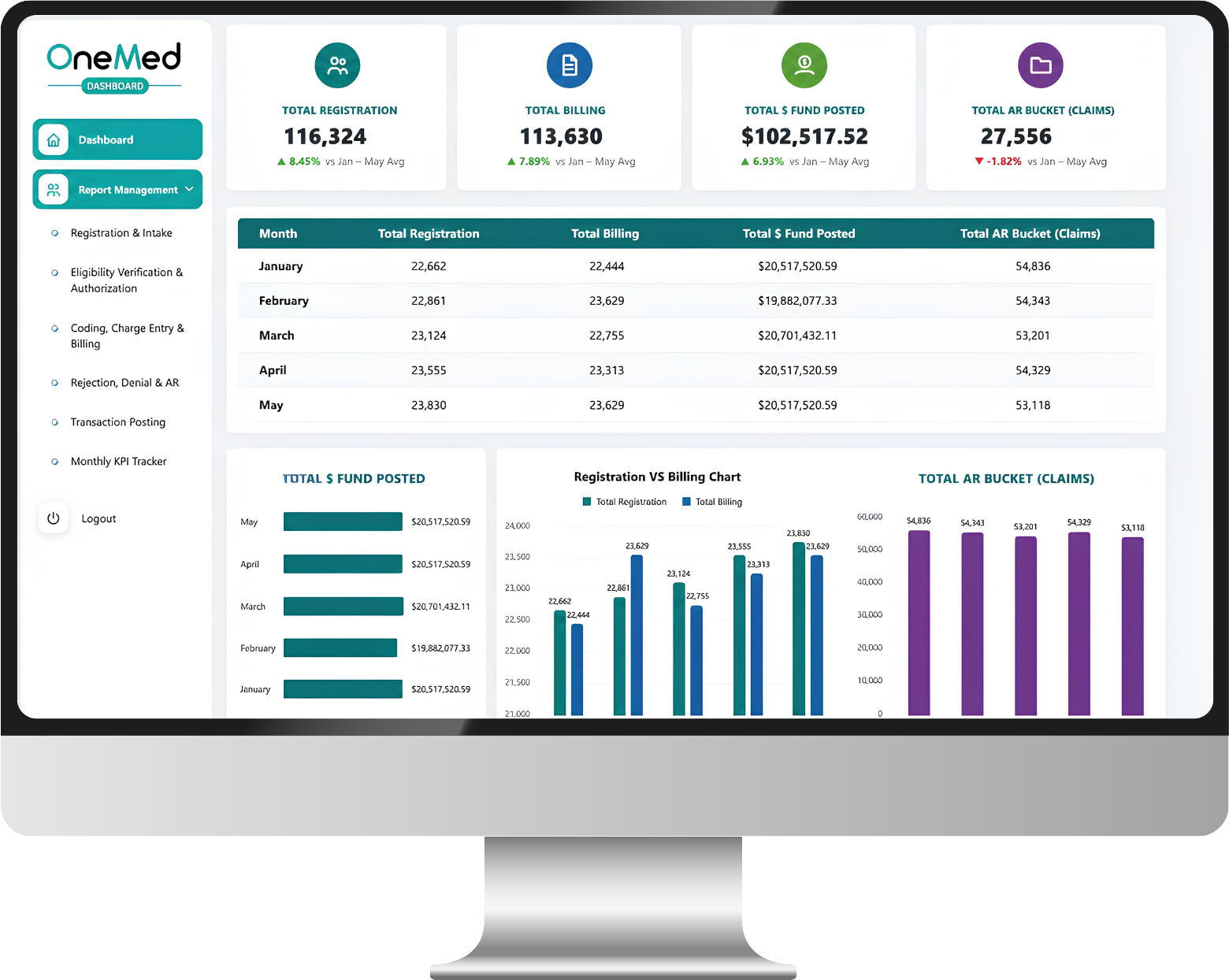
A dashboard-driven revenue risk review.
Four stages that turn claim-level data into recovered revenue — and fewer repeat leaks.
Connect & baseline
We connect to your data and build a live, claim-level baseline across facilities, departments, and payers.
Claim-level root-cause analysis
We surface where revenue leaks — coding and DRG, authorization, level of care, documentation, and underpayments — not just what denied.
Recovery & correction
Appeals, rebills, corrected claims, and underpayment recovery against contract terms, prioritized by dollar value.
Live reporting & prevention
Root causes reported live by facility and payer, with workflow fixes so the same leak doesn't recur.
How a hospital-and-clinics health system recovered $650K — and unified its billing.
A regional community health system — one critical access hospital and six rural health clinics, 42 providers, approximately 180,000 encounters annually — with professional and facility billing fragmented across multiple sites.
The challenge
- Revenue leaking between disjointed hospital (technical) and clinic (professional) billing.
- Compliance risk around hospital outpatient PPS and site-neutral payment rules.
- Separate hospital and physician bills confusing patients.
- Siloed A/R teams duplicating eligibility, authorization and follow-up work.
- No underpayment tracking across commercial contracts and fragmented executive reporting.
What OneMed did
- Deployed a centralized revenue cycle layer bridging hospital technical and professional billing without replacing the EHR.
- Reconciled professional and facility charges for strict site-neutral compliance.
- Consolidated hospital and physician charges into a patient-friendly billing experience.
- Recovered commercial underpayments at the claim level using contract validation.
- Delivered a live executive dashboard covering the hospital and all six clinics.
| Revenue Cycle Metric | Before | After | Industry Benchmark |
|---|---|---|---|
| First-pass claim acceptance | 88% | $95% | 92% |
| Average days in A/R | 55 days | 39 days | 42–48 days |
| Overall denial rate | 11.8% | 6.1% | 5–8% |
| Cost to collect | 4.6% | 3.3% | 3–4% |
| Net collection rate | 93.5% | 97.8% | 95–98% |
| Underpayments recovered | Minimal | $450,000 / year | — |
$650K
in previously written-off aged A/R recovered during the first year.
+ $450K annually in commercial underpayments recovered+ Cost to collect reduced to 3.3%
+ 30% fewer patient billing calls
"Managing revenue across our hospital and six rural clinics created significant blind spots and confused our patients with multiple bills. OneMed unified professional and facility billing, strengthened compliance, and gave our executive team one trusted financial dashboard. They operate like an extension of our leadership team."— Chief Financial Officer, Community Health System
Results shown represent one client engagement. Benchmark ranges are industry references. Individual outcomes vary based on payer mix, operational maturity and baseline performance.
From one facility to an entire system
The same claim-level discipline and live visibility, delivered at your scale — with infrastructure that grows from 100 to 1,000+ FTEs as you add facilities, service lines and payers.
Facility
A single hospital or facility that needs claim-level visibility and recovery across its service lines.
Network
A multi-facility or multi-specialty campus that needs one consistent standard and one source of truth.
Enterprise
A multi-entity health system needing enterprise-wide reporting and scalable delivery across payers.
Enterprise-grade by default
Patient and financial data handled inside a controlled, auditable environment across every entity.
Request a hospital revenue risk review.
A claim-level review of where your net revenue is leaking — coding and DRG, authorization, level of care, documentation, and underpayments — with findings delivered in a live dashboard by facility, department and payer.
- Claim-level root-cause findings, not a month-end summary
- Underpayment review against your contract terms
- Works with Epic, Oracle Health, MEDITECH and more
- HIPAA compliant with BAA executed before any data moves
Request your review
We'll reply within one business day to scope it with your team.
Common questions.
Do you work across multiple facilities and EHRs?
Yes. We work inside Epic, Oracle Health (Cerner), MEDITECH, and others, across single facilities and multi-entity systems, with reporting broken out by facility, department, and payer.
What does the revenue risk review include?
A claim-level review across coding and DRG accuracy, authorization, level of care, documentation, and payment accuracy, with root causes surfaced in a live dashboard by facility, department, and payer.
Do you recover underpayments, not just denials?
Yes. We review paid claims against contract terms, carve-outs, and stop-loss provisions — especially on high-dollar inpatient and surgical claims.
Can you scale to our volume?
Yes. Our delivery scales from 100 to 1,000+ FTEs, so we can start where you are and grow across facilities, service lines, and payers.
How is this different from our monthly reports?
Monthly reports explain what happened. Our live dashboard surfaces claim-level root causes as they emerge, so leadership can act while revenue is still recoverable.
Who is this built for?
CFOs, VPs of revenue cycle, and health-system RCM leadership responsible for net revenue across facilities.
What would a claim-level review reveal in your revenue?
Discover hidden denials, coding gaps, underpayments, and reimbursement opportunities before they become lost revenue.